

A low-VOC hotel room is one where independent measurement or a recognised eco-certification confirms that total volatile organic compound and formaldehyde levels sit well below standard indoor concentrations, achieved through low-emitting furnishings, non-toxic cleaning products, and adequate ventilation. That's the whole definition in one sentence. Everything else is detail.
The detail matters, though, because "low-VOC" gets used loosely in hotel marketing. A genuinely low-VOC room is measured in micrograms per cubic metre (µg/m3) or parts per billion (ppb), and the results are compared against health-based reference values, the kind the EPA and other agencies publish for compounds like formaldehyde and benzene. This matters because VOC exposure is linked to short-term irritation (headaches, eye and throat irritation) and, for a handful of specific compounds, longer-term health risks including cancer at high cumulative exposure. A hotel that can show you numbers, not just a green logo, is doing something different from one that can't.
What should a legitimately low-VOC room actually deliver? Expect these markers:
- Low-emitting paints, adhesives, and furniture finishes, chosen specifically to limit off-gassing.
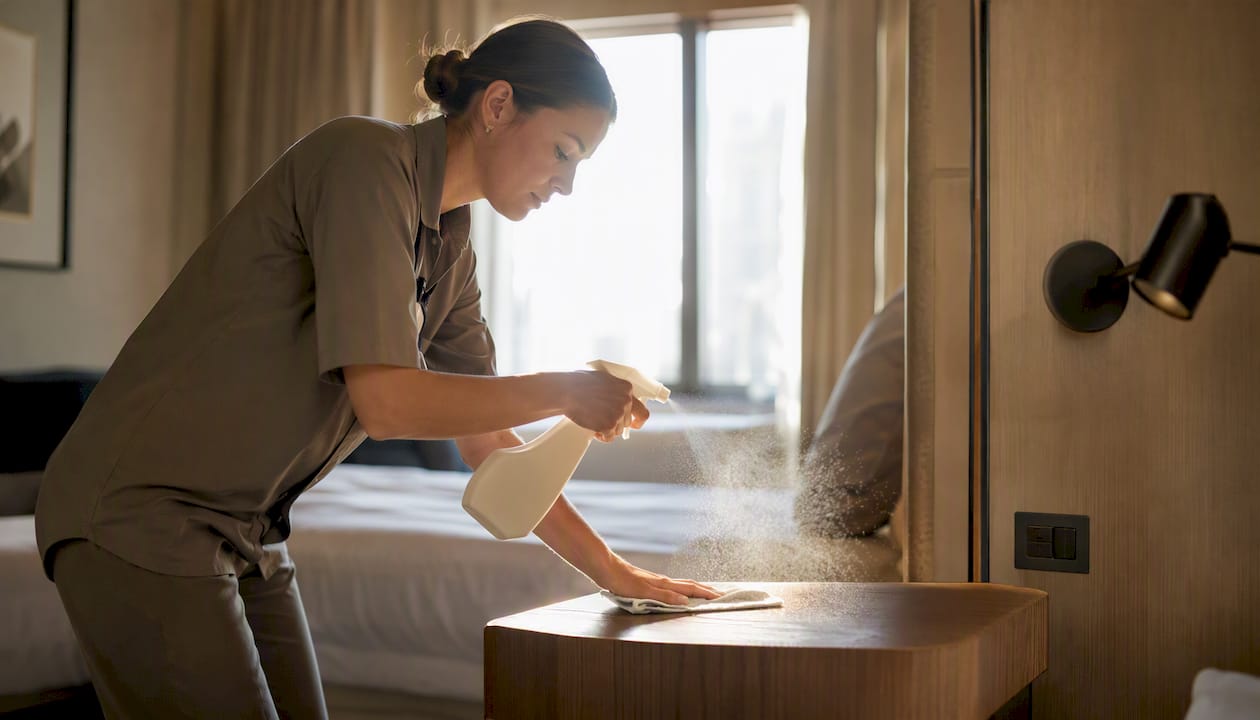
- Green cleaning products, applied through pump sprays rather than aerosols, with documented VOC content.
- Ventilation systems that actively exchange air rather than recirculate it, especially after cleaning or refurbishment.
- Some form of documented measurement or third-party verification, not just a marketing claim.
- Transparency from staff when asked about recent renovations, cleaning chemicals, or air quality testing.
Alto Hotel on Bourke in Melbourne is one example of a boutique property built around these principles from the ground up, which we'll come back to later in more practical detail.
Key takeaways
A genuinely low-VOC hotel room combines documented material and cleaning choices with adequate ventilation, verified by measurement rather than marketing language alone.
| Point | Details |
|---|---|
| Definition requires verification | A low-VOC claim only means something when backed by measured µg/m3 or ppb data, not just an eco-label logo. |
| Alcohols dominate hotel VOC profiles | Cleaning and disinfecting products, not building materials, are usually the largest ongoing VOC source. |
| Cumulative risk, not acute danger | Short stays carry low acute risk; the 2.25 × 10⁻⁶ cumulative cancer risk figure applies mainly to long-term occupational exposure. |
| Ventilation delivers the best return | Adequate air exchange and demand-controlled ventilation outperform most single product substitutions for overall air quality. |
| Alto Hotel applies these principles directly | Alto Hotel on Bourke uses waterborne finishes, formaldehyde-free adhesives, and non-toxic cleaning as built-in design choices. |
Table of Contents
- What are VOCs? The compounds actually found in hotel rooms
- Where do VOCs in hotel rooms actually come from?
- What does the health research actually say?
- How VOCs get measured and what the numbers mean
- What "low-VOC" actually means on a product label
- How hotels actually reduce VOCs in guest rooms
- What guests can do before and during a stay
- How Alto Hotel approaches low-VOC rooms in practice
- Why this issue deserves more attention than it gets
- Book a room built around this from day one
- Frequently asked questions
- Sources
What are VOCs? The compounds actually found in hotel rooms
Volatile organic compounds are simply organic chemicals that evaporate readily at room temperature. That's a deliberately broad definition, and it's the source of most confusion around the term. "VOC" isn't one chemical, it's a category that spans everything from the ethanol in hand sanitiser to industrial solvents in furniture lacquer, and the health implications differ enormously depending on which compound you're talking about.
A pilot study of hotel indoor air detected 57 individual VOCs spanning eight chemical groups: alcohols, halocarbons, aromatics, alkanes, terpenes, carbonyls, ethers, and esters. Alcohols turned up most often, largely a byproduct of cleaning and disinfecting routines.
Here's what actually shows up in a typical hotel room, and where it comes from:
- Alcohols (ethanol, isopropanol): from hand sanitiser, glass cleaners, and disinfectant wipes used during turnover cleaning.
- Terpenes (d-limonene, pinene): from fragranced cleaning products, air fresheners, and some personal care items. They smell "clean" but readily react with ozone to form secondary pollutants indoors.
- Formaldehyde: released slowly from composite wood furniture, particleboard, and some adhesives, particularly when items are new.
- Aromatics (benzene, toluene, xylenes): commonly linked to paints, varnishes, and certain finishes, and one of the more concerning groups because benzene is a recognised carcinogen even at low, sustained exposure.
- Halocarbons: often associated with certain plastics, foams, and older refrigerant or solvent residues.
Not all of these carry equal weight. Alcohols cause temporary irritation at worst, in the concentrations you'd typically find in a hotel room. Benzene and formaldehyde sit in a different category entirely, classified for chronic health risk even at lower ongoing exposure. This is why reading a single "TVOC" (total volatile organic compound) number on an air quality report tells you less than you'd think. A room could report a moderate TVOC figure dominated by relatively benign alcohols, or the same number could be driven by a smaller quantity of a genuinely hazardous aromatic. The total obscures the composition, and the composition is what actually determines the risk.
Where do VOCs in hotel rooms actually come from?
Most guests assume VOCs come from "the building" in some vague sense. In practice, the sources are specific and mostly avoidable.
Cleaning and disinfectant products are the single biggest contributor in most modern hotels. Alcohol-based sanitisers, chlorine-based disinfectants, and fragranced surface cleaners all off-gas during and after application. This got measurably worse during the COVID-19 period: cleaning regimens driven by pandemic protocols increased organic solvent and alcohol use across the hospitality sector, shifting the typical VOC profile of hotel rooms toward higher alcohol and solvent concentrations than had been seen previously.
Furnishings and finishes are the second major source. Carpets, vinyl wall coverings, and composite wood furniture release VOCs continuously, particularly formaldehyde from pressed-wood products and adhesives. The same pilot study found that a single new furniture item, a footstool or bedside table, could raise aromatic compound concentrations in a room by a meaningful margin simply by sitting there.
Paints, coatings, and adhesives used during construction or renovation off-gas most intensely in the weeks immediately following installation, then taper off over months. Some compounds persist far longer than guests assume.
Personal care products and guest behaviour contribute too, though this source varies room to room. Fragranced lotions, hairspray, and perfume all add to the VOC load, as does smoking (even where prohibited, residual exposure lingers in soft furnishings).
HVAC systems and linen storage closets round out the list. Poorly maintained ventilation recirculates VOCs rather than clearing them, and linen closets stocked with fragranced detergents or stored cleaning chemicals can become a low-level, ongoing source if they're adjacent to guest rooms.
Pro Tip: If you manage procurement for a hotel, the single highest-leverage change is usually switching bulk cleaning chemical storage away from guest floors and specifying water-based, fragrance-free products as the default rather than the exception. Storage location alone can meaningfully change ambient VOC levels on affected floors.
What does the health research actually say?
Short-term VOC exposure in most modern hotels sits below acute guideline thresholds. That's the direct answer. The more nuanced answer is that cumulative exposure to a mixture of compounds, some of them carcinogenic even in small quantities, is where the genuine long-term concern lies, particularly for hotel staff who spend entire shifts in these environments rather than a single night.
The same pilot study across multiple hotel properties calculated a cumulative occupational cancer risk of 2.25 × 10⁻⁶ from exposure to eight carcinogenic VOCs detected in hotel air. In plain terms, that's roughly two additional cancer cases per million people exposed at that concentration over a working lifetime, a small but non-zero figure that regulatory bodies typically treat as within an acceptable range, though not zero.
That statistic needs context to be useful rather than alarming. A risk estimate of this magnitude assumes continuous, long-term occupational exposure, the kind a housekeeper or long-term staff member accumulates over years, not the exposure profile of a guest staying two or three nights. For a short stay, the practical health relevance is closer to acute irritation risk (headaches, eye or throat irritation from higher-VOC compounds like fresh paint or intensive cleaning chemicals) than cancer risk. The chronic risk figure matters most for hotel operators thinking about staff welfare and long-term guest-facing employees, not for someone booking a weekend away.
The same research also found that lower-rated hotels tended to show higher VOC concentrations than higher-rated properties, likely reflecting differences in furnishing quality, cleaning product choices, and maintenance investment rather than any single dramatic cause. Alcohols were consistently the most prevalent compound group across the sample, a direct reflection of cleaning intensity rather than building materials.
What are the genuine limits of this evidence? The pilot study in question sampled a limited number of properties, so geographic variation, climate, ventilation design, and regional cleaning practices could all shift these figures elsewhere. TVOC readings, as mentioned earlier, are a blunt instrument. A property reporting "low TVOC" could still have a concerning concentration of one specific compound if that compound happens to be a small fraction of the total. Researchers working in this space have noted that while individual concentrations in most modern hotels sit below acute thresholds, the mixed, cumulative nature of exposure across many different compounds warrants continued caution around procurement and cleaning transparency, rather than treating a single low headline number as proof of safety.
For guests, the practical takeaway is proportion: a two or three-night stay carries meaningfully lower cumulative exposure than a staff member's working year, but that doesn't make the compounds involved irrelevant, particularly for anyone with asthma, chemical sensitivity, or young children in the room.
How VOCs get measured and what the numbers mean
Indoor air testing for VOCs typically uses one of two approaches: active sampling, where air is drawn through a sorbent tube using a pump over a set period, or passive sampling, where a badge-style device absorbs compounds from ambient air over several hours to days without mechanical assistance. Both sample types are then analysed in a lab using gas chromatography mass spectrometry (GC-MS), a technique that separates and identifies individual compounds rather than just producing a single combined figure. This is the method behind most credible peer-reviewed hotel air studies, including the pilot research already referenced above.
Sampling duration matters more than most guests realise. A short grab sample (minutes) captures a snapshot that might miss compounds released in cycles, such as VOCs spiking right after cleaning and dropping off within an hour. Longer passive samples (24 to 72 hours) give a more representative average but can smooth over acute peaks that matter for irritation risk. Neither method is wrong, they answer different questions, which is why it's worth asking a hotel which approach was used if they cite an air quality result.
Reports typically list results by individual compound rather than one lump figure, alongside the units used and applicable guideline comparisons:
Pro Tip: If a hotel offers you an air quality report, ask three things: the raw concentration per compound (not just a summary "pass/fail"), the sampling method and duration used, and whether the testing lab holds recognised accreditation. A report that only states "VOC-free" or "within guidelines" without these details tells you almost nothing verifiable.
Short-term guideline values are designed to flag acute irritation risk, useful for judging whether a freshly painted room is safe to occupy immediately. Long-term or chronic guideline values, the kind referenced in EPA and equivalent international guidance, are calculated for sustained daily exposure over years, which is the relevant frame for staff exposure rather than a guest's weekend stay.
What "low-VOC" actually means on a product label
Here's where things get genuinely confusing for consumers and hotel buyers alike: "low-VOC" is not a single, universally regulated threshold. It varies by product category, by region, and sometimes by which certification scheme is stamped on the tin.
For paints specifically, a commonly used benchmark defines low-VOC as under 50 grams per litre, with "near-zero" or "zero-VOC" products sitting under 5 g/L. But these thresholds differ for adhesives, sealants, carpets, and cleaning products, each of which has its own category-specific limit under various certification schemes, and there's no single global standard that applies uniformly across every product type.
Eco-labels and verification approaches worth recognising when evaluating a hotel's claims:
- Independent third-party certification schemes that test and verify specific product categories rather than relying on manufacturer self-declaration.
- Manufacturer product declarations, which disclose VOC content but aren't independently verified, worth less on their own than third-party certification.
- Direct lab testing of the finished, installed product in situ, the gold standard but rarely done outside research settings or high-end renovations.
- Material safety data sheets, which list hazardous components but weren't designed as consumer-facing low-VOC proof points.
A product's stated VOC content and the actual air concentration in an occupied room are two different measurements, and conflating them is one of the more common mistakes in eco-hotel marketing. Installation timing, room ventilation, temperature, and how many low-VOC items are combined in one space all shift the real-world result, sometimes considerably, from what the tin or spec sheet promised.
This is precisely why material choice for furniture and finishes is only half the picture. Waterborne finishes and powder coatings genuinely emit less than solvent-based lacquers, that's a real and measurable difference, but a room full of technically low-VOC furniture installed without adequate ventilation during the off-gassing window can still test higher than expected in the first weeks. Procurement teams and guests alike should treat a "low-VOC" marketing claim as a starting point for a question, not a finished answer: ask what was tested, when, and by whom.
How hotels actually reduce VOCs in guest rooms
The hotels doing this well tend to work across four levers at once: procurement, cleaning policy, ventilation, and timing.
Start with procurement. Specifying low-emitting furniture, waterborne finishes, and formaldehyde-free adhesives at the point of purchase avoids the problem entirely rather than trying to manage it after installation. Powder-coated metal fittings and water-based lacquers are genuine, measurable improvements over solvent-based alternatives, not marketing dressing.

Cleaning policy is the second lever, and often the fastest to change. EPA guidance for the lodging sector recommends choosing cleaning products with less than 10% VOC content by weight and favouring pump-style sprays over aerosols, since aerosolised chemicals disperse more broadly through room air than a targeted pump application.
A practical checklist for operators looks like this:
- Write procurement specifications that name maximum VOC content per product category, not just "eco-friendly" as a vague qualifier.
- Restrict bulk chemical storage to ventilated, non-guest-facing areas rather than linen closets adjacent to rooms.
- Substitute fragranced, aerosol-based cleaning products for unscented, pump-applied alternatives across housekeeping.
- Train housekeeping staff on correct dilution ratios, since over-concentrated cleaning solutions increase VOC release without improving cleaning outcomes.
- Schedule targeted indoor air testing after refurbishments, new furniture installs, or specific guest complaints, rather than testing on a fixed calendar regardless of events.
Ventilation is the third lever and arguably delivers the best return for the effort involved. Hotel facility guidance on indoor air quality points to adequate air exchange, including demand-controlled ventilation using CO2 sensors, as the foundation of good IAQ management, more impactful in most cases than chasing individual product substitutions. Ventilation dilutes whatever VOCs are present regardless of source, which makes it a broadly effective baseline strategy even when procurement changes take years to fully roll through a property.
Timing is the fourth and most overlooked lever. New furniture and finishes off-gas most intensely in the days and weeks after installation, tapering gradually, sometimes over months or longer depending on the material. Staging refurbished rooms, holding them out of inventory for a defined period with active ventilation before returning them to guest use, meaningfully reduces the VOC exposure a first guest would otherwise encounter.
Test-and-target beats routine whole-property sampling for most operators. Testing every room on a fixed schedule regardless of activity is expensive and often unnecessary; testing specifically after a refurbishment, a complaint, or in known high-turnover rooms delivers more useful data per dollar spent, an approach echoed in facility guidance on practical IAQ management. Hotels weighing these investments against the cost of eco-friendly upgrades generally find ventilation and cleaning policy changes deliver faster payback than a full furniture replacement cycle.
What guests can do before and during a stay
You don't need a chemistry background to reduce your own exposure, just a short checklist and a willingness to ask a couple of direct questions before you book.
Before booking, check for:
- Whether the hotel publishes any green cleaning policy or environmental certification, and how specific it is (vague claims versus named standards).
- Recent refurbishment dates, since freshly renovated rooms carry higher off-gassing risk in the weeks immediately following work.
- Presence of carpeting versus hard flooring, since carpets trap and slowly release VOCs, along with dust and allergens, more than hard surfaces do.
- Details on ventilation, particularly whether rooms have operable windows or rely entirely on recirculated HVAC air.
During your stay, a few habits make a measurable difference. Open a window when weather allows, even for twenty minutes, to flush accumulated indoor air. Ask reception for a room away from linen or chemical storage closets if you're sensitive to fragrance or chemical odours. Skip the provided air fresheners and scented amenities if you're prone to headaches or respiratory irritation, since terpene-based fragrance products are a common, easily avoidable VOC source. Highly sensitive travellers can pack a small portable HEPA and activated carbon air purifier, which handles both particulates and a meaningful share of gaseous VOCs in a single room overnight.
Pro Tip: If you're chemically sensitive, ask specifically whether your room has been refurbished or newly furnished in the past three to six months, and request an alternative if so. Off-gassing timelines vary by material, but this window covers the period of highest emission for most paints, adhesives, and composite furniture.
It's also worth simply asking the front desk a direct question: can they show a recent indoor air quality test result, or point to a specific product declaration for the cleaning chemicals used on your floor? A practical guest checklist built around exactly these questions gives you a fast way to separate hotels with genuine documentation from those relying on branding alone. Properties with nothing to show usually say so quickly, which is itself useful information, and those with real data tend to volunteer it happily.
How Alto Hotel approaches low-VOC rooms in practice
Alto Hotel on Bourke, an environmentally rated boutique hotel in Melbourne, was built around eco-conscious material choices rather than adding them as an afterthought. That distinction shows up in specifics rather than slogans.
The property favours waterborne finishes and formaldehyde-free adhesives in its furniture and fittings, the same category of material choice that independent guidance on hotel furniture emissions identifies as meaningfully lower-emitting than solvent-based lacquers and standard composite wood adhesives. Cleaning practices lean on non-toxic products across guest rooms, a policy choice that reduces the alcohol and solvent load research has flagged as the dominant VOC contributor in hospitality settings generally.
Guests researching non-toxic hotel room options consistently ask the same handful of questions: what's the flooring, what's the cleaning regimen, and how recently was the room refurbished. Alto Hotel's approach treats those as reasonable questions with concrete answers, not marketing objections to deflect.
None of this makes any single room a laboratory-verified zero-VOC space, no hotel room realistically is. It does mean the underlying procurement decisions align with what the research above identifies as the levers that actually move the needle, material choice, cleaning policy, and ventilation, applied at the point of design rather than bolted on afterward.
Why this issue deserves more attention than it gets
Most travellers never think about hotel air quality until something goes wrong, a headache after a night in a freshly painted room, a strong chemical smell from housekeeping products. That reactive pattern is exactly backwards. The evidence here isn't dramatic; nobody's suggesting hotel rooms are dangerous. But it is specific enough that guests and operators alike could be doing more with the information already available.
What frustrates me most about how this topic gets marketed is the gap between "eco-friendly" as a vibe and "low-VOC" as a measurable claim. Those are different things, and conflating them lets weak claims pass unchallenged. Hotel operators carry a genuine responsibility here, not just to travellers spending two nights, but to housekeeping staff spending years in these environments. Asking for actual measurement data, rather than accepting a green logo at face value, is a small habit that would shift the whole category if more guests and procurement teams adopted it.
Book a room built around this from day one
Reading about low-VOC principles is one thing. Sleeping in a room actually built on them is another. Alto Hotel on Bourke applies the material choices, cleaning standards, and ventilation thinking covered throughout this article as standing policy across its Melbourne CBD rooms, studios, and one and two-bedroom apartments, not as a retrofit or a seasonal marketing push.

Rooms come with in-room kitchen facilities for guests who'd rather cook than rely on takeaway packaging, secure parking, and free WiFi, alongside the eco-conscious material choices detailed above. The hotel's partnerships with local artisans extend that same environmental thinking into furnishings and finishes throughout the property, backed by its standing as one of Melbourne's first environmentally rated hotels and its Hall of Fame recognition in Victorian tourism. If the questions raised in this article, about materials, cleaning products, and ventilation, are ones you'd genuinely like answered before you book, check current room availability and rates directly on the Alto Hotel on Bourke website.
Frequently asked questions
What is a low-VOC hotel room, explained simply? A low-VOC hotel room is one where independent testing or credible certification confirms that airborne concentrations of volatile organic compounds, chemicals like formaldehyde, benzene, and various alcohols, sit meaningfully below standard indoor levels. It's achieved through low-emitting furnishings, green cleaning products, and effective ventilation, not just a marketing label.
Are VOCs in hotel rooms actually dangerous? For most short stays, VOC exposure in modern hotels sits below acute irritation thresholds. The more relevant concern is cumulative, long-term exposure, particularly for hotel staff, and certain specific compounds like benzene and formaldehyde that carry chronic health risks even at lower ongoing concentrations.
What are the most common VOCs found in hotel rooms? Alcohols from cleaning and disinfecting products are typically the most prevalent, followed by terpenes from fragranced items, formaldehyde from composite wood furniture, and aromatic compounds like benzene and xylenes from paints, finishes, and some adhesives.
How can I tell if a hotel's low-VOC claims are real? Ask whether they can share raw concentration data from air quality testing, the sampling method and duration used, and whether the lab holds recognised accreditation. A hotel relying only on a general "eco-friendly" label without measurement data is making a marketing claim, not a verified one.
What can I do as a guest to reduce VOC exposure during my stay? Ventilate the room when possible, avoid fragranced hotel amenities if you're sensitive, ask for a room away from housekeeping storage areas, and check whether the room has been recently refurbished, since off-gassing is highest in the weeks after new furniture or paint goes in.
Does a higher hotel rating mean lower VOC levels? Research suggests a correlation, with lower-rated hotels in one pilot study showing higher VOC concentrations, likely reflecting differences in furnishing quality and cleaning product choices. It's a pattern worth noting, not an absolute rule for every individual property.
This article is general information, not a substitute for advice from a qualified doctor. Consult a qualified healthcare professional about your own circumstances before acting on anything here.
Sources
For readers who want to go deeper than this explainer, these sources cover the methods and guidance referenced above:
- Volatile Organic Compound (VOC) Contamination in Hotel Rooms: A Pilot Study to Understand Sources and Health Risks (doi)
- EPA lodging/cleaning guidance (NEPIS document)
- Hotel indoor air quality management: beyond HVAC maintenance
- Low‑VOC finishes & non‑toxic adhesives for luxury hotel furniture