

An eco apartment hotel combines the autonomy of a private apartment with hotel services and a genuine commitment to sustainable design and operation. For couples, that means a separate kitchen and living area, periodic housekeeping, reliable Wi-Fi, and a building that has been designed to use less energy, less water, and healthier materials. The 'eco' modifier is not a marketing label when it is backed by verifiable standards. Passive House / IPHA principles, WELL Building Standard indoor environment criteria, and Green Star / GBCA ratings each give couples a way to check whether a property's sustainability claims hold up. Alto Hotel on Bourke in Melbourne CBD is one of the clearest local examples of this hybrid model in practice.
Table of Contents
- What is an eco apartment hotel, and how does the 'eco' part change your stay?
- Why do couples often prefer eco apartment hotels for romantic stays?
- What sustainability features should you actually check before booking?
- What can you expect in the room and from hotel services?
- How to choose and book: a practical checklist for eco-conscious couples
- Alto Hotel on Bourke: the concept in practice in Melbourne
- Key takeaways
- The case for staying somewhere that actually means it
- Book your eco apartment stay at Alto Hotel on Bourke
- Useful sources and further reading
What is an eco apartment hotel, and how does the 'eco' part change your stay?
An aparthotel sits between a serviced apartment and a traditional hotel. You get a private kitchen, a living area, sometimes an in-room washer and dryer, and the kind of space that lets two people actually spread out. Hotel services, such as a staffed reception, periodic cleaning, and flexible nightly or weekly rates, sit alongside that apartment autonomy.
Adding 'eco' to that formula changes the building itself and how it runs day to day. Practically, that means:
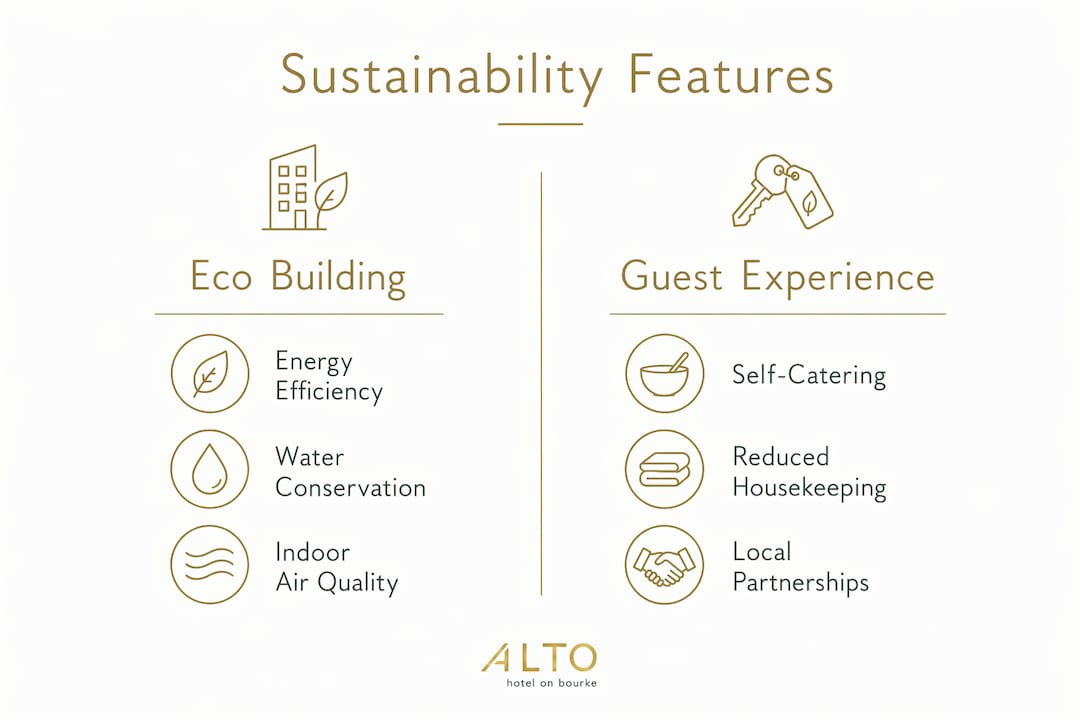
- Energy efficiency: high-performance insulation, LED lighting throughout, and HVAC systems designed to minimise heating and cooling loads
- Water conservation: low-flow taps, showerheads, and toilets; efficient in-room laundry where available
- Waste reduction: refill stations replacing single-use plastic bottles, on-site recycling, and composting where the property supports it
- Healthier materials: low-VOC paints and finishes, sustainably sourced timber, and natural textiles that improve indoor air quality
- Local sourcing: partnerships with local artisans and suppliers that reduce transport emissions and support the community
For a couple choosing where to stay in Melbourne, those features translate into a quieter, fresher-smelling room, lower energy use during the stay, and the option to self-cater using locally sourced produce.
Why do couples often prefer eco apartment hotels for romantic stays?
Space is the most immediate reason. Travel editorial guides consistently highlight aparthotels as a strong choice for couples who want privacy and exclusive, apartment-style spaces rather than a single hotel room where the bed takes up most of the floor. Separate zones for sleeping, dining, and relaxing matter when one partner wakes early or wants quiet time, while the other reads in the living area.

Self-catering is the second advantage, and it connects directly to sustainability. Cooking with locally purchased ingredients reduces food-transport emissions and cuts the single-use packaging that comes with daily restaurant meals. For couples, it also creates a rhythm that feels genuinely local: a morning walk to a Melbourne market, then breakfast back at the apartment.
The restorative environment matters too. Buildings designed to WELL indoor environment standards prioritise ventilation, low-VOC materials, and occupant comfort. That combination produces a room that feels calmer and cleaner, which is exactly what a romantic or restorative stay calls for. Passive House techniques add quieter interiors and more stable temperatures, benefits that go well beyond the energy bill.
For longer stays, aparthotels typically offer better value than fixed nightly hotel rates, so couples planning an extended Melbourne visit get more space and improved cost-effectiveness.
What sustainability features should you actually check before booking?
Knowing what to look for separates a genuinely sustainable stay from a greenwashed one. The table below maps the key feature categories to what they mean for your stay and how to verify them.
| Feature category | What it means for your stay | How to verify |
|---|---|---|
| Energy efficiency | Quieter HVAC, stable temperatures, lower bills on longer stays | Ask about Passive House / IPHA compliance or energy ratings; check published policy |
| Water conservation | Adequate shower pressure with low-flow fittings; efficient laundry | Look for low-flow labels in-room; ask about greywater or rainwater reuse |
| Waste and amenities | Refill stations instead of plastic bottles; recycling and composting options | Check guest-facing evidence: refill dispensers, recycling bins, no single-use plastics |
| Materials and indoor air | Fresher-smelling rooms; no chemical off-gassing from paints or finishes | Ask about low-VOC materials; look for WELL or GBCA references |
| Certifications | Independent verification of all the above | Check for Green Star / GBCA, LEED, Passive House, or published sustainability policy |
Passive House buildings can reduce heating and cooling energy use by up to about 50% compared with conventional non-passive buildings. That is not just an environmental statistic; it means a more comfortable, quieter room with fewer temperature swings overnight.
Pro Tip: Ask the property to send you its published sustainability policy before you book. A hotel with genuine credentials will have one. A vague reply about "caring for the environment" with no document attached is a red flag.
Common red flags to watch for:
- Sustainability claims with no certification, rating, or published policy to back them
- Single-use plastic toiletries still present in rooms
- No recycling or composting options for guests
- Guest reviews that contradict the property's eco claims
What can you expect in the room and from hotel services?
In an eco aparthotel, the room itself does more work than a standard hotel room. A kitchenette or full kitchen, a dining table, and a lounge area are standard. Quality linens made from natural fibres, low-VOC finishes, and energy-efficient appliances round out the in-room experience.
Hotel services in this model are deliberately lighter than a full-service hotel, and that is intentional. Housekeeping is typically offered every few days rather than daily, which reduces water and chemical use without affecting comfort. Reception and concierge hours vary by property; secure parking and reliable Wi-Fi are standard at well-run Melbourne properties.
The combination of self-catering and reduced housekeeping is where the sustainability gains stack up. Fewer room services means less water, fewer cleaning chemicals, and lower linen turnover. For couples, it also means fewer interruptions to a relaxed morning or a quiet evening in.
How to choose and book: a practical checklist for eco-conscious couples
Before you confirm a booking, work through these steps.
- Ask for the sustainability policy in writing. A credible property will have a published document, not just a webpage paragraph.
- Check for verifiable certifications. Green Star / GBCA is the primary Australian framework; Passive House and WELL are internationally recognised. LEED appears on some properties too.
- Confirm in-room features. Kitchen facilities, natural-fibre linens, refill stations, and recycling options should all be confirmed before arrival.
- Request low-impact housekeeping. Ask for every-third-day service rather than daily; most eco properties offer this as standard.
- Compare total stay costs. Eco aparthotels often offer better nightly rates for stays of five nights or more. Factor in the savings from self-catering when comparing options.
- Read recent guest reviews for consistency. Genuine eco credentials show up in guest comments about air quality, quiet rooms, and visible sustainability practices.
- Check cancellation flexibility. Longer stays benefit from flexible terms in case plans change.
For evaluating certifications and eco claims in more depth, a dedicated guide walks through the key questions to ask any Melbourne property.
Alto Hotel on Bourke: the concept in practice in Melbourne
Alto Hotel on Bourke is one of Melbourne's first environmentally rated hotels and a clear local example of the eco aparthotel model working as described. The property offers studio and one- and two-bedroom apartment-style rooms with in-room kitchen facilities, sustainable materials, secure parking, and free Wi-Fi, all within the CBD.
Alto Hotel on Bourke holds Hall of Fame recognition in the Victorian tourism sector and maintains a published sustainability policy covering energy, water, materials, and local partnerships. Its rooms are designed with eco-conscious materials and the hotel works with local artisans and organisations to support both the guest experience and the Melbourne community.
That combination of apartment-style layouts, verifiable environmental credentials, and community partnerships is precisely what the earlier checklist points toward. Couples booking directly through Alto Hotel's site can access exclusive direct booking offers not available through third-party platforms. For more on why sustainable hotels suit couples specifically, the hotel's blog covers the topic in detail.
Key takeaways
An eco apartment hotel for couples combines apartment-style space and self-catering with hotel services and independently verified sustainability, making it the strongest option for couples who want privacy, comfort, and a lower travel footprint in Melbourne.
| Point | Details |
|---|---|
| What an eco aparthotel is | A hybrid of apartment autonomy and hotel services, built and operated to verified sustainability standards. |
| Top features to verify | Energy ratings, low-VOC materials, refill stations, waste management, and published certifications such as Green Star or Passive House. |
| Booking red flag | No published sustainability policy and single-use plastics still in rooms are the clearest signs of greenwashing. |
| Value for longer stays | Aparthotels typically offer better nightly rates for stays beyond three to five nights, with self-catering adding further savings. |
| Local example | Alto Hotel on Bourke is Melbourne's Hall of Fame-recognised eco boutique hotel with apartment-style rooms and a published sustainability policy. |
The case for staying somewhere that actually means it
The gap between "eco-friendly" as a marketing claim and eco-friendly as a design and operational commitment is wider than most booking sites suggest. Properties that have pursued Green Star / GBCA ratings or Passive House certification have gone through independent assessment. That process costs time and money, which is exactly why it signals something real.
What I find couples underestimate is how much the physical environment affects the quality of a romantic stay. A room with stable temperatures, genuinely fresh air, and no chemical smell from new paint or synthetic textiles is simply more comfortable to spend time in. That is not a luxury add-on; it is what good sustainable design produces as a baseline. The WELL Building Standard exists precisely because indoor environment quality has measurable effects on how people feel. Choosing a property that takes that seriously is not a compromise; it is an upgrade.
The self-catering angle is also underrated. Couples who cook one or two meals in their apartment during a Melbourne stay tend to describe the experience as more relaxed and more local than a hotel stay where every meal is a booking. That shift in rhythm is part of what makes an eco aparthotel feel different from a standard room, regardless of the sustainability credentials.
Book your eco apartment stay at Alto Hotel on Bourke
Alto Hotel on Bourke gives eco-conscious couples something specific: apartment-style rooms with kitchen facilities in the Melbourne CBD, backed by genuine environmental credentials and Hall of Fame recognition in Victorian tourism. Booking directly through the hotel's website means access to exclusive rates and offers not available elsewhere, and you can request low-impact housekeeping or confirm kitchen facilities at the time of booking to reduce your stay's footprint from day one.
For a guilt-free luxury stay in Melbourne that holds up to scrutiny, check availability directly at Alto Hotel on Bourke.
Useful sources and further reading
Key references used in this guide:
- Passive House / IPHA — international standard for high-performance energy-efficient buildings
- WELL Building Standard — certification framework for healthier indoor environments
- Green Building Council of Australia (GBCA) — Australian Green Star certification and sustainability guidance
- LEED certification and eco apartments — international building rating used in eco apartment marketing
- How to enjoy self-catering stays — practical guide to self-catering in aparthotels
- The Guardian on passive-house benefits — reporting on occupant comfort in high-performance buildings
- RentCafe green living guide — guest-facing features to check in eco apartments
Internal reading for couples planning a Melbourne stay:
- Why sustainable hotels are better for couples
- How to choose an environmentally rated boutique hotel
- Ethical luxury accommodation defined