
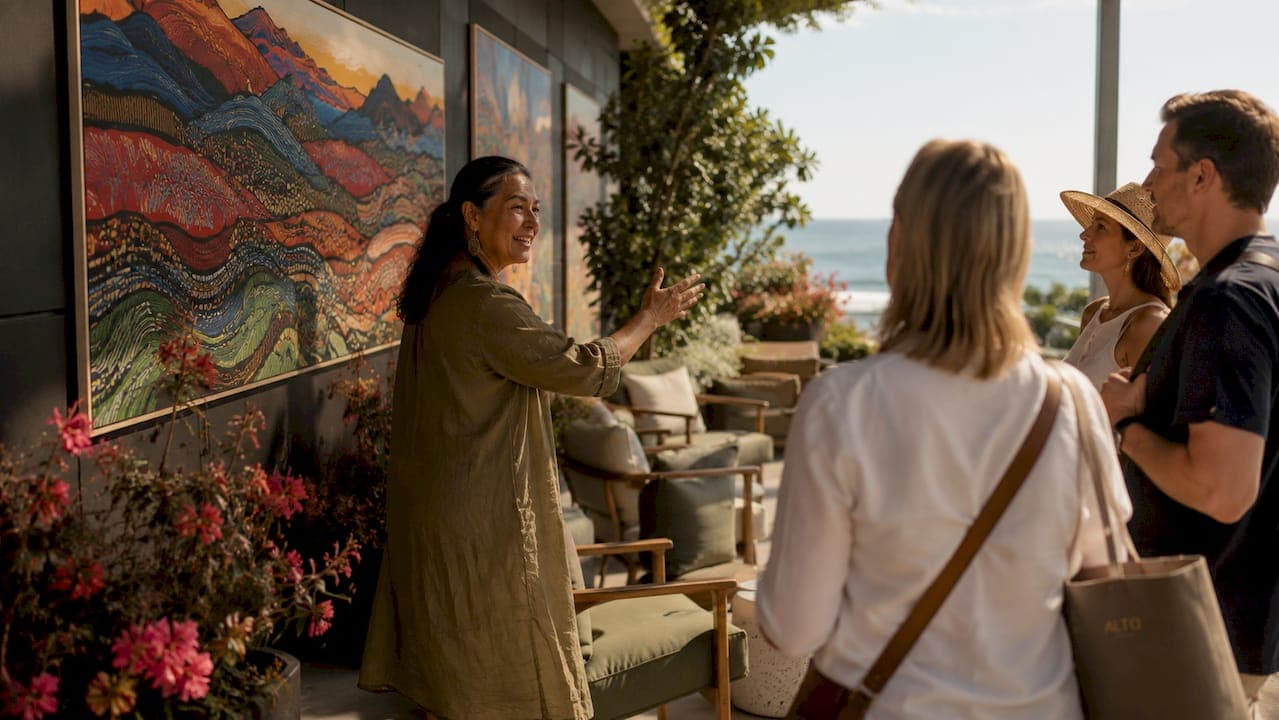
Indigenous art in hotels is defined as original works created by First Nations, Aboriginal, and other Indigenous peoples, commissioned or curated specifically to reflect the cultural identity of a place. The types of indigenous art featured in hotels range from site-specific installations and large-scale textiles to architectural carvings and ancient motif-inspired tilework. These are not decorative afterthoughts. They are the primary way many properties communicate where they stand, whose land they occupy, and what stories deserve to be told. For culturally curious travellers, recognising these art forms transforms a hotel stay into a genuine cultural encounter.
1. What types of indigenous art are most commonly featured in hotels?
Site-specific installations are the most impactful form of native art in accommodations. Unlike generic prints sourced from catalogues, these works are created by Indigenous artists for a particular space, responding to the building's location, history, and community. Métis Crossing commissioned eight local artists to create original works across 40 guest rooms, each piece reflecting Métis connections to land, animals, and culture. That scale of commissioning signals genuine intent, not tokenism.
The range of art forms is broader than most travellers expect. Paintings, sculptures, weavings, ceramics, and carved architectural panels all appear across properties worldwide. Each medium carries its own cultural logic and visual language. Understanding what you are looking at deepens the experience considerably.
- Paintings and prints: Works on canvas, bark, or paper using traditional colour palettes and symbols
- Weavings and textiles: Hand-loomed pieces using natural fibres, often depicting landscape or ancestral stories
- Ceramics and tilework: Patterns drawn from ancient pottery traditions, applied to floors, walls, and surfaces
- Carved panels and sculptures: Three-dimensional works in wood, stone, or bone featuring clan symbols or spiritual figures
- Architectural integration: Motifs built directly into the structure of a building, from ceiling beams to entry thresholds
Pro Tip: Ask the front desk whether the hotel has an artist interpretation guide. Properties like Métis Crossing provide written context in each room, which turns a glance into a genuine learning moment.
2. How do large-scale indigenous textile installations shape hotel spaces?
Large-scale textiles are the most physically commanding form of cultural art in hotels. A single woven installation can define the entire character of a lobby, replacing the need for conventional architectural decoration. Kimpton Miralina Resort features a 175-foot woven textile installation in its lobby, inspired by the colours and forms of the surrounding Sonoran Desert landscape. That single work anchors the resort's identity more powerfully than any paint colour or furniture selection could.
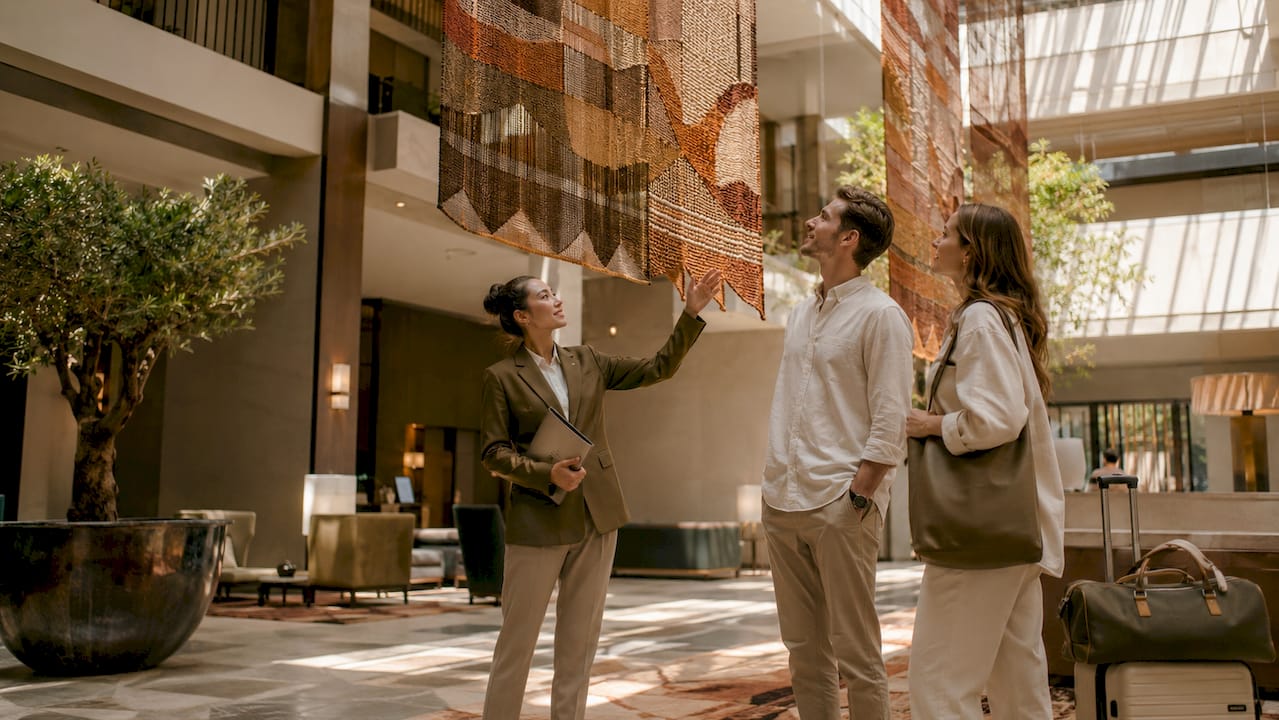
Woven textiles carry cultural knowledge encoded in pattern, colour, and material. The choice of fibre, the direction of the weave, and the specific motifs used are all deliberate decisions made by the artist. Travellers who take time to read accompanying notes often discover that what looks like abstract pattern is actually a map, a story, or a seasonal calendar.
| Feature | What it communicates |
|---|---|
| Fibre choice | Connection to local plant or animal species |
| Colour palette | Regional landscape, seasonal cycles, or ceremonial significance |
| Pattern structure | Ancestral stories, clan identity, or spiritual concepts |
| Scale | Architectural ambition and depth of cultural commitment |
| Placement | The spaces a community considers most significant |
The immersive sensory experience created by large textiles goes well beyond visual impact. Sound, texture, and the sheer physical presence of a hand-loomed work at architectural scale create a response that reproduced art simply cannot match. Hotels that invest in this format signal that cultural storytelling is central to their identity, not supplementary to it.
Pro Tip: Stand close enough to touch the edge of a large textile installation (without touching it). The variation in thread tension and colour gradation visible at close range reveals the hand of the maker in a way that photographs never capture.
3. How do hotels incorporate indigenous craftsmanship into architectural elements?
The role of indigenous culture in hotel design goes deepest when it moves from the walls into the structure itself. Hôtel-Musée Premières Nations uses wood surfaces and animal hides as primary interior materials, drawing directly from the building traditions of the Huron-Wendat Nation. The result is a space that feels grown from its location rather than imported into it. This approach is called critical regionalism in architectural practice, and Indigenous craftsmanship is its most authentic expression.
Hotel Indigo Nalati takes a similar approach in a very different cultural context. Its architecture draws from the traditional aul, a nomadic dwelling form used by Indigenous peoples of the Eurasian steppe. The spatial logic of the aul, including its orientation to seasonal light and its communal gathering forms, shapes the layout of the entire property. Guests experience Indigenous spatial thinking without necessarily knowing the term for it.
Common architectural and decorative elements that carry Indigenous craftsmanship include:
- Carved timber beams and lintels featuring clan crests or ancestral figures
- Hand-laid stone or mosaic floors using patterns from regional rock art traditions
- Woven or hide-covered wall panels replacing standard plasterboard finishes
- Threshold carvings at entry points marking the cultural significance of arrival
- Ceiling treatments referencing sky, stars, or seasonal movement in Indigenous cosmology
The most effective examples treat these elements as culturally grounded design rather than surface decoration. When a carved beam tells a specific story from a specific community, it creates a fundamentally different guest experience from a generic tribal motif applied for visual effect.
4. What role do ancient motifs play in hotel decor and surface design?
Ancient motifs translated into contemporary surfaces represent one of the most technically demanding forms of hotel indigenous decor. Choctaw Landing commissioned a Master Choctaw artist to design tile and carpet patterns inspired by pottery shards estimated to be 3,000 to 5,000 years old. Every guest who walks across that floor is walking across a living archive. The decision to use a Master artist rather than a commercial pattern studio is the difference between cultural art and cultural costume.
These surface designs appear in lobbies, corridors, bathrooms, and outdoor paving. When done well, they create a continuous visual language across the entire property. Travellers begin to read the patterns as a vocabulary, noticing repetitions and variations that carry meaning. That kind of visual literacy builds over a stay in a way that a single artwork on a wall cannot.
The key distinction is authorship. Motifs designed by the community they represent carry authority. Motifs adapted from reference books by a non-Indigenous design team carry risk. Showcasing local art through surface design only works when the original artist retains creative control and receives proper attribution.
5. What makes indigenous art in hotels authentic rather than appropriative?
Authentic indigenous art in hotels is defined by the presence of genuine partnership with Indigenous artists and cultural advisors throughout the commissioning process. Hotels that engage cultural advisors avoid cultural appropriation and create collaborations that benefit communities and guests alike. The advisor's role is not decorative. They set the terms of engagement, review final works, and confirm that the cultural narrative presented is accurate and consented to.
The distinction between appreciation and appropriation comes down to who benefits and who decides. When an Indigenous artist is paid fairly, credited publicly, and given creative control, the work is appreciation. When a hotel uses a motif without permission, pays a non-Indigenous designer to replicate it, and provides no cultural context, the work is appropriation. Most travellers cannot spot the difference visually. The ethical commissioning process is what makes the work trustworthy.
"Proper commissioning and presentation of Indigenous art increases emotional guest response and validates local artisanship beyond tokenistic décor. Hotels that move beyond literal replication of Indigenous motifs towards transformative cultural logic achieve deeper guest connections and stronger place attachment."
Educational materials are the most visible sign of authentic intent. Métis Crossing rooms provide information about each artist and the cultural meanings behind their work. That interpretive layer transforms a guest from a passive viewer into an engaged participant. It also creates accountability. A hotel that names the artist and explains the work cannot later claim the motif was generic.
Community partnerships that include benefit-sharing agreements, ongoing artist relationships, and cultural review processes set the standard for the industry. Travellers who ask about these arrangements before booking send a clear market signal about what they value.
Key takeaways
The most authentic indigenous art in hotels combines site-specific commissioning, cultural advisor partnerships, and interpretive materials to create guest experiences that respect and genuinely represent Indigenous heritage.
| Point | Details |
|---|---|
| Site-specific installations | Works created for a particular hotel space carry more cultural authority than generic prints or reproductions. |
| Large-scale textiles | Architectural-scale weavings define a property's identity and encode cultural knowledge in pattern, colour, and material. |
| Craftsmanship in structure | The deepest integration embeds Indigenous spatial logic and materials into the building itself, not just the walls. |
| Ancient motif surfaces | Tile and carpet patterns drawn from archaeological sources require a Master artist's authorship to remain authentic. |
| Ethical commissioning | Cultural advisors, fair payment, and interpretive materials separate genuine cultural art from appropriation. |
Why indigenous art in hotels changed how I think about travel
The first time I walked into a hotel lobby anchored by a hand-loomed textile the size of a tennis court, I stopped moving. Not because it was beautiful, though it was. Because I realised I had no framework for what I was looking at. I had spent years travelling and staying in properties that called themselves culturally immersive, and most of them had delivered a framed print and a minibar. This was something else entirely.
What I have come to understand is that the guest experience shifts fundamentally when art is made for a place rather than placed in it. The difference is not subtle. A commissioned work by an Indigenous artist who grew up on the land surrounding a property carries a weight that no amount of interior design budget can replicate. It makes the guest feel located. That is a rare and valuable thing in modern travel.
The uncomfortable truth I have learned is that most travellers, myself included, do not ask enough questions. We accept the framed print. We assume the carpet pattern is decorative. We do not ask who made it, whether they were paid fairly, or whether the cultural story being told is accurate. The hotels that answer those questions before you ask them are the ones worth returning to. Authenticity in this space is not a marketing claim. It is a set of decisions made long before the guest arrives.
— Kamal
Altohotel and the art of culturally grounded stays
Altohotel on Bourke in Melbourne has built its reputation on the idea that a hotel should reflect the place it occupies, not erase it. That commitment extends to supporting local creative communities, including partnerships with local artisans and organisations that bring genuine cultural storytelling into the guest experience.
For travellers who want a stay that connects them to Melbourne's creative and cultural identity, Altohotel delivers that without compromise. The hotel's eco-conscious design philosophy and community partnerships mean every element of the space has been considered with both environmental and cultural responsibility in mind. Explore Altohotel's rooms and philosophy to see how a boutique property can make cultural authenticity a core part of what it offers.
FAQ
What types of indigenous art appear most often in hotels?
Site-specific paintings, large-scale woven textiles, carved architectural elements, and ancient motif-inspired tilework are the most common forms. The best examples are commissioned directly from Indigenous artists rather than sourced from commercial suppliers.
How can travellers tell if indigenous art in a hotel is authentic?
Look for named artists, written cultural context in rooms or on signage, and evidence of community partnerships. Hotels like Métis Crossing provide interpretive materials in each guest room explaining the artist and the cultural meaning of each work.
What is the difference between cultural appreciation and appropriation in hotel art?
Appreciation involves fair payment, creative control, and accurate cultural representation by the originating community. Appropriation occurs when motifs are used without permission, without attribution, and without benefit to the community they come from.
Why do hotels use indigenous art in architectural elements rather than just wall art?
Embedding Indigenous craftsmanship into structural elements like carved beams, woven wall panels, and patterned floors creates a more immersive and culturally grounded environment. Properties like Hotel Indigo Nalati use Indigenous spatial logic in their entire layout, not just their decoration.
Do indigenous art installations in hotels benefit the artists and their communities?
They do when the commissioning process includes fair payment, ongoing attribution, and benefit-sharing agreements. Métis Crossing's lodge initiative is a documented example of a hotel creating genuine economic opportunities for Indigenous artists through site-specific commissions.