
Sustainability in Melbourne tourism is defined as the integration of environmental, social, and cultural stewardship practices that protect the city's long-term visitor economy. The role of sustainability in Melbourne tourism has moved from niche preference to mainstream expectation, driven by a visitor economy that recorded 3.5 million interstate visitors spending $5.9 billion in the 12 months to december 2025. At that scale, unmanaged tourism growth creates measurable environmental and social costs. Melbourne's response spans three simultaneous layers: shaping traveller behaviour, building enabling infrastructure, and preserving cultural heritage. Each layer reinforces the others, and none works in isolation.
How sustainable tourism melbourne shapes visitor behaviour
Tourism Australia's 'Green is Our Gold' initiative, unveiled in 2026, is the clearest signal that sustainable tourism in Melbourne and across Australia is now a sector-wide priority. The programme calls on 360,000 tourism businesses to voluntarily adopt five responsible-travel principles. Voluntary adoption matters because it frames sustainability as a commercial opportunity rather than a regulatory burden.
The consumer data behind this shift is compelling. Tourism Australia's Consumer Demand Project found that 77% of travellers prioritise sustainability in their everyday lives, and 70% carry those preferences directly into travel decisions. That means seven in ten visitors arriving in Melbourne are actively looking for green tourism practices to support.

Businesses that respond to this demand gain a real competitive edge. Eco-friendly travel Melbourne options, from carbon-neutral accommodation to low-impact tour operators, attract a growing segment of visitors who will pay a premium and return more often. The diversity of Melbourne's tourism sector, from boutique hotels to large conference venues, means sustainability interventions must be tailored rather than uniform.
Key principles from 'Green is Our Gold' include:
- Reduce waste and single-use plastics across all visitor touchpoints
- Support local and First Nations suppliers to strengthen community benefit
- Communicate sustainability credentials clearly to travellers
- Measure and report environmental performance annually
- Treat sustainability as a long-term business investment, not a cost
Pro Tip: When booking accommodation or tours in Melbourne, look for operators who publish verified sustainability data, not just marketing claims. Certification bodies like Ecotourism Australia provide independent ratings you can trust.
What infrastructure powers melbourne's green tourism footprint?
Enabling infrastructure is where Melbourne's sustainability commitments become measurable. The City of Melbourne's 'Green Our City Strategic Action Plan', adopted in march 2026, promotes green roofs and vertical greening across the city as part of its net-zero by 2040 goals. These aren't decorative additions. Green roofs reduce urban heat, lower building energy demand, and improve air quality in precincts that millions of visitors move through each year.
Transport decarbonisation delivers some of the most quantifiable results. Yarra Trams installed 860 solar panels across its depots, producing 500 MWh of electricity annually and cutting CO2 emissions by 500 tonnes per year. The project also saves $370,000 annually in operating costs. Those savings can be redirected into further sustainability upgrades, creating a compounding effect. Beyond solar, Yarra Trams' LED retrofits reduce an additional 700 tonnes of CO2 per year. Together, these two projects cut over 1,200 tonnes of emissions annually from public transport alone.
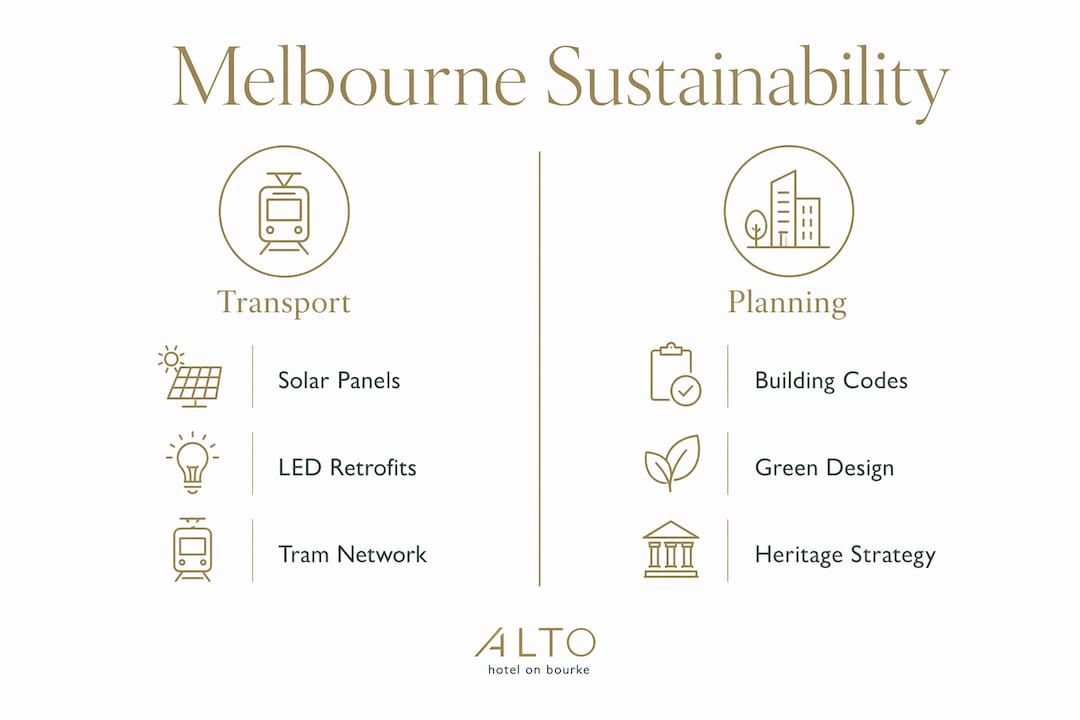
Planning regulations reinforce these gains. Planning Scheme Amendment C376 mandates sustainable building design standards across Melbourne, meaning new developments in tourism precincts must meet environmental benchmarks from the ground up. This regulatory mechanism ensures that growth in visitor infrastructure does not outpace sustainability progress.
| Infrastructure Initiative | Environmental Impact | Financial Benefit |
|---|---|---|
| Yarra Trams depot solar (860 panels) | 500 tonnes CO2 reduced per year | $370,000 saved annually |
| Yarra Trams LED lighting retrofit | 700 tonnes CO2 reduced per year | Reduced operating costs |
| Green Our City urban greening | Reduced urban heat, improved air quality | Lower building energy demand |
| Planning Scheme Amendment C376 | Mandated sustainable building standards | Long-term precinct resilience |
Pro Tip: Melbourne's tram network is one of the largest in the world. Choosing trams over ride-share vehicles during your visit is one of the simplest and most impactful sustainable travel tips Melbourne has to offer.
How does heritage preservation connect to sustainability?
Melbourne's 2026 Heritage Strategy treats sustainability and environmental responsibility as a core priority area, not an afterthought. The strategy is non-statutory but guides heritage management across the city for the next ten years. Its central argument is that adaptive reuse and retrofitting of heritage buildings are more sustainable than demolition and new construction, because they retain embodied carbon and preserve cultural identity simultaneously.
This matters for tourism because Melbourne's heritage precincts, including Flinders Lane, Carlton, and Fitzroy, are among the city's most visited areas. Visitors come specifically for the character and history those buildings provide. If climate adaptation policies forced wholesale demolition of heritage stock, Melbourne would lose a core part of its tourism appeal.
The strategy resolves this tension through several practical mechanisms:
- Adaptive reuse guidelines allow heritage buildings to be retrofitted with modern energy systems without compromising their heritage values
- Climate impact assessments are integrated into heritage permit processes, so decisions account for long-term environmental risk
- Sustainability as a heritage value means that a building's contribution to Melbourne's environmental goals is now considered alongside its historical significance
- Active precinct management ensures heritage sites contribute to city vitality rather than sitting as static, energy-inefficient monuments
Understanding how heritage hotels align sustainability with preservation goals gives travellers a richer appreciation of what Melbourne's built environment represents. A heritage building that has been retrofitted with solar panels and efficient insulation is not a compromise. It is the fullest expression of what sustainable urban tourism looks like in practice.
Comparing melbourne's sustainability interventions across sectors
Melbourne's approach to green tourism practices works across three distinct sectors simultaneously. Comparing them reveals where the strongest gains are being made and where gaps remain.
| Sector | Mechanism | Measurable Outcome |
|---|---|---|
| Public transport | Solar panels and LED retrofits at Yarra Trams depots | 1,200+ tonnes CO2 reduced annually |
| Urban planning | Green Our City plan and Amendment C376 | Mandated green infrastructure in new builds |
| Tourism business sector | Tourism Australia's 'Green is Our Gold' voluntary principles | 360,000 businesses targeted for adoption |
| Heritage precincts | 2026 Heritage Strategy adaptive reuse guidelines | Embodied carbon retained, cultural identity preserved |
The transport and planning sectors produce the most verifiable outcomes because they involve capital investment and regulatory enforcement. The business sector relies on voluntary uptake, which means results depend heavily on how well Tourism Australia communicates the commercial case for sustainability. The heritage sector sits between the two: guided by strategy rather than law, but with clear frameworks that give heritage managers practical tools.
The impact of sustainability on tourism is most visible when these sectors align. A visitor who arrives by solar-powered tram, stays in a retrofitted heritage building, and spends money at a business certified under 'Green is Our Gold' has a genuinely low-impact Melbourne experience. That alignment is the goal Melbourne's 2026 strategies are working toward.
Travellers who want to support this system should actively choose environmentally rated accommodation and use public transport wherever possible. Researcher and policy audiences should note that the most reliable indicators of progress are quantified emissions reductions, not sustainability branding alone.
Key takeaways
Melbourne's sustainable tourism progress is most credible when measured through verified emissions reductions, regulatory frameworks, and heritage-aligned adaptive reuse rather than marketing claims alone.
| Point | Details |
|---|---|
| Scale demands sustainability | Melbourne's $5.9 billion visitor economy makes unmanaged tourism growth an environmental and social risk. |
| Voluntary sector principles | Tourism Australia's 'Green is Our Gold' targets 360,000 businesses with five practical sustainability principles. |
| Infrastructure delivers hard numbers | Yarra Trams' solar and LED projects cut over 1,200 tonnes of CO2 annually and save $370,000 per year. |
| Heritage and sustainability align | Melbourne's 2026 Heritage Strategy uses adaptive reuse to retain embodied carbon while preserving cultural tourism assets. |
| Three layers must work together | Traveller behaviour, enabling infrastructure, and heritage experience each reinforce the others for meaningful impact. |
Why melbourne's sustainability story is still being written
I've spent years watching cities claim sustainability leadership, and most of them mean one thing: a recycling programme and a solar panel on the roof of the town hall. Melbourne is doing something more structurally interesting, and I think it deserves more credit than it typically gets.
What strikes me most is the deliberate layering. The 'Green is Our Gold' initiative works on demand. The Green Our City plan and Amendment C376 work on supply. The Heritage Strategy works on cultural continuity. These aren't separate programmes running in parallel. They're designed to reinforce each other, and that systems-level thinking is rare in urban tourism policy.
The tram depot solar project is a good example of why I trust measurable infrastructure over branding. Five hundred tonnes of CO2 per year is not a marketing claim. It's an audited number. When I see that kind of specificity, I know the commitment is real. When I see a hotel describe itself as "eco-conscious" without publishing a single verified metric, I'm sceptical.
My honest advice to travellers is this: ask questions. Ask your accommodation provider what their energy rating is. Ask your tour operator how they measure their environmental impact. Melbourne has enough genuinely sustainable options that you don't need to settle for greenwashing. The city's policy frameworks are creating real infrastructure for eco-friendly travel. Your choices as a visitor either support that infrastructure or undermine it.
Melbourne has the foundations to become a global reference point for sustainable urban tourism. The gap between ambition and achievement is closing. But it will only close faster if travellers, businesses, and policymakers hold each other to the same standard of measurable, verified progress.
— Kamal
Stay green in melbourne at Altohotel
Altohotel on Bourke is one of Melbourne's first environmentally rated boutique hotels, and it sits at the centre of everything this article describes. The hotel's eco-conscious design, use of sustainable materials, and partnerships with local artisans make it a direct expression of Melbourne's green tourism values rather than a passive participant in them.
Altohotel has earned Hall of Fame recognition in the Victorian tourism sector, a distinction that reflects years of consistent environmental performance. For travellers who want their accommodation choice to actively support Melbourne's sustainability goals, the 2 Bedroom Deluxe Apartments offer a spacious, eco-conscious base in the heart of the city. Browse the full range of sustainable accommodation options and choose a stay that puts your values into practice.
FAQ
What is the role of sustainability in melbourne tourism?
Sustainability in Melbourne tourism integrates environmental, social, and cultural practices to protect the city's long-term visitor economy. It operates across three layers: shaping traveller behaviour, building green infrastructure, and preserving heritage precincts.
How does tourism australia's 'green is our gold' affect melbourne visitors?
The 2026 initiative calls on 360,000 tourism businesses to adopt five voluntary sustainability principles. Visitors benefit through more transparent sustainability credentials and a wider range of verified eco-friendly travel options.
Which melbourne transport initiatives reduce tourism's carbon footprint?
Yarra Trams' depot solar panels and LED lighting retrofits cut over 1,200 tonnes of CO2 annually. Using Melbourne's tram network instead of private vehicles is one of the most direct sustainable travel choices visitors can make.
How does melbourne's heritage strategy support sustainable tourism?
The 2026 City of Melbourne Heritage Strategy promotes adaptive reuse and retrofitting of heritage buildings, retaining embodied carbon while preserving the cultural character that makes Melbourne's precincts attractive to visitors.
What percentage of travellers prioritise sustainability when choosing melbourne travel?
Tourism Australia's Consumer Demand Project found 70% of travellers apply their sustainability preferences to travel decisions. That figure makes green tourism practices a commercial priority for Melbourne's visitor economy, not just an ethical one.