
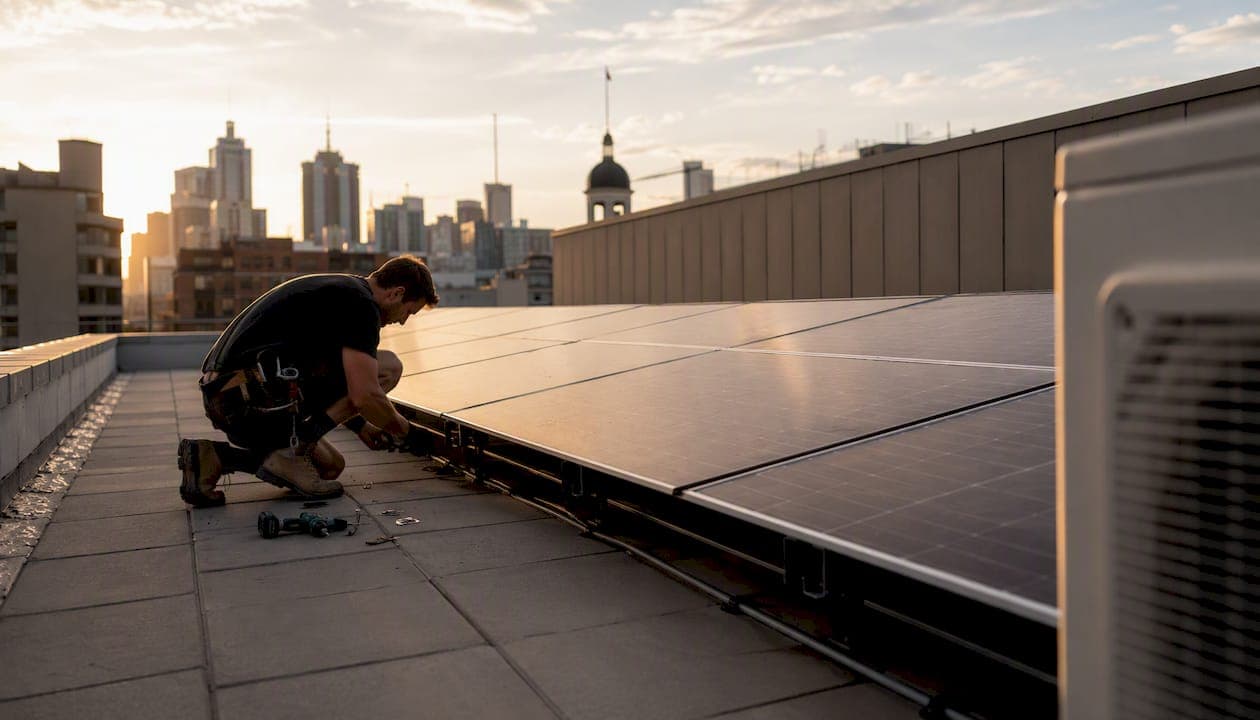
Start with rooftop solar PV and electrify your hot water with commercial heat pumps. Those two moves address the largest energy loads in most Australian hotels and deliver the clearest return on investment.
Why these two first? A 2024 MDPI multi-criteria study ranked photovoltaic panels highest across technical, economic and environmental criteria for hotel buildings, with heat pumps scoring second for thermal loads. A separate MDPI literature review found that where policy and incentives supported adoption, hotels achieved energy reductions of around 25%. Australia's solar irradiance and existing incentive landscape make both technologies unusually well-matched to the local context.
What you can do in the next 72 hours:
- Order a preliminary energy audit from a NABERS-accredited assessor or a commercial energy consultant
- Pull 12 months of interval meter data from your energy retailer and calculate your kWh per occupied room night
- Walk your roof with a structural engineer or solar installer to assess usable area, shading and load-bearing capacity
- Contact a local commercial installer (Melbourne Energy Group covers Victoria) to request a no-obligation feasibility scope
Pro Tip: Before you call an installer, know your peak demand charge on your electricity bill. Demand charges often represent a large proportion of a hotel's electricity cost and a correctly sized battery system can cut them significantly, changing the payback calculation entirely.
Key takeaways
Rooftop solar PV paired with commercial heat pumps for hot water is the highest-impact starting point for renewable energy in Australian hotels, with storage or a PPA as the logical next stage once baseline data is established.
| Point | Details |
|---|---|
| Start with the audit | Measure kWh per occupied room night and identify your top five loads before committing to any technology. |
| Electrify hot water first | Replacing gas hot water with heat pumps removes scope 1 emissions and improves PV payback in subsequent stages. |
| PV and BESS sequencing | Install PV sized to daytime load; add battery storage after 12 months of generation data unless outage resilience is urgent. |
| Use Australian incentives | SRES, CEFC green loans and ARENA grants reduce capital cost; NABERS and Green Star ratings support corporate booking revenue. |
| Altohotel leads by example | As one of Melbourne's first environmentally rated hotels, Altohotel demonstrates that boutique CBD properties can achieve verified sustainability credentials. |
Table of Contents
- How does a hotel implement renewable energy step by step?
- Which renewable technologies suit Australian hotels best?
- How do grid connection and storage affect your project?
- What financing options are available to Australian hotels?
- How do you measure and certify renewable energy performance?
- What can other boutique hotels learn from Alto Hotel on Bourke?
- What does a 6–18 month pilot look like in practice?
- What should you actually prioritise first?
- Altohotel: where Melbourne's sustainability commitment is already built in
- Sources
How does a hotel implement renewable energy step by step?
The Melbourne Energy Group's 10-step hospitality guide provides a practical template for Australian venues. The following roadmap adapts that framework for hotel-specific procurement, with decision gates and indicative timelines at each stage.
Step 1: Energy audit and baseline measurement
Measure kWh per occupied room night, split thermal versus electrical loads, and identify your top five energy consumers. Most hotels find hot water, HVAC and lighting account for over 70% of consumption. This audit typically costs several thousand dollars and takes a few weeks.
Step 2: Define your goals
Are you targeting a NABERS Energy rating improvement, net-zero by a specific year, or simply fossil-fuel removal from hot water? Goals drive technology selection. A hotel chasing a 5-star NABERS rating needs a different configuration than one trying to eliminate gas bills.
Step 3: Site assessment
Assess roof area, structural load capacity, shading from adjacent buildings, orientation, and the condition of your existing hot-water plant. For CBD hotels, façade-integrated PV (BIPV) and carpark canopies are worth scoping if roof space is limited.
Step 4: Technology shortlist
Match technologies to your hotel type. Urban boutique properties typically suit rooftop PV plus heat pumps. Full-service city hotels add BESS for demand management. Resorts and regional lodges may have ground-mount PV options and stronger cases for solar thermal.
Step 5: Options analysis
Compare on-site ownership, a PPA (where a third party owns and operates the system), a green tariff from your retailer, or a hybrid. Score each option against your goals, payback tolerance, balance-sheet constraints and operational complexity. A simple weighted scorecard prevents the analysis from stalling.
Step 6: Commercial model and financing
Map capex, lease, green loan, energy-as-a-service and PPA structures against your cashflow. Australian funding channels include the Australian Renewable Energy Agency (ARENA), the Clean Energy Finance Corporation (CEFC) green loans, and the Clean Energy Regulator's Small-scale Renewable Energy Scheme (SRES) for systems under 100 kW. Larger systems access the Large-scale Renewable Energy Target (LRET) via Large-scale Generation Certificates (LGCs).
Step 7: Procurement and contractor selection
Issue a request for proposal covering system design, performance warranties, operations and maintenance (O&M) terms, insurance, commissioning milestones and handover documentation. Require Clean Energy Council (CEC) accreditation for installers and designers.
Step 8: Installation and commissioning
Sequence installation to minimise guest disruption. Roof work during low-occupancy periods, electrical switchboard upgrades during planned maintenance windows. Commission with a formal test plan that includes islanding protection checks and metering verification.
Step 9: Monitoring, verification and energy management
Install sub-metering at the generation, storage and load level. Connect to an energy management system (EMS) that reports in real time and flags anomalies. Set a monthly reporting cadence for ownership and a quarterly review against baseline KPIs.
Step 10: Staff training, guest communication and continuous optimisation
Train facilities staff on system operation, fault response and escalation. Brief front-of-house teams so they can answer guest questions accurately. Review performance data quarterly and adjust setpoints, schedules and tariff structures as your retailer's rates change.
Indicative timeline and cost bands:
| Phase | Typical duration | Indicative cost range |
|---|---|---|
| Audit and feasibility | 4–8 weeks | $2,000–$8,000 |
| Design and procurement | 8–16 weeks | Several thousand dollars |
| Installation (rooftop PV, 100 kW) | 2–4 weeks | tens of thousands of dollars |
| BESS addition (50 kWh) | 2–4 weeks | tens to hundreds of thousands of dollars |
| Heat pump hot-water system | 1–3 weeks | tens of thousands of dollars |
| Commissioning and handover | 2–4 weeks | Included in above |
Costs are indicative ranges for Australian commercial projects and vary by site complexity, grid connection requirements and equipment specification.
Pro Tip: Build a contingency into every cost estimate for grid-connection works. Distribution network service providers (DNSPs) in Australia often require switchboard upgrades or protection relay changes that are not visible until the connection application is lodged.
Which renewable technologies suit Australian hotels best?
Technology selection is a systems decision. Research using AHP and VIKOR multi-criteria methods consistently places PV and heat pumps at the top for hotel applications, but the right configuration depends on your building type, load profile and local climate.
Solar photovoltaic (rooftop, carport, BIPV)
Australia's solar resource is among the strongest in the world. A north-facing rooftop system in Melbourne yields roughly 1,300–1,400 kWh per installed kW per year; Brisbane and Perth yield 1,500–1,700 kWh. Maintenance is low: annual cleaning and a five-yearly inverter inspection. The main constraint in CBD hotels is roof area competing with HVAC plant, cooling towers and access routes.
Battery energy storage systems (BESS)
BESS solves the solar-hotel mismatch: hotels consume heavily in the evening when PV output is zero. A correctly sized BESS stores midday generation and dispatches it during the dinner service and overnight. Beyond self-consumption, batteries cut demand charges by capping peak draw from the grid. Safety and insurance requirements for lithium-ion systems in occupied buildings are tightening; confirm your insurer's requirements before specifying chemistry and location.
Heat pumps and solar hot water
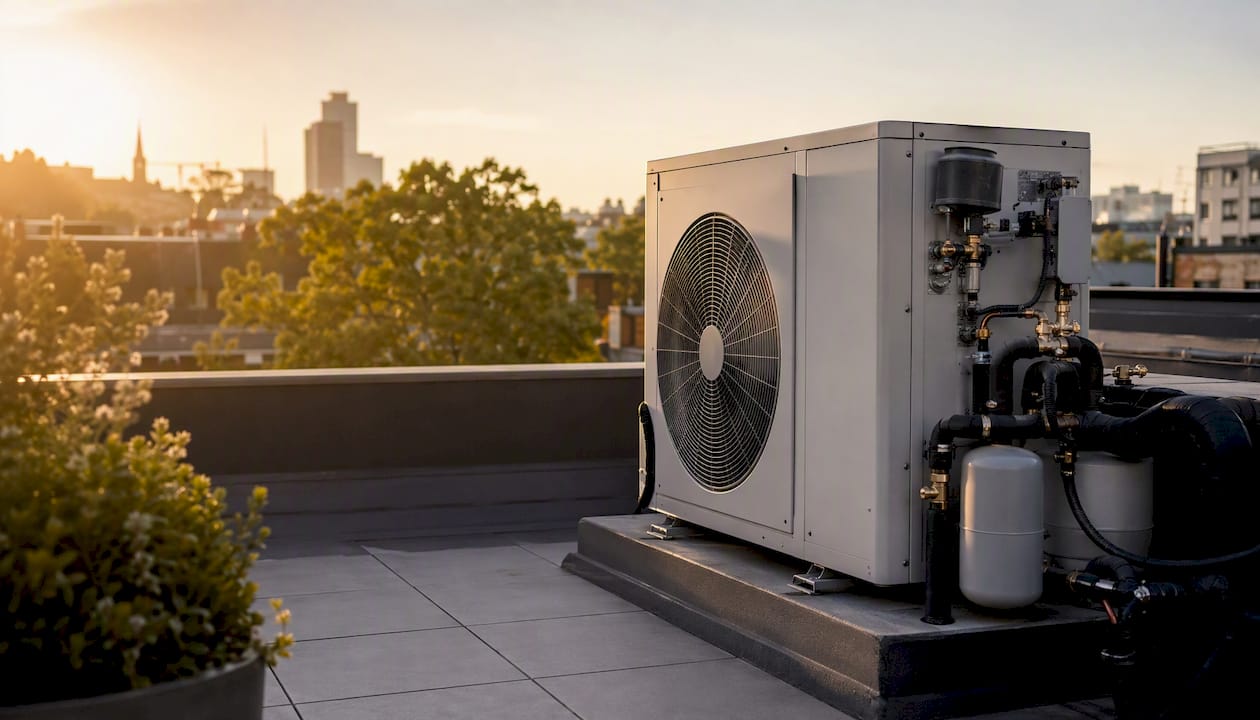
Water heating is often the single largest energy drain in a hotel, and it runs on gas in most Australian properties. Replacing gas hot-water systems with commercial heat pumps is the fastest route to fossil-fuel removal and pairs directly with rooftop PV. A heat pump draws roughly one unit of electricity for every three to four units of heat delivered, making it three to four times more efficient than a gas boiler at the point of use. Solar thermal collectors can supplement heat-pump systems in resorts with large roof areas and consistent hot-water demand, though the economics for urban hotels usually favour heat pumps alone.
Solar thermal and absorption chillers
For high-cooling-demand properties (large resorts, convention hotels), solar thermal driving an absorption chiller can reduce electrical cooling loads. The capital cost is higher and the technology requires specialist maintenance. Most urban boutique hotels are better served by high-efficiency electric chillers powered by PV.
Small-scale wind, biomass and hydro
These are niche options for most Australian hotels. Wind requires exposed sites with consistent resource, rare in urban settings. Biomass can work for remote or alpine properties with reliable local fuel supply; a BBC Travel feature on an Austrian alpine hotel illustrates how a 300-year-old property converted local timber to wood gas for electricity and heat, but that model depends on cultural fit and local regulation. Micro-hydro suits remote lodges near reliable waterways.
Energy management systems and sub-metering
An EMS ties everything together. It controls when the battery charges and discharges, adjusts HVAC setpoints based on occupancy, and provides the metered data NABERS assessors need. Without sub-metering at the generation and load level, you cannot verify savings or satisfy certification requirements.
Suitability by hotel type
| Hotel type | Primary fit | Secondary fit | Lower priority |
|---|---|---|---|
| Urban boutique (CBD) | Rooftop PV, heat pumps | BESS, EMS | Wind, biomass |
| Full-service city hotel | Rooftop PV, heat pumps, BESS | EV chargers, solar thermal | Biomass, hydro |
| Resort (coastal/regional) | Ground-mount PV, heat pumps | Solar thermal, BESS | Wind (site-dependent) |
| Remote/regional lodge | Ground-mount PV, BESS | Biomass, micro-hydro | Grid-tied solar thermal |
Pro Tip: Size your PV system for your daytime load, not your total daily consumption. Oversizing to export is rarely economic for hotels under current Australian export tariff structures. Add BESS in a second stage once you have 12 months of generation data.
How do grid connection and storage affect your project?
Grid integration is where many hotel renewable projects stall. Understanding the rules early prevents costly redesigns.
Connection constraints and DNSP engagement
Every Australian state has a distribution network service provider (DNSP) that governs how much power you can export and what protection equipment your system needs. Export limits vary by feeder capacity and can be as low as zero in some inner-city Melbourne feeders. Engage your DNSP at the feasibility stage, not after you have signed a contract. The connection application process typically adds 8–16 weeks to a project timeline.
BESS versus PPA for balancing and resilience
A BESS provides on-site resilience: it can ride through short outages and protect critical loads (reception, lifts, refrigeration) during grid interruptions. A PPA provides volume coverage but no physical resilience. For hotels where a power outage means guest safety and reputational risk, a BESS sized to cover critical loads for two to four hours is worth the capital cost. For hotels primarily focused on cost reduction and carbon claims, a PPA or green tariff may deliver faster payback.
Peak shaving, load-shifting and blackout ride-through
A well-configured EMS can shave peak demand by discharging the battery when grid draw approaches the demand threshold on your tariff. Load-shifting moves flexible loads (laundry, pool heating, EV charging) to periods of high PV output. Blackout ride-through requires islanding capability, which adds cost and requires specific protection relay settings approved by your DNSP.
EV charging integration
EV chargers add a significant and variable load. Managed charging (smart chargers that respond to EMS signals) prevents EV charging from triggering demand charges or depleting the BESS during peak periods. Plan EV charging infrastructure at the same time as PV and BESS to avoid switchboard upgrades twice.
Grid-scale battery projects like the Mortlake 300 MW / 650 MWh BESS developed by Hitachi Energy and AusNet demonstrate that Australia's grid is actively building the storage backbone that makes distributed hotel renewables more viable. As grid stability improves through projects like Mortlake, the export and connection constraints that currently limit hotel PV systems are likely to ease over the coming years.
Operational checklist for DNSP engagement:
- Confirm export limit and protection requirements with your DNSP before system design is finalised
- Lodge a connection application early; allow 8–16 weeks for approval
- Specify AS/NZS 4777.2-compliant inverters (grid protection standard)
- Confirm metering configuration with your retailer before commissioning
- Test islanding protection and anti-islanding settings at commissioning with DNSP sign-off
What financing options are available to Australian hotels?
The financing gap is the most common reason hotel renewable projects stall after feasibility. The good news is that Australia has more routes to close that gap than most hotel managers realise.
Commercial structures
Direct capex gives you full ownership, maximum long-term savings and the ability to claim LGCs or STCs. It requires upfront capital and sits on the balance sheet.
Leasing and energy-as-a-service move the asset off balance sheet. A third party owns and maintains the system; you pay a fixed monthly fee. Savings are lower but the risk transfer can suit hotels with constrained capital or upcoming refurbishments.
PPAs are contracts where a developer installs and owns the system on your roof or at a remote site and sells you the output at an agreed rate, usually below your grid tariff. A PPA requires a long-term commitment (typically 10–20 years) and careful review of performance guarantees and exit provisions.
Green tariffs from retailers are the simplest entry point: you pay a premium for electricity matched to renewable generation certificates. No capital required, but no on-site resilience and no direct ownership of generation assets.
Australian funding channels
- ARENA (Australian Renewable Energy Agency): grant funding for projects with innovation or demonstration value; hotels with novel configurations or precinct-scale projects are eligible
- CEFC (Clean Energy Finance Corporation): concessional green loans for commercial buildings; accessible via partner lenders including major banks
- SRES (Small-scale Renewable Energy Scheme): upfront certificate rebate for systems under 100 kW; reduces installed cost by roughly $300–$500 per kW depending on zone and current STC price
- State government programmes: Victoria's Sustainability Fund and similar state-level programmes periodically offer co-funding for commercial energy upgrades; check current eligibility with your state energy agency
- Green building finance: several major Australian banks offer preferential rates for assets meeting NABERS or Green Star thresholds
Modelling payback
Include non-energy benefits in your model: a sustainable hotel positioning can support higher average daily rates and stronger occupancy from corporate travel programmes that require verified sustainability credentials. Corporate travel policies increasingly specify NABERS ratings or Green Star certification as a condition of preferred-supplier status.
Finance-ready proposal checklist:
- 10-year cashflow model with base, upside and downside energy price scenarios
- Risk allocation table (performance risk, grid-connection risk, technology obsolescence)
- Performance guarantee terms from the contractor (minimum generation, availability)
- Insurance confirmation covering the system and any building modifications
- DNSP connection approval or conditional approval letter
Pro Tip: When approaching the CEFC or a green-loan lender, lead with your NABERS baseline rating and your target rating post-project. Lenders respond to measurable outcomes, and a two-star NABERS improvement is a concrete, verifiable claim that reduces their credit risk assessment.
How do you measure and certify renewable energy performance?
Claims about renewable energy are only as credible as the measurement behind them. Australia has two primary frameworks hotel teams need to understand.
NABERS Energy
NABERS (National Australian Built Environment Rating System) rates a building's actual energy performance on a 1–6 star scale, measured from 12 months of metered data. Renewable generation fed into the building reduces the energy intensity figure and improves the rating. A PPA or green tariff can also contribute, but the rules on what counts and how much vary by agreement type. Engage a NABERS-accredited assessor before you design your system to confirm how your chosen configuration will be treated in the rating calculation.
Green Star
Green Star (administered by the Green Building Council of Australia) awards credits for energy efficiency, renewable generation and carbon reduction. A Green Star rating is typically sought at design or major refurbishment stage, but existing buildings can pursue a Green Star Performance rating. Renewable energy projects can contribute to multiple credit categories.
Carbon accounting: scope 1 and scope 2
Removing gas hot water eliminates scope 1 emissions (direct combustion on site). Switching to renewable electricity reduces scope 2 emissions (purchased electricity). A PPA backed by LGCs can support a scope 2 claim under the GHG Protocol's market-based method, but the certificates must be retired in your name and the agreement must meet additionality requirements. Buying a generic green tariff without retired certificates does not support a robust scope 2 claim under most reporting frameworks.
Minimum metering requirements
- Generation meter at the inverter output (revenue-grade, Class 1.0 or better)
- Import/export meter at the grid connection point
- Sub-meters on major loads (hot water, HVAC, kitchen) for NABERS and Green Star verification
- Monthly data export to your EMS or reporting platform
Suggested KPIs and reporting cadence
- Monthly: kWh generated, kWh imported, renewable fraction (%), demand peak (kW)
- Quarterly: kWh per occupied room night, scope 1 and 2 emissions, NABERS indicative rating
- Annually: full NABERS assessment, LGC retirement confirmation, Green Star credit update, guest-facing sustainability report
The GSTC certification framework provides an internationally recognised layer on top of NABERS and Green Star, giving corporate bookers and eco-conscious guests a verified signal that your sustainability claims are independently assessed rather than self-reported.
What can other boutique hotels learn from Alto Hotel on Bourke?
Altohotel (Alto Hotel on Bourke) sits in Melbourne's CBD and holds the distinction of being one of the first environmentally rated hotels in the city. That history matters for this discussion because it demonstrates what is achievable for a boutique property operating in a dense urban environment with constrained roof space, heritage-adjacent planning considerations and a guest base that expects both comfort and credibility.
For a CBD boutique hotel, the practical renewable and efficiency measures that deliver the most impact are: rooftop PV scaled to available area, LED lighting throughout (typically the fastest payback of any energy measure), smart building controls that adjust HVAC to actual occupancy, and commercial heat pumps replacing gas hot water. Altohotel's partnerships with local artisans and organisations extend the sustainability story beyond energy into procurement and community impact, which matters when communicating with guests and corporate bookers.
The lesson from properties like Altohotel is that sustainability credibility is built incrementally. Start with what you can measure, certify what you can verify, and communicate only what you can substantiate. Guests and corporate buyers are increasingly sophisticated; a NABERS rating or a Green Star Performance certification carries more weight than a self-declared "eco hotel" label.
What other boutique CBD hotels should replicate:
- Pursue a NABERS Energy baseline rating before any capital spend; it tells you where you actually are
- Replace gas hot water with heat pumps as the first major capital project
- Install rooftop PV sized to daytime load, not total consumption
- Retrofit LED lighting with occupancy sensors in corridors and back-of-house
- Train front-of-house staff to explain energy measures accurately to guests
- Publish a brief annual sustainability report with verified metrics, not marketing copy
- Use sustainable hotel business packages to translate energy credentials into corporate booking propositions
The Hotel Marcel case study in the United States shows what full electrification looks like at scale: large rooftop PV, commercial heat pumps across all thermal loads including laundry and kitchens, and utility clean-energy contracts covering the remainder. The financing drew on tax credits, grants and supportive utility programmes. The Australian equivalent draws on SRES, CEFC green loans and ARENA grants. The pathway is comparable; the incentive names differ.
What does a 6–18 month pilot look like in practice?
A pilot project scoped to rooftop PV plus heat-pump hot water is achievable within 18 months from decision to operation. Here is a realistic checklist.
- Month 1–2: Commission energy audit; pull 12 months of interval data; calculate kWh per occupied room night and identify top five loads
- Month 2–3: Define project goals and get owner/board sign-off on budget envelope and acceptable payback period
- Month 3–4: Complete site assessment (roof structural, shading, hot-water plant condition, switchboard capacity)
- Month 4–5: Issue RFP to three to five CEC-accredited installers; evaluate proposals against performance, warranty and O&M terms
- Month 5–6: Select contractor; lodge DNSP connection application; finalise financing (SRES rebate, green loan or PPA terms)
- Month 6–8: Install rooftop PV; commission with DNSP sign-off; verify metering
- Month 8–10: Install commercial heat-pump hot-water system; decommission gas system; verify scope 1 reduction
- Month 10–12: Connect EMS; establish sub-metering; begin monthly KPI reporting
- Month 12–15: Collect 12 months of post-installation data; engage NABERS assessor for updated rating
- Month 15–18: Review performance against goals; model BESS or PPA as next stage; update guest-facing communications
Who to involve at each stage:
- Feasibility and audit: facilities manager, energy consultant, NABERS assessor
- Design and procurement: facilities manager, procurement team, CFO or finance lead
- Installation: facilities manager, contractor, DNSP representative
- Commissioning: contractor, facilities manager, DNSP, insurer
- Operations and reporting: facilities manager, front-of-house manager, sustainability lead
Pro Tip: Schedule the NABERS assessor briefing before you finalise system design, not after. The assessor can tell you exactly which metering points and data formats the rating tool requires, saving you from a costly sub-metering retrofit six months into operation.
Integrating food and lodging operational efficiency into the same planning cycle is worth doing: kitchen energy loads are often underestimated in hotel energy audits, and aligning kitchen equipment upgrades with the PV and heat-pump project can improve the overall system sizing and payback.
What should you actually prioritise first?
Most hotel sustainability leads face the same constraint: a limited budget, a facilities team stretched across competing maintenance priorities, and an ownership group that wants a business case before approving capital. Here is a frank view on sequencing.
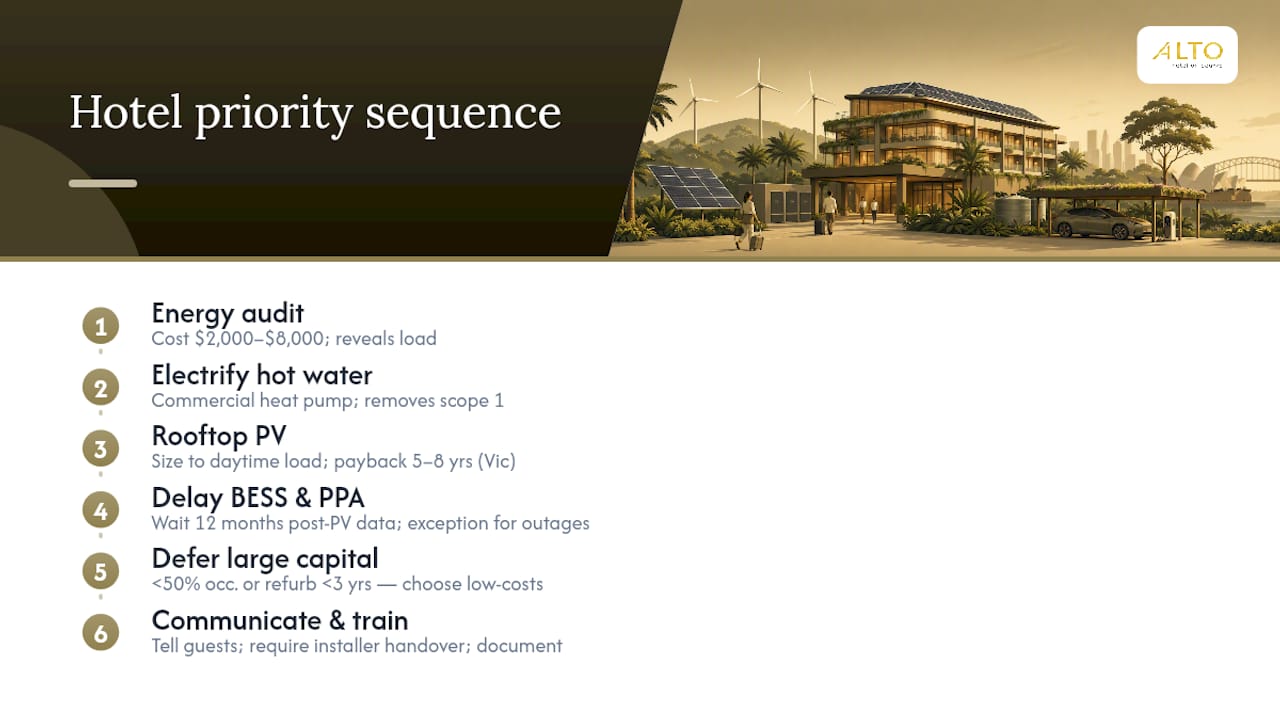
Start with the audit, not the technology. The energy audit is the only thing that tells you where your money actually goes. Hotels that skip this step and go straight to a solar quote often install a system sized for the wrong load profile. Spend the $2,000–$8,000 on the audit first.
Electrify hot water before you add PV. Gas hot water is usually the largest single source of both cost and emissions in an Australian hotel. Replacing it with a commercial heat pump removes a scope 1 emission source entirely and reduces your gas bill to near zero. That saving also improves the payback on subsequent PV investment because the PV now powers the heat pump rather than displacing lower-value grid electricity.
Rooftop PV is your third move, not your first. Once hot water is electrified and you have a clean baseline, size PV to your daytime electrical load. The payback is typically five to eight years for a commercial system in Victoria, shorter in Queensland and Western Australia.
Delay large BESS or PPA decisions until you have data. Storage and long-term PPA contracts are significant commitments. Make them after 12 months of post-PV generation data, not before. The exception is a hotel where grid outages are a genuine operational risk; in that case, a critical-load BESS is worth prioritising alongside PV.
When to defer capital entirely: if occupancy is below 50% for a sustained period, or if a major refurbishment is planned within three years, defer large capital projects and focus on no-cost and low-cost measures: LED retrofits, occupancy-sensor controls, hot-water temperature setpoint optimisation, and a green tariff from your retailer to support scope 2 claims in the interim.
Guest communication during upgrades protects revenue. A brief, honest message ("we are installing solar panels this month to reduce our carbon footprint; access to the rooftop terrace will be limited for two weeks") lands better than silence followed by complaints about noise and disruption. Guests who book eco-friendly accommodations are typically more tolerant of visible sustainability works than the average traveller, and many find it reassuring.
Staff training is the most undervalued part of any renewable project. A heat pump that is incorrectly set by a maintenance contractor unfamiliar with the controls will underperform for years before anyone notices. Build a formal handover session with the installer into your contract, and document operating procedures in plain language for the facilities team.
Altohotel: where Melbourne's sustainability commitment is already built in
If you are researching renewable energy for hotels because you want to stay somewhere that has already done the work, Altohotel is Melbourne's answer. As one of the first environmentally rated hotels in the city, Altohotel has built its guest experience around verified sustainability rather than marketing claims, with eco-conscious materials, partnerships with local artisans, and a Hall of Fame recognition in Victorian tourism.
Guests choosing Altohotel get the benefit of that commitment without the complexity: rooms, studios and two-bedroom apartments designed for eco-conscious travellers who want a genuine Melbourne CBD experience without compromising on comfort or environmental standards. Whether you are a sustainability lead scouting accommodation for a corporate event or a traveller who wants your hotel stay to align with your values, Altohotel offers direct booking with exclusive rates. Check availability and book your stay directly to secure the best rate and support a hotel that takes its environmental rating seriously.
Sources
- Renewable Energy Technology Selection for Hotel Buildings: A Systematic Approach Based on AHP and VIKOR Methods
- This Hotel Runs Entirely on Renewable Energy: Does it Pay Off?
- 10 Step Guide to Renewable Energy for the Hospitality Industry
- Certified sustainable hotels (GSTC)