

NABERS measures how a building actually performs, using 12 months of real energy, water, waste and indoor-air data. Green Star measures broader sustainability outcomes across design, construction, fitout and, through Green Star Performance, ongoing operations. Neither replaces the other. Most Australian building managers end up using both: Green Star to set the ambition, NABERS to prove it's being met, with NABERS data feeding directly into Green Star Performance credits.
TL;DR:
- NABERS provides a real-world measure of building performance based on 12 months of actual energy, water, and waste data, with ratings updated annually.
- Green Star evaluates broader sustainability design and construction criteria using a points system, with ratings that do not expire but are periodically renewed.
- Combining NABERS and Green Star involves aligning performance and rating periods within three months to reduce duplicated efforts and improve data consistency.
- Most successful hotel projects pursue Green Star during design and NABERS after occupancy, with data collection and assessor engagement scheduled sequentially.
- For hotels, NABERS influences operational costs and procurement, while Green Star enhances broader sustainability credentials favored by investors and ESG targets.
Table of Contents
- NABERS vs Green Star: how the two systems actually differ
- How Green Star and NABERS work together on a real project
- What this means for Australian hotels and portfolios
- Your checklist to start or align both ratings
- Why Alto Hotel treats both ratings as operational discipline, not marketing
- The take building managers won't hear from a ratings consultant
- Sources
NABERS vs Green Star: how the two systems actually differ
The confusion usually comes down to timing. NABERS is retrospective, it rates what a building did last year. Green Star is largely prospective, it rates what a building was designed and built to do, then optionally extends into operations through Green Star Performance.
NABERS runs on a 1 to 6 star scale, recalculated annually from metered data. A hotel needs a full 12 months of validated consumption figures before a rating can be issued, and the certificate has a shelf life; you renew it every year to keep it current. Green Star works differently. It uses a points-based credit system across categories like energy, water, materials, indoor environment quality and governance, and the resulting rating (from Green Star Certified up to 6 Star) doesn't expire the same way, though Green Star Performance ratings are renewed periodically to reflect ongoing operational reality.
Who does the assessing also differs. A NABERS rating requires a NABERS accredited assessor to collect and validate the data against the NABERS Energy and Water for Hotels Rules, version 4.3. Green Star ratings go through the Green Building Council of Australia (GBCA), which reviews submitted evidence against its own credit criteria and issues certification.
The overlap that matters most for hotels:
- NABERS Energy and Water ratings can be submitted as evidence for specific Green Star Performance credits.
- The GBCA's own guidance requires the NABERS rated period to sit within three months either side of the Green Star performance period.
- You still need to provide the actual NABERS certificate or report, not just the star number, when making that claim.
A building can hold a 6 Star Green Star Design rating and still perform poorly once occupied if operations don't match the design intent, which is exactly the gap NABERS is built to catch.
How Green Star and NABERS work together on a real project
Sequencing avoids most of the pain. Run through it in this order and the two systems stop competing for your time and start reinforcing each other.
- Design and delivery. Pursue Green Star Design & As Built (or Interiors) to lock in efficient systems, water fixtures, materials and indoor environment targets before the building opens.
- Occupancy and data collection. Once the hotel is trading, start collecting 12 months of clean metered data. This is non-negotiable for a NABERS rating and it also becomes your Green Star Performance evidence base.
- NABERS rating. Engage an assessor, validate the data against the hotel-specific rules, and get your star rating.
- Green Star Performance. Submit the NABERS certificate for the relevant energy and water credits, provided the rated period aligns within that three-month window either side of your Green Star Performance period.
Skipping the sequencing is where most operators lose time. Industry guidance on linking a NABERS programme to Green Star Performance points out that a mature NABERS programme materially reduces duplicated evidence-gathering, because the same metering infrastructure and data governance underpin both submissions.
Pro Tip: Set your NABERS rated period and your Green Star Performance period in the same calendar planning session. Retrofitting alignment after the fact almost always means waiting another 12 months for clean data to line up.
The most common pitfall is treating the two schemes as unrelated paperwork exercises run by different teams. Get your facilities manager and your sustainability consultant talking to the same assessor early, and the evidence maps itself.
What this means for Australian hotels and portfolios
The hotel sector's NABERS uptake tells its own story. In FY24, 90 Australian hotels received a NABERS Energy or Water rating, and the average hotel landed a 4.3-star NABERS Energy rating, a healthy result that puts real pressure on the properties still sitting outside the system.
That uptake isn't happening for its own sake. NABERS ratings feed directly into three commercial levers:
- Operating costs. Verified energy and water performance data exposes waste that would otherwise sit hidden in a utility bill.
- Procurement access. Government employees are required to consider NABERS ratings when booking accommodation, which puts unrated properties at a structural disadvantage for corporate and government bookings.
- Investor and tenant confidence. Portfolio owners increasingly expect a NABERS certificate as standard due diligence, the same way they'd expect a building compliance certificate.
For portfolio managers deciding where to spend limited sustainability budget first, the practical rule is simple: NABERS first if you need to prove current performance for procurement or booking platforms; Green Star Performance if you're also chasing a broader sustainability credential for investors or a corporate ESG target. Most large hotel groups end up doing both, staggered over 12 to 18 months rather than simultaneously. Corporate travel buyers increasingly build sustainability credentials into their travel policies, so a hotel without either rating is quietly filtered out before it's even shortlisted.
Your checklist to start or align both ratings
- Audit your data first. Confirm you have (or can get) 12 months of clean, metered energy and water data, then check the current NABERS Energy and Water for Hotels Rules v4.3 for hotel-specific metering requirements.
- Engage a NABERS accredited assessor early. Get a scope and cost estimate before committing to a rating period; assessor experience with hotel operational profiles varies enough to be worth comparing quotes.
- Map your Green Star Performance credits. Identify which ones accept NABERS evidence and set your performance period with the three-month alignment window built in from day one.
- Feed the findings back into operations. Use the NABERS results to prioritise retrofit spending, whether that's renewable energy infrastructure or simple metering upgrades, and carry that evidence straight into your next Green Star submission.
Pro Tip: Don't wait for a perfect 12-month dataset before talking to an assessor. Most will review partial data and tell you exactly what's missing, which saves months compared to discovering gaps after your reporting period closes.
Why Alto Hotel treats both ratings as operational discipline, not marketing
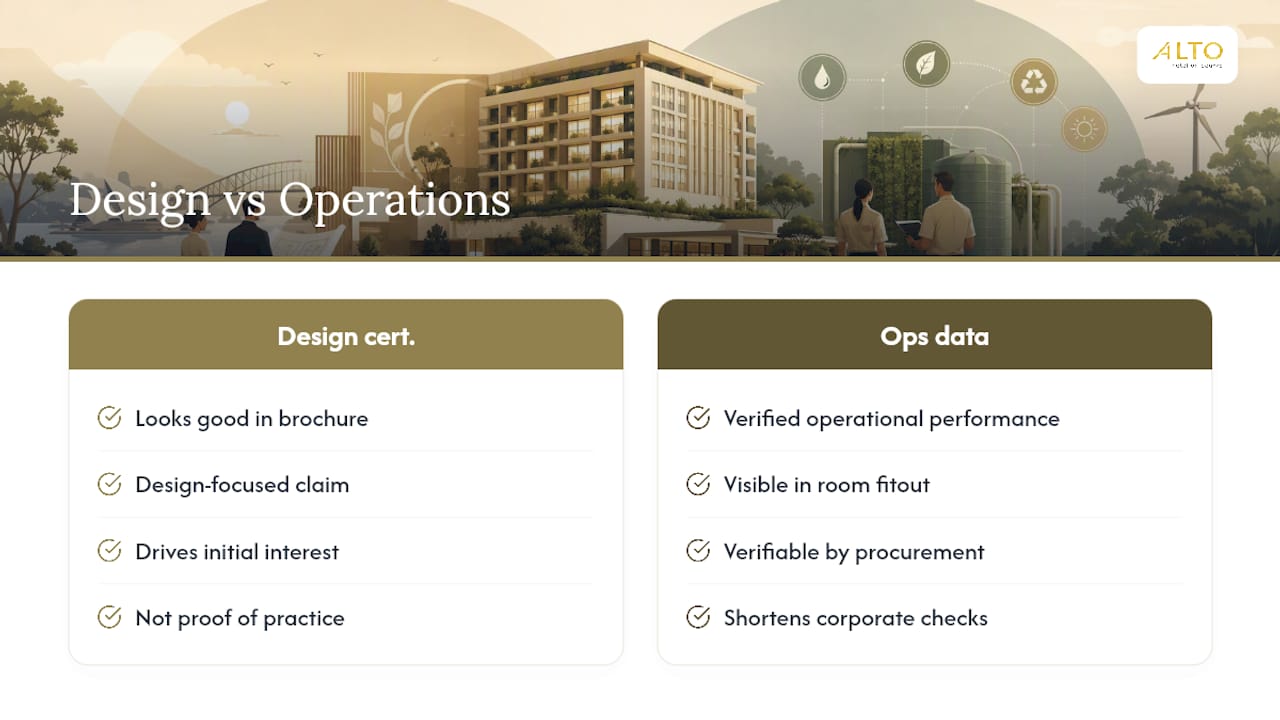
An environmentally rated hotel in Melbourne, and its history shapes how we think about this comparison. A design certificate looks good in a brochure. What actually changes a guest's stay, and what procurement teams actually check, is verified operational performance. That's why we treat sustainability as something guests can see in the room fitout and something corporate bookers can verify on paper. When a corporate travel manager asks for evidence, having both the design credentials and the operational data ready shortens that conversation considerably. Guests booking a Petite Queen room or exploring our boutique rooms and apartments are increasingly asking these exact questions before they book.
The take building managers won't hear from a ratings consultant
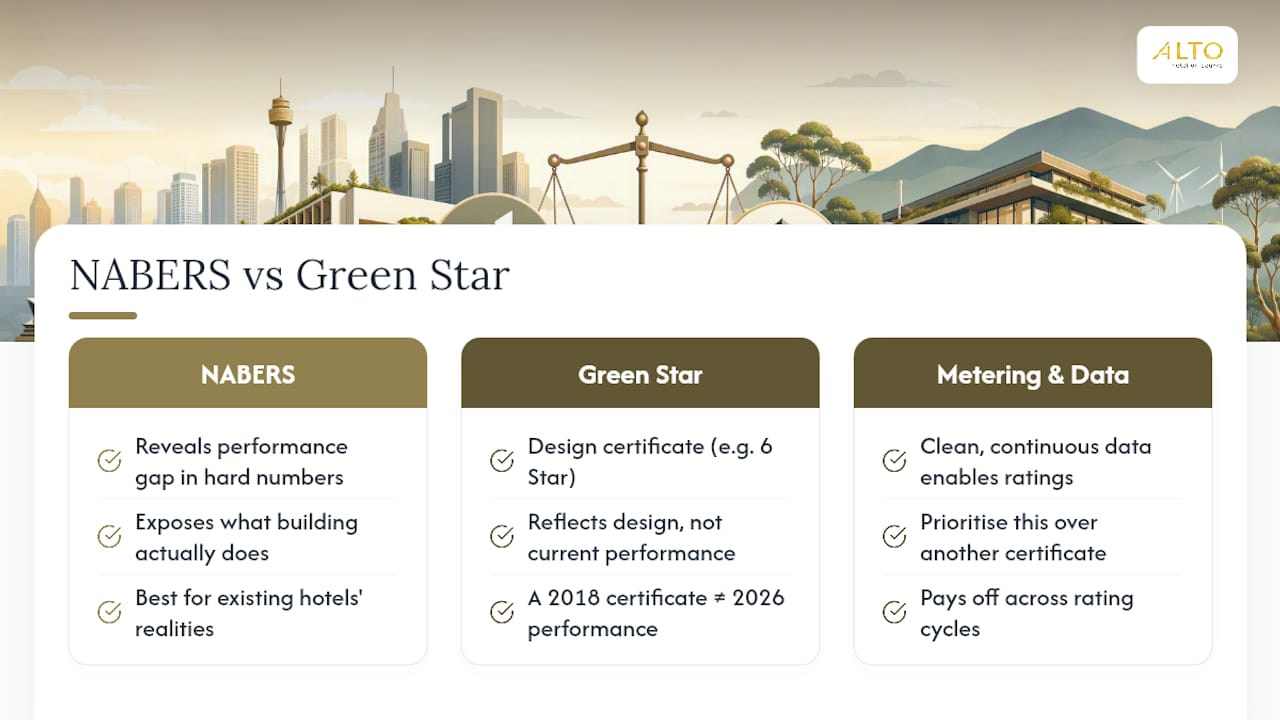
Most advice on this topic treats NABERS and Green Star as a checklist decision: pick one, tick the box, move on. That's backwards. The real judgement call isn't which system to choose, it's which one exposes the gap between what your building was designed to do and what it's actually doing. For most existing hotels, that gap is bigger than owners expect, and NABERS is the only tool that shows it in hard numbers.
Where conventional advice falls short is treating Green Star as the finish line. A 6 Star design certificate earned in 2018 tells you nothing about performance in 2026. If you're prioritising one thing this year, make it your metering and data governance, not another design credential. Clean, continuous data is what makes both ratings possible, and it's the one asset that keeps paying off, rating cycle after rating cycle, long after the certificate's been framed and hung in the lobby.
— Kamal
Sources
- Green Star FAQs - Green Building Council Australia (GBCA)
- NABERS Energy and Water for Hotels Rules | NABERS