
For a stay of a month or longer, five categories cover almost every situation: serviced apartments and aparthotels, extended-stay or residential hotels, furnished short-term rentals, house or flat-shares, and corporate housing. For most people planning a month-plus stay in Melbourne, a serviced apartment or eco-conscious aparthotel offers the best balance of cost, convenience, and comfort, because it comes fully furnished with hotel-grade support but without a lease. The City of Melbourne's own guide to temporary accommodation lists hotels, serviced apartments, and short-term private rentals as the standard local options, and demand shifts noticeably around the city's major event calendar.
- Serviced/aparthotel: hotel service plus kitchen, best for convenience seekers
- Extended-stay/residential hotel: apartment-style suites with weekly rates
- Furnished rental: more space, lower cost, less flexibility
- House/flat-share: cheapest option, least privacy
- Corporate housing: employer-arranged, ideal for relocations
Pro Tip: Book direct with the property wherever possible. It's often the difference between a rigid seven-night minimum and a host who'll happily negotiate a five-week stay.
Key Takeaways
For month-plus stays, serviced apartments and eco-conscious aparthotels typically deliver the strongest balance of cost, flexibility, and comfort compared with hotels or private rentals.
| Point | Details |
|---|---|
| Match type to trip length | Aparthotels suit flexible stays; furnished rentals suit fixed month-plus commitments. |
| Compare true cost, not headline rate | Confirm who pays utilities and whether cleaning is included before booking. |
| Book direct when possible | Direct bookings often unlock better rates and easier modification terms. |
| Check the calendar | Public holidays and major events push demand and prices up around those dates. |
| Consider Altohotel for Melbourne stays | Alto Hotel on Bourke offers eco-certified studios and apartments with kitchens and direct-booking flexibility. |
Table of Contents
- Comparing long stay accommodation choices at a glance
- What each long-stay accommodation type actually offers
- How do you choose the right long-stay option?
- What do long stays typically cost, and how long do people book for?
- Where to search for long stay accommodation
- Why an eco-conscious boutique aparthotel suits longer stays
- Book a studio or apartment that's built for longer stays
- Sources
Comparing long stay accommodation choices at a glance
Here's how the five main categories stack up against the things that actually matter when you're staying somewhere for weeks rather than nights.
| Dimension | Serviced/Aparthotel | Extended-Stay Hotel | Furnished Rental | House/Flat-Share | Corporate Housing |
|---|---|---|---|---|---|
| Typical cost | Nightly or weekly rates vary by property | Nightly rates with monthly discounts offered | Weekly rates typical | Weekly rates typical | Prices set by employer or contract |
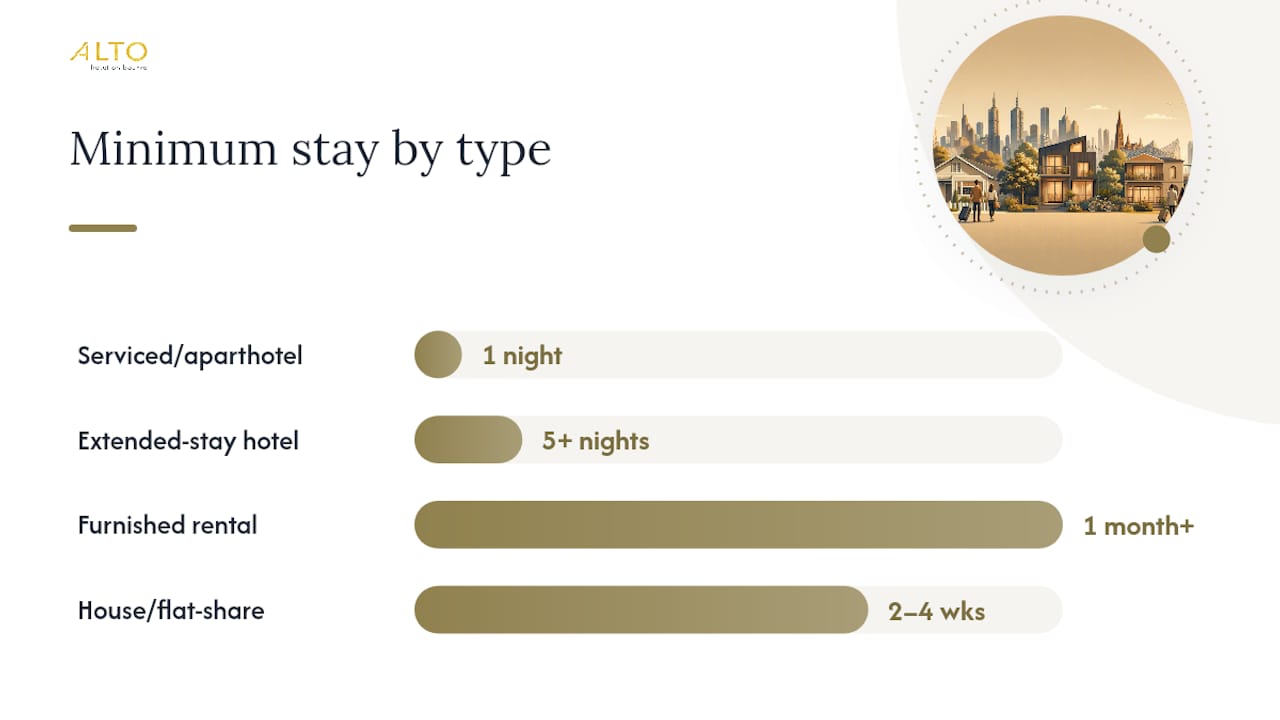
| Minimum stay/notice | 1 night, best rates from 7+ | Often 5+ nights | Usually 1 month+ | Varies, 2–4 week notice common | Set by employer contract |
| Included amenities | Kitchen, Wi-Fi, cleaning, laundry | Kitchenette, Wi-Fi, some cleaning | Kitchen, Wi-Fi, no cleaning | Shared kitchen, Wi-Fi | Fully furnished, utilities often included |
| Space & privacy | Studio to 2-bedroom, private | Studio suites, private | Full apartment, private | Shared common areas | Private, apartment-style |
| Best for | Business travellers, couples | Longer solo stays, projects | Families, budget-conscious groups | Students, solo budget travellers | Relocating employees |
A few things jump out once you line these up side by side:
- Cleaning and laundry are the first amenities to disappear as price drops, so factor in your own time cost.
- Furnished rentals usually beat aparthotels on space per dollar but rarely offer daily service or a front desk.
- House-shares are cheapest but the trade-off is privacy, not just price.
- Corporate housing sidesteps most of this comparison entirely since the employer sets the terms.
What each long-stay accommodation type actually offers
Serviced apartments and aparthotels blend hotel infrastructure with a full kitchen and living space. Expect daily or scheduled housekeeping, front-desk support, and often a gym or parking. Downsides: nightly rates can look steep before you factor in the weekly discount, and some buildings feel more corporate than homely. Best suited to business travellers, couples, and anyone who wants convenience without sacrificing space.

Extended-stay or residential hotels sit close to aparthotels but usually skew toward longer, less flexible bookings. Sonesta's extended-stay format, for example, pairs kitchen facilities with weekly and monthly rate tiers built specifically for guests staying a while. These properties often skip strict maximum-stay caps, which makes them a genuine option for open-ended work projects.
Furnished short-term rentals trade hotel services for space and cost savings, particularly for families or small groups. Expect a full apartment or house, but no daily cleaning, no front desk, and a lease-style agreement rather than a nightly rate. Some residence operators, such as the long-stay model used by Terres de France, offer terms from 30 nights up to 11 months with flexible termination clauses, which is worth knowing exists even outside that specific market.
House or flat-shares are the budget play. Bathrooms and kitchens are shared, bond and notice terms mirror standard tenancy law, and the social trade-off suits students or solo travellers more than families.
Corporate housing is arranged by an employer for relocation or project work, typically fully furnished with utilities bundled in. Pro Tip: If your employer offers corporate housing, ask specifically whether utilities and internet are included in the headline rate. It rarely is stated up front.
How do you choose the right long-stay option?
Work through this before you commit to anything:
- How long am I actually staying, and could that change?
- What's my weekly or monthly budget, all-in?
- Do I need a dedicated workspace and reliable Wi-Fi?
- How much storage or luggage space do I need?
- Do I need parking, and is it included or extra?
- Am I travelling with a pet?
- What's the neighbourhood like for transport, groceries, and daily life?
Before signing anything, ask the host or property directly:
- What's the exact notice period if I need to leave early?
- Which bills, if any, are included in the rate?
- How often is cleaning provided, and can I opt out for a discount?
- What security measures are in place (locks, building access, cameras)?
- Is there a guest policy I need to know about?
Watch for red flags: no written agreement, vague or unstated cancellation terms, a price that seems too good against comparable listings, or a listing that can't tell you basic Wi-Fi speed. If you're between homes or downsizing for the move, self-storage providers are a practical way to keep belongings accessible without cramming them into a temporary space.
What do long stays typically cost, and how long do people book for?
Pricing almost always improves as the booking period stretches.
- Aparthotels: typically booked from a week up to a few months
- Extended-stay hotels: often a month or more, sometimes open-ended
- Furnished rentals: almost always a month minimum, sometimes longer
- House-shares: flexible, from a few weeks to many months
Prices also move with the calendar. Victoria's public holiday schedule and the city's major events both push demand and rates up around those dates, so booking outside peak periods, or well ahead of them, protects your budget. Beyond the headline rate, check who pays utilities, whether cleaning is extra, and what the deposit covers. That detail alone can shift the real cost of a stay by hundreds of dollars a month.
Where to search for long stay accommodation
Start with official hotel and aparthotel websites for the most accurate availability and any direct-booking perks. From there:
- Extended-stay booking pages, like Travelocity's extended-stay hotel listings, which show weekly and monthly rates clearly
- Mainstream OTAs, filtered for weekly/monthly pricing
- Furnished-rental platforms for house or apartment-style bookings
- Local council or tourism accommodation pages for verified options
- Self-storage providers if you need overflow space during the move
Booking direct tends to unlock better rates and more flexible modification terms than third-party platforms, which matters if your plans shift mid-stay. For a practical walkthrough, see this guide on booking an extended stay eco apartment.
Why an eco-conscious boutique aparthotel suits longer stays
Eco-certified boutique aparthotels solve a problem most long-stay guests don't realise they have until they hit it: generic serviced apartments can feel sterile, while budget rentals rarely include real hospitality support. A boutique property with sustainability credentials gives you both the practical infrastructure (kitchen, workspace, laundry access) and a sense of place, often through partnerships with local artisans and businesses.
A guest settling in for five weeks of remote work might use a studio apartment to cook most meals, run a proper workspace by day, handle laundry on-site, and store luggage securely between short trips out of the city, all without leaving a hotel-grade support network behind.
What this style of stay typically adds over a standard rental or generic hotel:
- On-site staff for issues that would otherwise mean a landlord phone call
- Sustainable materials and practices, appealing if that matters to you
- Community and local artisan partnerships that add texture to a long stay
- Apartment-style rooms with kitchens, similar in spirit to the suites offered by Zoku in Copenhagen, designed for guests to "unpack and start living" rather than just pass through
A quick perspective on trade-offs
The trade-off most people underestimate isn't cost versus convenience, it's community versus control. A house-share gives you people; a serviced apartment gives you predictability. Neither is wrong, but know which one you're actually optimising for. [Author's professional background or credentials specific to eco-friendly hospitality or sustainable travel]
Book a studio or apartment that's built for longer stays
Compared with a standard rental lease or a generic extended-stay chain, Altohotel gives you hotel-grade flexibility with none of the bond, utility juggling, or furniture-hunting a private rental demands, in a boutique building recognised as one of Melbourne's first environmentally rated hotels.
Alto Hotel on Bourke's studio and apartment rooms are built with exactly this kind of stay in mind: in-room kitchen facilities, secure parking, free Wi-Fi, and eco-conscious materials throughout, backed by a Hall of Fame recognition in Victorian tourism. The Studio King Plus suits couples or business travellers wanting extra space, while the Petite Queen is a smart, efficient option for solo guests settling in for a month or more. Direct bookings come with clear cancellation terms and exclusive offers you won't find through third-party platforms. Check current availability and rates for your dates on the Alto Hotel on Bourke website.