

Choosing to use public transport from a boutique hotel is the most practical and eco-friendly way to explore a city on your own terms. Public transit, the industry term for bus, tram, train, and metro networks, puts local neighbourhoods within reach without the cost of taxis or the hassle of parking. Boutique hotels are frequently positioned close to major transit stops, with some properties sitting within 50–60 metres of the nearest bus or tram connection. Altohotel, Melbourne's award-winning eco-friendly boutique property, is a strong example of this model in action. Getting around from boutique accommodation is straightforward when you know what to look for before you leave your room.
How to use public transport from a boutique hotel
The first step is knowing what transit options exist within walking distance of your hotel. Most boutique properties in city centres sit near at least one bus route, tram line, or train station. Boutique hotels near transit reduce your travel time to key landmarks significantly, often placing you within a short walk of frequent services.

Check proximity before you arrive
Use Google Maps or your city's official transit authority website to identify the nearest stops before check-in. Look for stops within a five-minute walk and check how frequently services run during the hours you plan to travel. A stop that runs every 30 minutes is fine for a leisurely morning, but not ideal if you need to catch a timed event.
Evaluate routes, not just stops
A stop close to your hotel means nothing if the route does not go where you want. Map out two or three key destinations, such as a local market, a gallery, or a waterfront precinct, and confirm which lines connect them. Local hidden gems near boutique hotels are often best reached by tram or bus rather than train.
Here are the key factors to evaluate when assessing public transit options near your hotel:
- Frequency: Services running every 10–15 minutes give you flexibility. Anything less than every 30 minutes requires careful planning.
- Operating hours: Check first and last service times, especially for evening outings.
- Accessibility: Confirm whether stops involve stairs, steep ramps, or long footpaths, particularly if you are travelling with luggage.
- Ticketing: Know whether the route accepts contactless payment, a travel card, or cash only.
- Real-time tracking: Many transit authorities offer apps or SMS services for live departure times.
Pro Tip: Ask your hotel concierge which transit app locals actually use. Official apps vary widely in quality, and a concierge who knows the city will point you to the most reliable one.
Step-by-step guide to getting around by public transit
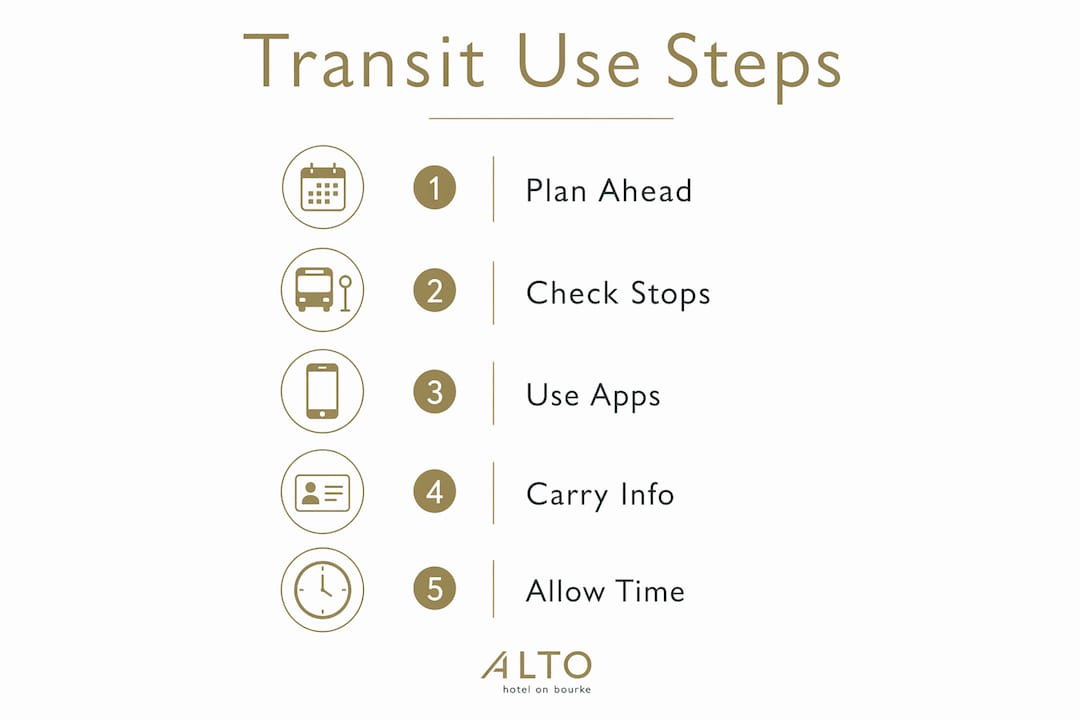
Planning your trip before you leave the hotel saves time and reduces stress on the ground. Follow these steps for a smooth experience.
-
Check routes to your destination. Open your city's official transit app or website and enter your hotel address as the starting point. Note the line number, direction, and any transfers required.
-
Buy your ticket or travel card in advance. Most cities offer a reloadable travel card, such as Melbourne's Myki, that works across buses, trams, and trains. Contactless bank cards are accepted on many networks. Paper tickets cost more per trip and require exact change on some services.
-
Arrive at the stop with time to spare. Aim to reach your stop two to three minutes before the scheduled departure. Check the destination board or display screen to confirm the service. On trams and buses, board through the front door unless the driver signals otherwise.
-
Handle transfers confidently. On multi-leg trips, note the transfer stop name and the line you need to board next. Give yourself at least five minutes between connections. If a service is delayed, check the real-time app rather than waiting and hoping.
-
Return to your hotel without stress. Save your hotel's address and nearest transit stop in your phone before you leave. If you are out late, check the last service time for your route. Many city networks reduce frequency after 9PM, so plan your return accordingly.
Cost is worth factoring in from the start. Comparing transit options by total cost, including waiting time and convenience, gives you a clearer picture than looking at ticket price alone. For solo travellers, public transit almost always wins on cost. For groups of three or more, a taxi or rideshare can sometimes match or beat the combined ticket price.
Pro Tip: Carry a printed card with your hotel's address and the nearest transit stop name. If you get turned around, any local can point you in the right direction without needing a shared language.
Common challenges when using public transit from boutique hotels
Public transport is not without friction. Knowing the likely problems in advance means you can plan around them rather than scramble on the day.
The final-mile challenge is the most underestimated obstacle. A transit stop that looks close on a map can feel very different when you are carrying a 20-kilogram suitcase up a flight of stairs or crossing a busy road without a pedestrian crossing. A 500-metre walk with heavy luggage can triple your actual travel time. Plan your luggage strategy before you commit to a transit route.
Here are the most common issues travellers encounter, and how to handle each one:
- Infrequent late-night services: Many city networks cut to hourly or less after 10PM. Check the timetable for your return trip before you head out for the evening.
- Complex intermodal connections: Switching between bus, train, and tram networks can be confusing in an unfamiliar city. Stick to routes with one transfer maximum until you know the network.
- Digital map errors: Relying solely on digital maps can mislead you in cities with unusual pedestrian layouts or restricted access zones. Always cross-check with the transit authority's own app.
- Unexpected disruptions: Track maintenance, special events, and weather can cancel or reroute services without much notice. Check the transit authority's social media or app alerts on the morning of travel.
- Group cost creep: For small groups, multiple transit tickets can add up to more than a shared taxi fare. Run the numbers before assuming public transit is cheaper.
"The best transfer option is rarely the cheapest upfront. Weighing luggage, waiting time, and arrival circumstances gives you a far more accurate picture of what each option actually costs."
Hotel concierges are the most underused resource for transit advice. They know about current disruptions, local ticketing quirks, and which routes are genuinely reliable versus which ones look good on paper. A two-minute conversation at the front desk can save you an hour of confusion.
Pro Tip: Build an extra 15 minutes into any trip involving a transfer or a walk with luggage. Public transit rewards patience, not rushing.
Sustainable travel benefits of public transit from boutique hotels
Choosing public transit over a private car or taxi reduces your carbon footprint in a measurable way. Buses and trains carry far more passengers per kilometre than any private vehicle, which means each individual journey contributes far less to urban emissions and traffic congestion.
Boutique hotels near transit hubs actively support this model by positioning guests to travel sustainably from day one. Altohotel, recognised in the Victorian tourism Hall of Fame, is built around this principle. Its location in Melbourne's CBD places guests within easy reach of tram and train connections, making car-free exploration a genuine option rather than an aspiration.
Public transit also delivers an experience that private transport cannot. Sitting on a tram through a neighbourhood you would otherwise drive past gives you a ground-level view of local life. You notice the cafés, the street art, the rhythms of a place. That kind of immersion is exactly what travellers staying in boutique accommodation are seeking.
| Travel mode | Carbon impact | Cost (solo) | Local experience |
|---|---|---|---|
| Public transit | Low | Low | High |
| Rideshare | Medium | Medium | Low |
| Private taxi | Medium to high | High | Low |
| Rental car | High | High | Low |
Affordability is another advantage. Solo travellers and pairs consistently save money on public transit compared to taxis, and those savings compound across a multi-day stay. For travellers who want to access local markets and authentic neighbourhood experiences, transit is the obvious choice.
Key takeaways
Staying at a boutique hotel near a transit hub is the single most effective way to combine sustainable travel with genuine local exploration.
| Point | Details |
|---|---|
| Transit proximity matters | Choose boutique hotels within a five-minute walk of a frequent bus, tram, or train stop. |
| Plan before you leave | Check routes, timetables, and ticketing options from your hotel room before heading out. |
| Final-mile planning | Account for luggage and walking distance when assessing whether a transit route is practical. |
| Use your concierge | Hotel concierges offer real-time, local transit knowledge that no app can fully replicate. |
| Groups need a cost check | For three or more travellers, compare combined transit ticket costs against a shared taxi fare. |
What I have learned from years of transit travel
Public transit is one of those things that rewards preparation and punishes assumptions. The travellers I have seen struggle most are the ones who check the map once, assume the route is straightforward, and then discover at the stop that the service only runs twice an hour or that the entrance involves three flights of stairs with no lift.
My strongest advice is to treat your hotel concierge as a local expert, not just a booking desk. I have had concierges in cities across Australia and Europe flag disruptions that were not yet showing in any app, suggest a parallel route that saved 20 minutes, and recommend the exact travel card that avoided a surcharge I would never have known about. That kind of knowledge is not searchable.
The other thing I have come to appreciate is the difference between transit for airport arrivals and transit for daily exploration. Boutique hotel guests often prefer a pre-booked transfer for the first leg, when they are tired and loaded with bags, but switch to public transit for everything after that. That split approach is genuinely sensible. Save the taxi for when you need reliability under pressure. Use the tram when you want to feel like you actually live in the city for a few days.
Verify your timetables on the day, not the night before. Services on weekends and public holidays often run to a completely different schedule, and that is the kind of detail that catches people out.
— Kamal
Altohotel: boutique stays with real transit access

Altohotel sits in Melbourne's CBD, one of Australia's most transit-rich city centres, where trams run frequently and train stations are minutes away on foot. As one of Melbourne's first environmentally rated boutique hotels and a Victorian tourism Hall of Fame recipient, Altohotel is built for travellers who want to explore the city without a car. The hotel's concierge team provides practical, up-to-date transit advice tailored to each guest's plans. Whether you are heading to the Queen Victoria Market, the Yarra River precinct, or a neighbourhood café, public transit gets you there directly. Explore Altohotel and find a boutique stay that makes sustainable city travel genuinely easy.
FAQ
How close should a boutique hotel be to a transit stop?
A boutique hotel within a five-minute walk of a frequent transit stop gives you practical, daily access to public transport. Some properties, like Hotel Botticelli in Florence, sit within 50–60 metres of the nearest bus stop.
Is public transport cheaper than taxis from a boutique hotel?
For solo travellers and pairs, public transit is almost always cheaper. For groups of three or more, combined ticket costs can match or exceed a shared taxi fare, so compare both before deciding.
What is the best way to find public transit routes near my hotel?
Use your city's official transit authority app or website, and confirm the details with your hotel concierge. Concierge advice covers real-time disruptions and local ticketing nuances that apps often miss.
How do I handle luggage when using public transit from my hotel?
Plan your route with luggage in mind before you leave. A 500-metre walk with heavy bags can triple your travel time, especially if stairs or busy roads are involved. Store luggage at the hotel until your last day if possible.
Can I rely on digital maps for public transit in unfamiliar cities?
Digital maps are a useful starting point but not a complete guide. In cities with complex layouts or restricted pedestrian access, digital map routes can be misleading. Always cross-check with the official transit authority's own app or website.