

Hotels champion local food producers by forming direct, long-term partnerships that reshape supply chains and transform what guests eat. This is not a trend. It is a structural shift in how the hospitality industry thinks about procurement, community, and culinary identity. From Kerala to South Africa to Serbia, hotels are building relationships with smallholder farmers, women-led microenterprises, and artisan producers that deliver real economic outcomes. For travellers interested in sustainable tourism, understanding how hotels champion local food producers reveals a layer of a stay that most guests never see but always taste.
How do hotels establish partnerships with local food producers?
The most effective hotel partnerships with producers begin with structured, face-to-face engagement rather than procurement forms. The RUSTIK project in Serbia demonstrated this clearly. A 2026 experiment involving 37 venues revealed that local products were significantly underrepresented on hotel menus. Hotels responded by hosting Living Lab meetings where producers brought samples directly to kitchen teams and management. Hotel Sunce reached a trial supply agreement with local cheese producers through exactly this process. The trial model removes the risk for both sides and creates a foundation of trust before any formal contract is signed.

Operational structure matters as much as goodwill. Hotels that succeed in local food procurement designate a single purchasing contact to manage all supplier relationships. This prevents the communication breakdowns that occur when multiple kitchen staff interact with producers without coordination. A stable roster of three to five farms outperforms a rotating pool of many suppliers because it allows both parties to plan, adjust, and grow together.
Local food hubs and digital marketplaces are also changing how hotels connect with producers. These platforms aggregate smallholder supply into volumes that hotels can actually use, solving one of the most persistent barriers in the sector.
- Living Lab meetings bring producers and hotel buyers into the same room for product trials before any commitment is made.
- Single purchasing contacts reduce miscommunication and give producers a reliable point of accountability.
- Stable supplier rosters of three to five farms create predictability for both kitchen planning and farm production.
- Local food hubs aggregate small-scale supply into usable volumes for hotel procurement teams.
Pro Tip: When a hotel first approaches a local producer, suggest a four-week trial order rather than a long-term contract. This lowers the barrier for the producer and gives the kitchen team time to assess quality and consistency before committing.
What are the benefits of local sourcing for hotels, producers, and guests?
Local sourcing in hotels delivers benefits across three distinct groups: the community, the property, and the guest. The socio-economic case is the most compelling and the least discussed.
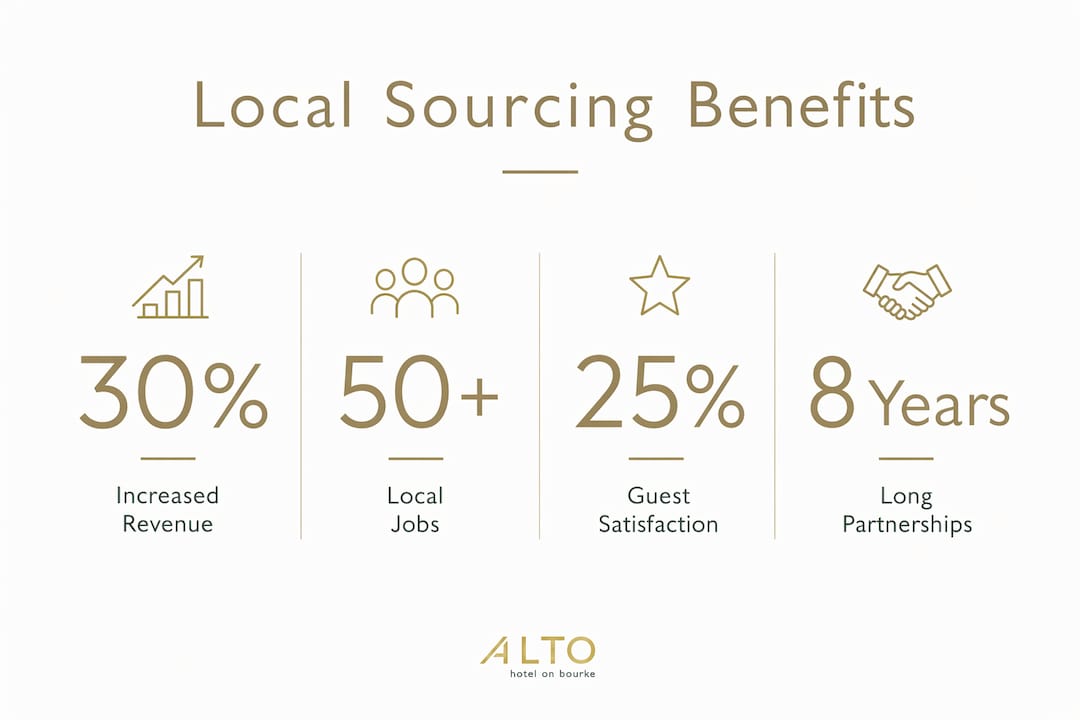
Xandari Pearl Beach Resort in Kerala has maintained an eight-year partnership with women-led Kudumbashree microenterprises, sourcing roughly 60 kg of traditional food products monthly. These products include puttu podi, appam podi, and ari podi. That consistent commercial relationship provides stable income for women who would otherwise depend on irregular informal markets. Eight years of purchasing is not a marketing exercise. It is a genuine economic anchor for those producers.
The employment dimension is equally significant. Kruger Gate Hotel's local sourcing initiative employed eight locals, six of whom were under 34 years old. Six young people gaining commercial agricultural experience through a hotel's purchasing decision is a concrete outcome that no corporate sustainability report can fabricate.
For guests, the benefit is experiential. Travellers respond strongly to sourcing narratives. Knowing that the eggs at breakfast came from a specific farm 12 kilometres away, or that the honey was produced by a family operation in the next valley, creates a connection to place that generic supply chains cannot replicate. This is what restaurants featuring local ingredients understand: the story behind the food is part of the meal.
"Shifting to local sourcing provides financial security to micro-farmers, fostering a resilient, sustainable local agricultural ecosystem, particularly in remote regions. Hotels that offer guaranteed commercial markets are not just buying produce. They are sustaining entire farming communities."
The environmental case is also real. Shorter supply chains reduce transport emissions and improve food freshness. A vegetable harvested and delivered within 24 hours tastes different from one that has spent four days in a refrigerated container.
The benefits, ranked by measurable impact, are:
- Stable income for producers, particularly women and youth in underserved regions.
- Employment creation in local communities, with preference for young workers.
- Guest experience uplift through sourcing narratives and fresher ingredients.
- Reduced carbon footprint from shorter transport distances.
- Economic retention within the local community rather than leakage to distant supply chains.
Which food categories do hotels source locally, and why?
Hotels do not need to source everything locally. The most effective approach focuses on high-impact categories where quality is visible and the sourcing story resonates with guests. Shifting just 10–20% of purchases in these categories produces a meaningful change in both guest experience and community benefit.
Bulk commodities like flour, rice, and cooking oil are poor candidates for local sourcing. The volumes required, price sensitivity, and logistics make them impractical for most hotels. The categories where local sourcing delivers the greatest return are proteins, dairy, specialty produce, and artisan pantry items.
| Category | Why it works locally | Guest impact |
|---|---|---|
| Proteins (eggs, poultry, fish) | Short shelf life rewards proximity | High. Freshness is immediately noticeable |
| Dairy (cheese, yoghurt, butter) | Artisan quality exceeds commodity alternatives | High. Distinct flavour and sourcing story |
| Seasonal produce (vegetables, fruit) | Harvest-to-kitchen speed improves flavour | Medium to high. Seasonal menus signal authenticity |
| Artisan pantry items (honey, preserves, cured goods) | Unique products unavailable through global chains | High. Strong gift and narrative value |
| Traditional staples (puttu podi, appam podi) | Cultural specificity and community livelihood | High in culturally immersive properties |
The Xandari Pearl example illustrates why traditional staples deserve a place on this list. Puttu podi and appam podi are not luxury items. They are everyday products that carry cultural meaning and support women-led enterprises. A hotel that sources them locally is doing something that a five-star property sourcing imported cheese is not: it is preserving a food culture while sustaining the people who produce it.
Pro Tip: Start local sourcing with your breakfast menu. Eggs, dairy, honey, and fresh fruit are high-visibility, high-frequency items where guests notice quality immediately. A strong local breakfast builds the sourcing narrative before a guest even reaches the restaurant for dinner.
How do hotels track and evaluate local sourcing success?
Measurement is what separates genuine local sourcing programmes from marketing claims. Hotels that take this seriously track volume, employment, and guest response as three distinct metrics.
The volume metric is the most straightforward. Kruger Gate Hotel tracked its initiative and recorded over 745 kg of fresh local vegetables sourced in eight months. That figure is specific enough to be credible and large enough to demonstrate operational scale. Volume tracking also helps hotels identify which producer relationships are growing and which need attention.
Employment tracking captures the human dimension. The same initiative recorded eight local jobs created, with six going to workers under 34. Hotels that connect guests to local makers and report these numbers publicly give travellers a reason to choose them over properties that offer no such transparency.
Guest feedback is the third pillar. Hotels that share sourcing stories on menus, in room materials, or through staff conversations generate measurable responses. Guests who understand where their food comes from rate their dining experience more highly and are more likely to return. Long-term supply relationships built on this feedback loop outperform charity-style initiatives because they are grounded in commercial reality rather than goodwill alone.
The metrics that matter most:
- Kilograms sourced locally per month or per quarter, tracked by category.
- Number of local producers on the active roster, with notes on relationship length.
- Local jobs supported, broken down by age and gender where possible.
- Guest satisfaction scores for dining, compared before and after sourcing narratives were introduced.
- Supply chain resilience, measured by how often local suppliers fulfilled orders on time versus global alternatives.
Key takeaways
Hotels that commit to local sourcing create measurable benefits for producers, guests, and communities, with the greatest impact coming from focused partnerships in proteins, dairy, and artisan categories rather than attempting to source everything locally.
| Point | Details |
|---|---|
| Start with Living Lab trials | Direct producer-to-kitchen meetings build trust before any formal supply agreement is signed. |
| Designate one purchasing contact | A single point of contact prevents communication failures and gives producers reliable accountability. |
| Focus on 10–20% of key categories | Shifting proteins, dairy, and artisan items locally creates visible guest impact without operational overload. |
| Track volume and employment | Measuring kilograms sourced and jobs created turns goodwill into credible, reportable outcomes. |
| Long-term partnerships outperform short-term initiatives | Eight-year relationships like Xandari Pearl's Kudumbashree partnership deliver sustained community benefit. |
Why authentic local sourcing is the real test of sustainable hospitality
The uncomfortable truth about hotel sustainability is that most of it is invisible to guests. Solar panels, water recycling, and green certification matter, but travellers cannot see them at work. Local food sourcing is different. It shows up on the plate, in the menu description, and in the conversation a staff member has when a guest asks where the cheese came from.
What I have observed is that hotels which treat local sourcing as a procurement exercise tend to abandon it when a cheaper global option appears. Hotels that treat it as a community relationship tend to deepen it over time. The Xandari Pearl model is instructive here. Eight years of purchasing from the same women-led enterprises is not a procurement strategy. It is a commitment that has outlasted staff changes, ownership reviews, and supply disruptions.
The challenge for travellers is knowing the difference. A menu that says "locally sourced" without naming a producer is a marketing claim. A menu that names the farm, the producer, or the community enterprise is evidence of a real relationship. When you choose accommodation that publishes this level of detail, you are voting with your travel spend for a model that actually works.
The other thing worth saying is that local sourcing is not perfect. Smallholder farmers face weather, seasonal gaps, and capacity limits that global supply chains do not. Hotels that stick with local producers through these disruptions, rather than reverting to convenience, are the ones building something durable. That resilience is what sustainable hospitality actually looks like in practice.
— Kamal
Altohotel and the local food experience in Melbourne
Altohotel, Melbourne's award-winning eco-friendly boutique property on Bourke Street, is one of the first environmentally rated hotels in the city. Its commitment to local partnerships extends beyond certification. Guests staying at Altohotel experience a property that actively supports local artisans and community organisations, reflecting the same values that drive the best local sourcing programmes worldwide.

Melbourne's food culture is built on exactly the kind of producer relationships this article describes. Staying at Altohotel puts you at the centre of that culture. The 2 Bedroom Deluxe Apartments offer the space to settle in and explore the city's local food scene properly, while the 1 Bedroom Spa Apartments provide a quieter base for travellers who want comfort alongside community connection. Altohotel's Hall of Fame recognition in the Victorian tourism sector reflects a long-term commitment to sustainable hospitality that goes well beyond a marketing claim.
FAQ
How do hotels find local food producers to work with?
Hotels typically find local producers through Living Lab meetings, local food hubs, and direct community outreach. The RUSTIK project in Serbia showed that structured trial meetings between producers and hotel management are the most effective starting point.
What percentage of food should a hotel source locally?
Hotels do not need to source everything locally. Shifting 10–20% of purchases in high-impact categories like proteins, dairy, and artisan items creates meaningful guest and community benefit without disrupting operations.
How do hotel partnerships with producers benefit local communities?
Partnerships provide producers with guaranteed commercial markets, stable income, and employment opportunities. Kruger Gate Hotel's initiative created eight local jobs and sourced over 745 kg of fresh vegetables in eight months, with most workers under 34.
What food categories are best suited to local hotel sourcing?
Proteins, dairy, seasonal produce, honey, preserves, and traditional staples deliver the highest return from local sourcing. These categories offer visible quality differences and strong sourcing narratives that guests notice and remember.
How can travellers tell if a hotel genuinely sources locally?
A hotel with genuine local sourcing names specific producers, farms, or community enterprises on its menus or in guest communications. Generic claims like "locally sourced" without producer details are a sign the relationship may not be as deep as advertised.