
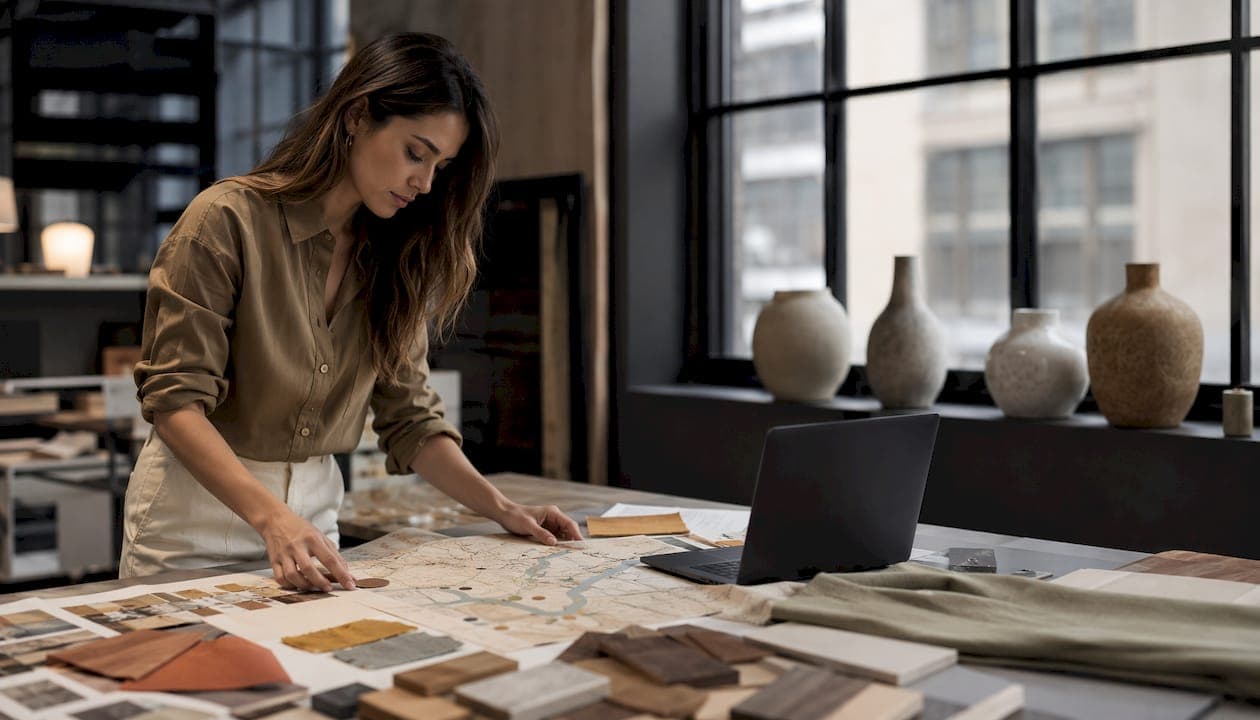
The most effective way hotels celebrate regional craftsmanship is by treating it as infrastructure, not decoration. That means commissioning local makers during the project initiation phase, embedding craft into architecture, joinery, textiles and public art, and then building guest-facing programming around those objects once the hotel opens. The result is a property that genuinely belongs to its place rather than one that could have been assembled anywhere.
The primary channels are:
- Commissioned architecture and joinery: structural elements made by local craftspeople using regional materials
- Bespoke furniture and textiles: hand-loomed throws, locally tanned leather, ceramics and custom cabinetry
- Public art programmes: rotating exhibitions, permanent installations and lobby-scale works
- Guest workshops and artist residencies: paid experiences that connect visitors directly to makers
- Local procurement and interpretive storytelling: provenance labels, QR codes and room naming that give objects a voice
Pro Tip: Start craft integration at project initiation, before design boards are finalised. Mapping local materials and cultural narratives early prevents the common mistake of parachuting decorative objects into a scheme that was never designed to hold them.
Table of Contents
- How hotels create an authentic sense of place through design
- Where regional craft actually appears in a hotel
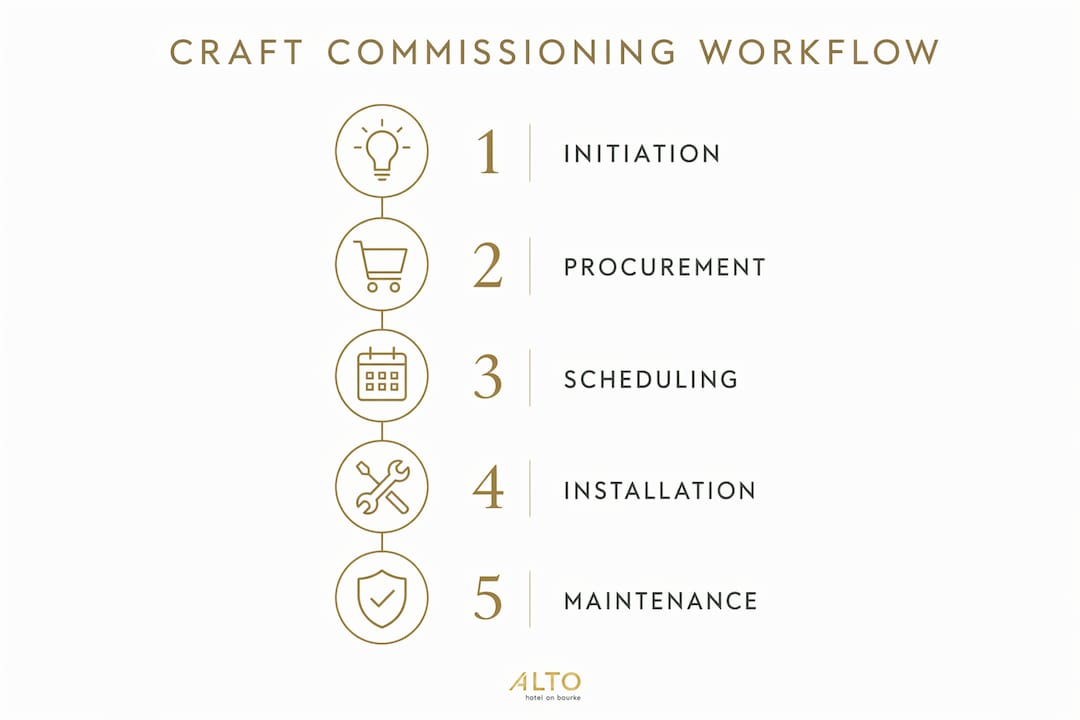
- The commissioning workflow from initiation to installation
- Guest programming: workshops, demonstrations and artist residencies
- Community and procurement: fair pay, capacity building and local supply chains
- Interpreting craft for guests: labels, QR codes and room naming
- Sustainability, longevity and maintenance of crafted elements
- How to measure the impact of a craft programme
- Altohotel: craft integration in a Melbourne context
- Key takeaways
- The part most hotels get wrong
- Further reading and Australian resources
How hotels create an authentic sense of place through design
Authenticity in craft-led hospitality is not a mood board choice. It is a structural decision made at the brief stage. The difference between a hotel that feels genuinely rooted in its region and one that feels themed comes down to whether craft is performing a function or merely referencing one.
Boutique hotels that reflect local culture consistently start with cultural mapping: identifying the material traditions, making techniques and place-based narratives that exist within a reasonable radius of the site. That research shapes the brief rather than being retrofitted to it. Jeremy Grove of Sibley Grove argues that luxury is shifting away from standardised templates toward site-specific narratives that feel durable and meaningful, and that hotels should pursue "holistic beauty" rather than theming.
Material honesty is the practical expression of that principle. Leaving tool marks visible, exposing weld seams on custom metalwork, or using hand-finished plaster rather than spray-applied render all signal that a human made this. The UK's Powdermills hotel demonstrates the approach well: rather than replicating Georgian decorative conventions, the design team avoided pastiche by working with the existing building fabric, layering old and new, and commissioning locally sourced timber furniture and ceramics for public spaces.
The operational constraints that matter most at design stage are cleanability, maintenance access and life-cycle cost. A hand-thrown ceramic tile is beautiful; it also needs to be specifiable in a grout joint that a cleaner can actually maintain. Adapting local technique to modern durability and fire-code requirements is not a compromise. It is what separates a craft programme that lasts from one that deteriorates within two years.
Where regional craft actually appears in a hotel
Craft opportunities exist at every scale, from the structural to the tactile. The key is matching the right medium to the right functional context.
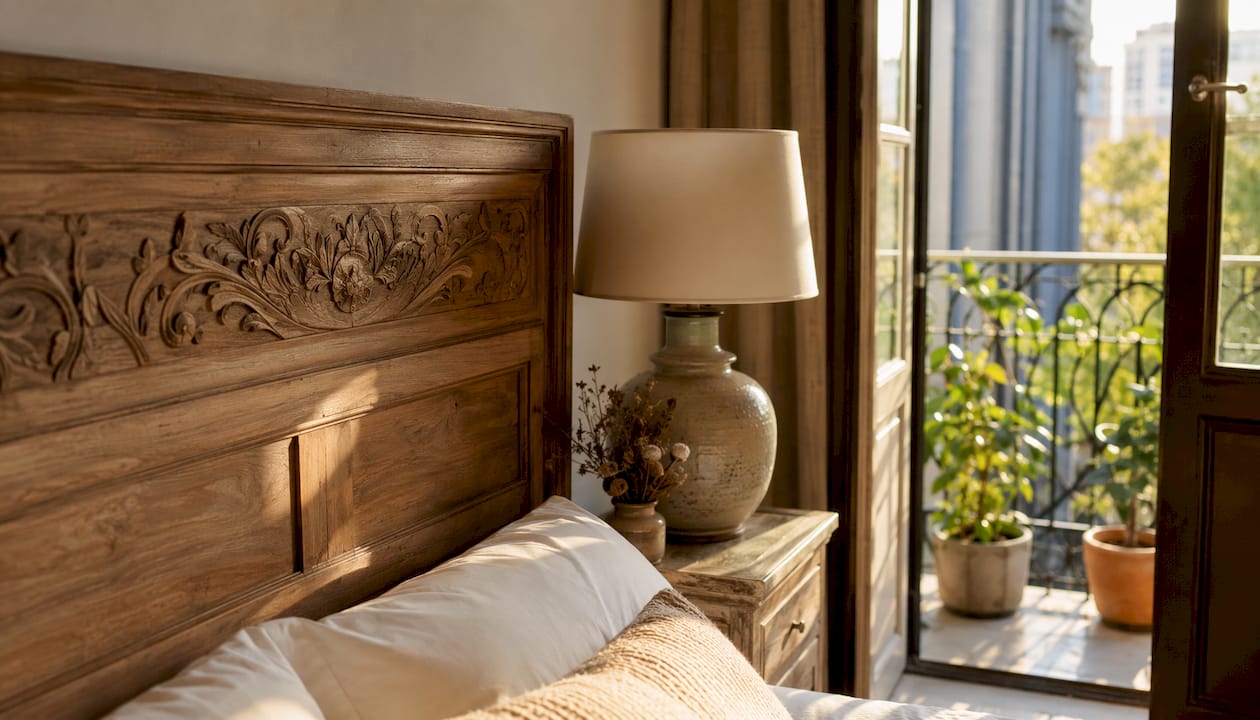
Guest rooms are where guests spend the most time alone with objects, so provenance matters most here. Bespoke headboards, hand-loomed throws, locally tanned leather on bedside tables, studio ceramics on the vanity and in-room art with small provenance cards all contribute to a cumulative sense of place. The cards do not need to be elaborate: maker name, technique, location and one sentence about the tradition is enough.
Public spaces carry the highest visual load and the highest traffic. Reception joinery with visible fabrication marks, bar tops in locally quarried stone, hand-thrown lighting pendants and hand-laid tile work in corridors all read immediately on arrival. Research from Condé Nast Traveller on Powdermills notes that combining historic fabric, local makers and curated displays can make a lobby feel more like a crafts exhibition than a standard hotel arrival.
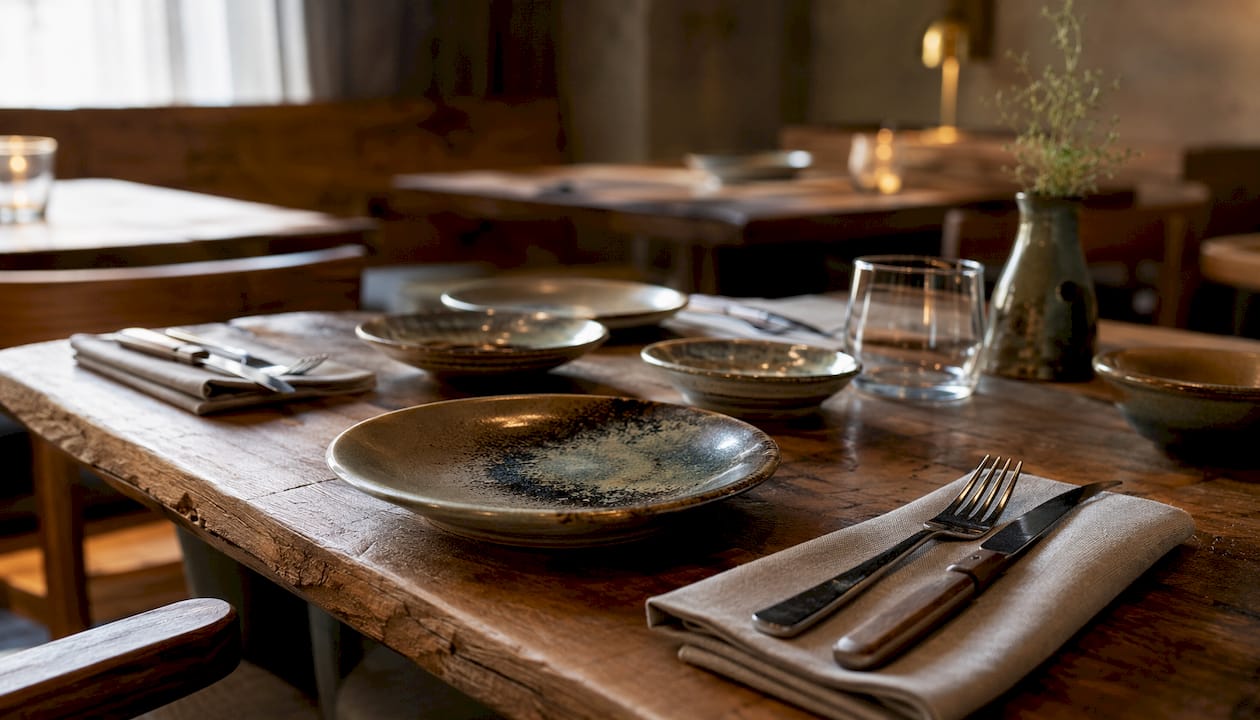
F&B and back-of-house are often overlooked. Artisan-made crockery, timber benchtops and custom furniture designed for heavy use extend the craft narrative into every meal. Specification notes for these areas should include durability grades, stain resistance and appropriate finish choices. Timber benchtops in a busy kitchen pass need a penetrating oil finish that can be reapplied, not a lacquer that chips.
Pro Tip: Build procurement schedules that allow for artisan lead times. A hand-thrown crockery set for a 60-cover restaurant typically takes several weeks from commission to delivery. Factor staged delivery into the installation programme so fit-out is not held up by a single maker.
The commissioning workflow from initiation to installation
Hotels that commission local craftspeople using a clear stage-by-stage process treat craft as integrated infrastructure rather than a decorative afterthought. The table below maps responsibilities across the four stages.
| Stage | Key activities | Who is responsible |
|---|---|---|
| Initiation | Cultural mapping, artisan identification, brief development | Design lead, procurement |
| Design | Concept development, material testing, mock-ups | Designer, artisan, project manager |
| Creation | Fabrication, quality checks, certification testing | Artisan, QA lead |
| Installation | Staged delivery, site sign-off, maintenance handover | Project manager, artisan, operations |
Procurement and contracting deserve particular attention. Fair pay means transparent costing where the artisan's time, materials and overhead are all visible, not a lump-sum that squeezes margin invisibly. IP terms should specify who owns the design: if the hotel commissions an original pattern, does the maker retain the right to sell it elsewhere? Delivery milestones with staged payments reduce risk for both parties.
Scheduling bespoke work requires contingency that standard FF&E procurement does not. Build a minimum 20% time buffer into any commission with hand-fabrication involved. Quality control should include physical mock-ups and site-based sign-off sessions with the maker present, not just photographic approvals sent by email.
Guest programming: workshops, demonstrations and artist residencies
Interactive experiences convert craft from something guests observe into something they remember. Hotels that run on-site workshops, artist-led demonstrations and studio tours position themselves as cultural hubs rather than accommodation providers.
The most practical programming formats are:
- Short workshops (60–90 minutes): weaving, ceramics, natural dyeing or printmaking run in a dedicated space or adapted meeting room. Ticket these separately or include them in a room package.
- Live demonstrations in public spaces: a potter or weaver working in the lobby or bar during peak check-in hours creates ambient storytelling without requiring guest sign-up.
- Studio visits: guided trips to a local maker's workshop, either self-guided with a map or led by a staff member. Low overhead, high perceived value.
- Pop-up maker markets: quarterly or seasonal events that bring several local makers into the hotel for a day. These generate retail revenue and PR coverage simultaneously.
- Artist-in-residence programmes: short-term residencies of two to eight weeks where a maker works on-site, exhibits in progress and sells finished pieces. The living gallery model used by properties like Seattle's Populus supports continual renewal and retail income while keeping the programme fresh.
Operational logistics for hands-on experiences include public liability insurance, participant caps (typically 8–12 for craft workshops), dedicated staffing and a clear health-and-safety briefing for tools or materials involved. For guest experience design that integrates craft with culinary programming, pairing a ceramics workshop with a meal served on the pieces made that morning is a particularly effective format.
Community and procurement: fair pay, capacity building and local supply chains
A craft programme that pays artisans below market rate for their time is not a community partnership. It is extraction with better branding. Fair contracting means transparent costing, milestone payments tied to delivery stages, and IP arrangements that respect the maker's creative contribution.
Capacity building goes further. Some hotels fund apprenticeships, contribute to shared workshop spaces or establish training funds that allow emerging makers to develop skills alongside a commission. Co-operative procurement models, where a hotel contracts with a cluster of local makers rather than a single supplier, reduce single-supplier risk and distribute economic benefit more broadly. This also gives the hotel production resilience: if one maker is delayed, others in the cluster can absorb part of the workload.
Hotels that support local creative communities measure community impact through artisan income uplift, training outcomes and local employment figures. These metrics are increasingly expected by ESG-conscious investors and tourism bodies.
Populus in Seattle reports a significant number of visitors engaging with its art programming annually, demonstrating the neighbourhood revitalisation potential of a well-run hotel arts programme.
Supply-chain resilience also means documenting your maker relationships. A register of local suppliers, their lead times, capacity and specialisations gives procurement teams the information they need to plan future commissions without starting from scratch each time.
Interpreting craft for guests: labels, QR codes and room naming
The physical object is only half the story. Hyperlocal storytelling through provenance labels, room naming and QR codes is what transforms a decorative element into a meaningful cultural encounter.
- Provenance labels: a small card or engraved plate naming the maker, technique, location and year. Keep it to three lines. Guests read short copy; they skip long copy.
- In-room books: a curated booklet explaining the craft traditions represented in the room, with photographs of the maker at work. This works particularly well for textile and ceramic commissions.
- QR-code experiences: a short film (two to three minutes) showing the making process, a maker interview, or a link to purchase a piece or book a studio visit. Place the QR code on the provenance label or inside the welcome booklet.
- Room naming: naming rooms after local makers, craft traditions or place-based materials creates a micro-narrative that guests carry with them. "The Wattle Room" or "The Blackwood Suite" does more work than "Room 204."
- Staff talking points: front-of-house staff are the most direct interpretation channel. A one-page briefing note per craft element, with three or four talking points and a suggested response to "who made this?", gives staff the confidence to engage authentically.
Pro Tip: Train staff during pre-opening and refresh briefings quarterly. Craft narratives lose impact when the person handing over the room key cannot answer a basic question about the headboard they are standing next to.
Sustainability, longevity and maintenance of crafted elements
Craft and sustainability are natural allies when the specification is done well. Local materials travel shorter distances, support regional economies and often carry lower embodied energy than imported alternatives. Regionally grown and well-seasoned timber, for instance, is dimensionally stable and less likely to crack or warp than kiln-dried imported stock rushed to site.
- Design for longevity: specify finishes that patinate rather than fail. Oiled timber develops character; lacquered timber chips. Hand-thrown ceramics with a matte glaze hide minor scratches better than high-gloss alternatives.
- Maintenance planning: include a maintenance schedule in the handover documentation. For each crafted element, note the cleaning regime, the recommended repair approach and the contact details of the original maker. An artisan-maintenance contract, where the maker returns annually to inspect and touch up their work, is worth negotiating at commission stage.
- Design for disassembly: avoid bonded assemblies in areas where wear is predictable. A re-upholstery-friendly chair frame with exposed joinery can be refurbished without replacing the whole piece. A glued-and-pinned frame cannot.
- Environmental choices: low-VOC finishes, locally sourced timber certified by the Forest Stewardship Council, and the reuse of on-site historic materials all reduce environmental impact and strengthen the authenticity narrative.
Pro Tip: Photograph every crafted element at installation and store the images with the maintenance register. When a repair is needed three years later, the original maker can match finish and patina far more accurately with a reference photograph than without one.
How to measure the impact of a craft programme
Measurement turns a craft programme from a design gesture into a business case. The table below sets out the key performance indicators, data sources and reporting cadence that give hotel teams the evidence they need to iterate and reinvest.
| KPI | Data source | Reporting cadence |
|---|---|---|
| Guest satisfaction referencing craft | Post-stay surveys, review platforms | Monthly |
| Incremental revenue from craft experiences | Experience booking data, retail sales | Monthly |
| PR impressions and media coverage | Clipping reports, social media analytics | Quarterly |
| Artisan income uplift | Artisan feedback, payment records | Annually |
| Repeat booking rate | PMS data segmented by experience purchasers | Quarterly |
Forbes notes an industry-wide shift: hotels are rethinking mass-produced art to create dynamic cultural ecosystems with curation embedded into operations. That shift is measurable. Post-stay surveys that ask about craft and local culture can provide useful insights to justify future commissions. Retail sales from a rotating exhibition tell you which artists resonate most with your guest profile.
Quarterly impact reviews that bring together procurement, F&B and marketing ensure the programme is assessed as a whole rather than in silos. Use the results to refine the artist selection brief, adjust pricing on experiences and build the case for the following year's budget.
Altohotel: craft integration in a Melbourne context
Altohotel on Bourke in Melbourne operates as one of the city's first environmentally rated boutique hotels, and its approach to craft integration reflects that founding commitment. The hotel's eco-conscious materials specification and partnerships with local artisans and organisations are not a marketing layer applied after the fact. They are built into the procurement and design brief.
The hotel's room and public-space fittings draw on locally sourced and sustainably specified materials, with artisan relationships that extend beyond a single commission to ongoing maintenance and renewal. The Petite Queen rooms exemplify the approach: considered material choices and a muted palette that allows the craft objects in the room to carry the narrative rather than compete with a busy decorative scheme.
Altohotel's craft programme has contributed to its Hall of Fame recognition in the Victorian tourism sector, a result that reflects sustained guest satisfaction rather than a single strong year. The award-winning approach to city identity demonstrates that craft investment pays back in brand differentiation and repeat bookings.
Key lessons from the Altohotel model:
- Integrate craft procurement into the environmental brief from the outset, not as a separate workstream.
- Maintain ongoing artisan relationships rather than treating each commission as a one-off transaction.
- Use interpretive storytelling in rooms to connect guests to the provenance of the materials around them.
- Measure guest feedback specifically against craft and local culture touchpoints to build the evidence base for continued investment.
Key takeaways
Hotels that embed regional craftsmanship as infrastructure, not decoration, create measurable differentiation in guest satisfaction, brand recognition and community impact.
| Point | Details |
|---|---|
| Start at initiation | Map local materials and cultural narratives before design boards are finalised. |
| Commission fairly | Use transparent costing, milestone payments and clear IP terms with every maker. |
| Interpret for guests | Provenance labels, QR codes and staff talking points turn objects into stories. |
| Plan for maintenance | Include artisan-maintenance contracts and a photographic register at handover. |
| Measure and iterate | Track guest satisfaction, retail revenue and artisan income uplift quarterly. |
The part most hotels get wrong
There is a version of craft integration that looks right in the design presentation and falls apart within eighteen months. The headboard is beautiful. Nobody on the front desk knows who made it. The artisan was paid a lump sum with no IP agreement, and when a guest asks to buy a similar piece, there is no pathway. The maintenance register does not exist. The craft programme, in practice, is a set of objects with no story attached.
The fix is not complicated, but it requires discipline at the brief stage. Mock-ups matter more than most project managers want to admit. A physical sample in the actual lighting conditions of the room, assessed by the designer and the maker together, catches problems that a rendered visualisation never will. Texture, scale, how a finish reads under warm versus cool light — these are things you have to stand in front of.
The IP conversation is the one most hotels avoid because it feels awkward. It should not. A maker who retains the right to sell their pattern elsewhere is a maker with a sustainable business. A maker who signs away all rights for a one-time fee is a maker who may not be available for your next commission. Fair IP terms are a retention strategy as much as an ethical one.
The other underestimated factor is staff training. The most beautifully curated craft programme loses half its value if the person handing over the room key cannot answer "who made the throw on the bed?" Front-of-house staff are the last metre of a very long supply chain. Brief them properly, refresh those briefings regularly, and the craft narrative reaches the guest intact.
Further reading and Australian resources
These sources support procurement briefs, staff training and deeper research into craft-led hospitality design.
- How hotels connect guests to local makers — practical strategies for linking guests with local creators, useful for programming briefs
- Why local textile art is featured in hotels — textile specification and provenance, relevant for FF&E schedules
- Types of community partnerships boutique hotels use — procurement and training models for Australian operators
- Types of indigenous art featured in hotels — a guide to working sensitively with First Nations art forms in hospitality contexts, including legal and ethical considerations relevant to Australian properties
- Local art in boutique hotel design — contextual analysis and programme examples for Australian designers
- Benefits of locally curated hotel experiences — evidence on guest satisfaction and loyalty outcomes
- Behind the artisan wall: how hotels commission local craftspeople — commissioning workflow detail and case material
- Crafted hotel avoids the pastiche at Powdermills — design precedent for material honesty and avoiding themed interiors
- How to combine lodging and gastronomy — integrating craft with culinary programming and F&B partnerships
Use these sources to build procurement briefs, develop staff training materials and benchmark your programme against international and Australian examples.