
Heritage-inspired hotel design is the practice of embedding authentic regional architecture, local materiality, and cultural storytelling into a hospitality environment to create a sense of place that goes beyond decoration. The best examples of heritage-inspired hotel design do not replicate history. They reinterpret it. Projects like Capella Diriyah in Saudi Arabia and Soori Penang in Malaysia show that the most compelling results come from layering contemporary function over genuine cultural fabric, not from applying a historical veneer to a generic building. For architects and designers, the distinction between authentic cultural hotel design and themed pastiche is the defining challenge of the discipline.
What defines exemplary heritage-inspired hotel design?
The industry term for this approach is contextual hospitality design, though the phrase heritage-inspired hotel design has become the working shorthand across the sector. The difference between the two is subtle but worth naming: contextual design is a methodology, while heritage-inspired describes the outcome.
The strongest projects share four characteristics:
- Regional architectural vernacular expressed with contemporary restraint. Successful designs draw on local building traditions, such as Najdi courtyard logic or Malaysian shophouse typology, without copying them literally. The form is familiar; the execution is current.
- Material continuity over decorative mimicry. Straw marquetry, lime-washed surfaces, handmade tiles, and locally sourced timber connect a building to its place through texture and craft, not through reproduction furniture.
- Layered storytelling embedded in spatial organisation. Cultural references appear in furniture detailing, artwork, and reinterpreted familiar forms rather than in overt thematic decoration. Subtlety is the mark of confidence.
- Adaptive reuse that reveals original spatial logic. Removing poor-quality modern additions to expose original air wells and structural rhythms gives heritage hotels their most powerful asset: genuine bones.
Pro Tip: Brief your client early that heritage design is not a style choice. It is a research process. The more specific the cultural reference, the more authentic the result.
1. Capella Diriyah, Saudi Arabia
Capella Diriyah is the clearest current example of Najdi architectural traditions translated into luxury hospitality. Designed by Aedas, the project uses solid-void rhythms, earthen palettes, and courtyard organisation to reflect the social fabric and spatial hierarchy of historic Diriyah. The result reads as unmistakably Saudi without resorting to costume-drama decoration.
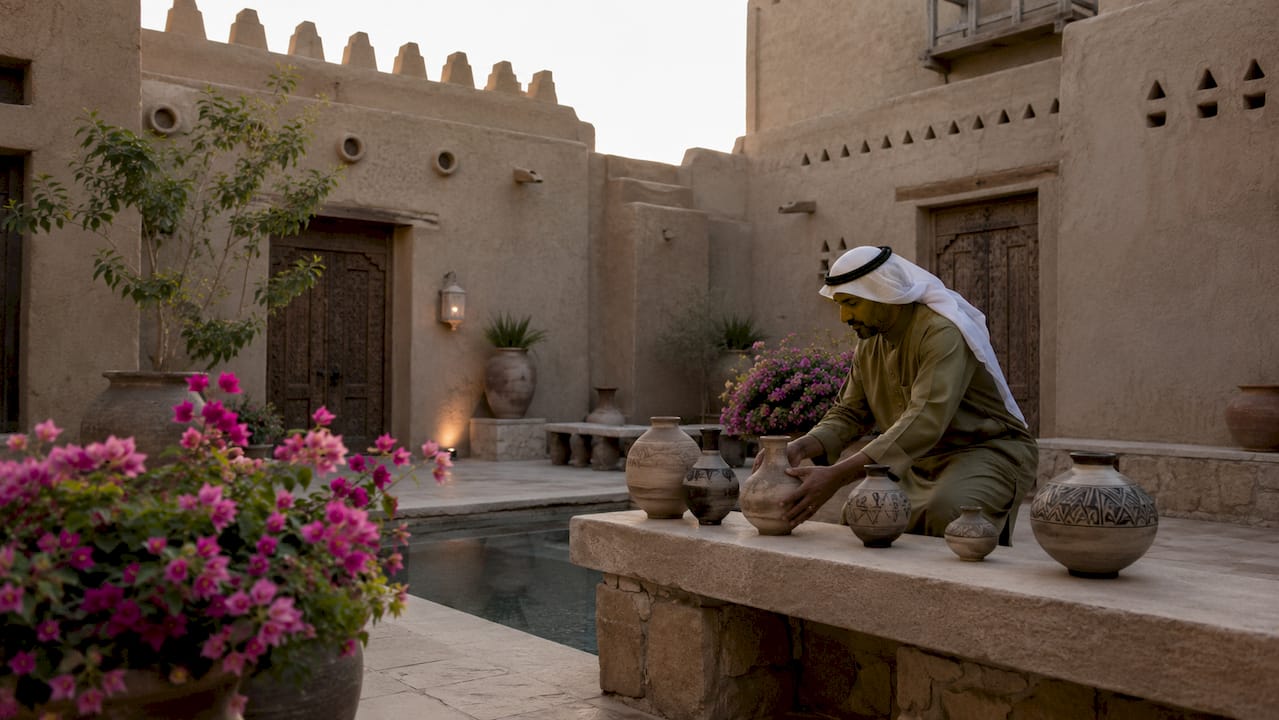
The project covers 14,168 sqm GFA across 100 keys. That scale demands consistency, and the design delivers it through material discipline: raw earth tones, textured plaster, and shaded colonnades that respond to the desert climate as much as to cultural precedent. The courtyards are not decorative. They are the primary organising device, controlling light, air movement, and social gathering in the same way they did in historic Najdi settlements.
For architects working in culturally sensitive contexts, Capella Diriyah demonstrates that the most powerful heritage gesture is often structural rather than ornamental.
2. Soori Penang, Malaysia
Soori Penang opened in january 2026 as one of the most disciplined examples of shophouse typology applied to boutique accommodation. Designed by SCDA Architects and Soo K. Chan, the project reduced the original hotel layout to just 15 suites to preserve historic granite thresholds and original timber doors. That decision to reduce room count in favour of material integrity is rare and instructive.
The palette of dark timber, lime-washed panels, and rattan creates contextual aesthetics that feel earned rather than applied. The project sits within UNESCO heritage George Town, which raises the stakes considerably. Every intervention had to justify itself against the existing fabric. The result is a hotel that feels like it has always been there, which is the highest compliment in heritage hotel architecture.
Pro Tip: When working within a UNESCO heritage zone, treat the original fabric as the brief. Every new element should answer the question: does this serve the building or just the brand?
3. RISONARE Shimonoseki, Japan
RISONARE Shimonoseki uses the local maritime culture of the Kanmon Strait as its primary design language. The 187-room waterfront hotel incorporates cultural motifs drawn from the region's pufferfish heritage and tidal rhythms into its architectural form and interior spatial narratives. The twin curved volumes reference the movement of water and the silhouette of local fishing vessels.
What makes this project notable for designers is the interior-exterior continuity. The cultural storytelling does not stop at the facade. It flows through the public spaces, the room layouts, and the framing of views across the strait. Guests experience the local maritime identity at every scale, from the building's massing to the texture of a wall panel.
4. Crafted Powdermills, United Kingdom
Crafted Powdermills demonstrates that heritage-inspired design does not require a single-period approach. House of Dré's design layers Georgian architecture with contemporary interiors through a technique the studio calls "double drenching," applying earthy tones that complement original features rather than compete with them. Bespoke furniture crafted from British timber and handmade tiles reinforce the connection to local craft without producing a period room.
The project's philosophy is worth noting directly: mixing eras acknowledges living history, making a heritage hotel feel layered and welcoming rather than museum-like. This is the practical argument against single-period restoration in hospitality contexts. Guests are not curators. They want atmosphere, not accuracy.
5. 1926 Heritage Hotel, Penang
The 1926 Heritage Hotel occupies restored officers' quarters built in 1926, and its 70-room programme treats the building as a place of pause rather than a showpiece. Straw marquetry, lime-washed surfaces, and restrained colonial spatial logic create an atmosphere of accumulated time. Cultural storytelling appears in furniture details and artwork rather than in graphic heritage branding.
The design team maintained essential spatial qualities including scale, wall thickness, and window rhythm while updating infrastructure. This balance, restrained and respectful of original fabric, is the equivalent of classic car maintenance: replace what is worn, preserve what defines the character. The analogy is useful when briefing clients who want to modernise aggressively.
6. Motto by Hilton Recife Antigo, Brazil
Motto by Hilton Recife Antigo shows that cultural hotel design can operate at the level of narrative as much as architecture. The 132-room hotel uses corridor artwork inspired by local Cordel literature, a Brazilian folk art tradition of illustrated pamphlets, to create an immersive storytelling environment. The cultural reference is specific, local, and non-obvious to international guests, which gives it genuine depth.
This project exemplifies the post-experiential hospitality trend in which hotels function as cultural gateways rather than simply as accommodation. Guests engage with local identity through the physical environment rather than through a curated programme of activities. The design does the cultural work.
7. Sinkeh Hotel and adaptive reuse principles
Adaptive reuse is the structural foundation of most successful heritage hotel projects. The Sinkeh Hotel demonstrates how removing low-quality modern partitions to reveal original air wells transforms both the spatial quality and the environmental performance of a heritage building. Air wells that were blocked by later additions become tools for natural light and ventilation once exposed.
This approach requires a clear hierarchy of decisions. Original fabric takes precedence. Later additions are assessed for cultural value before removal. New interventions use materials that are legible as contemporary without being jarring. The discipline of this process is what separates genuine adaptive reuse from renovation with heritage branding.
8. How cultural programming extends the design intent
The physical design of a heritage hotel sets the stage, but culturally immersive hotel stays require programming that activates the space. Hotels that treat culture as an experiential platform rather than a visual backdrop attract more authentic guest engagement. The design and the programme must speak the same language.
Practical strategies that reinforce heritage design intent include:
- Commissioning local artists and craftspeople whose work connects directly to the building's cultural context, as seen in projects that support local creative communities.
- Curating public spaces as cultural reference points, with furniture, objects, and materials that guests can read as belonging to a specific place and time.
- Avoiding interpretive signage that over-explains the heritage narrative. The best cultural hotel design communicates without captions.
- Designing for co-creation: spaces that invite guests to engage with local culture rather than observe it from a distance.
The post-experiential hospitality trend confirms that guests now expect this level of cultural integration. Aesthetic heritage alone is no longer sufficient.
Key takeaways
The most successful heritage-inspired hotel designs achieve cultural authenticity through material continuity, layered spatial storytelling, and adaptive reuse rather than through decorative replication.
| Point | Details |
|---|---|
| Material continuity over mimicry | Use lime-washed surfaces, handmade tiles, and local timber to connect a building to its place through craft, not reproduction. |
| Layered design beats single-period restoration | Mixing eras, as seen at Crafted Powdermills, produces atmosphere rather than a museum exhibit. |
| Adaptive reuse reveals genuine heritage value | Removing poor additions to expose original air wells and structural rhythms gives hotels their most authentic spatial quality. |
| Cultural storytelling belongs in the fabric | Embed narrative in furniture, artwork, and spatial organisation rather than in graphic heritage branding or interpretive signage. |
| Programme must match design intent | Physical heritage design requires cultural programming that activates the space and invites genuine guest engagement. |
What I have learned from watching heritage hotels succeed and fail
Kamal's perspective
The projects that stay with me are never the ones with the most faithful restoration. They are the ones where I felt the place had a life of its own, where the history was present but not anxious about being noticed. Capella Diriyah does this through structure. Soori Penang does it through restraint. Both choices are correct for their context.
The failure mode I see most often is what I call the heritage costume: a contemporary building dressed in regional motifs, with carved screens applied to a glass facade and "traditional" patterns printed on soft furnishings. It satisfies a brief without answering a place. Clients often push for this because it is legible and photographable. The designer's job is to redirect that energy toward something with actual roots.
Collaboration with local craft communities is not a nice-to-have. It is the mechanism by which a design earns its cultural references. When the heritage neighbourhood hotel works with the people who carry the living tradition of a craft, the result has a specificity that no amount of research can replicate from a distance.
The direction I find most interesting right now is the playful layering approach: contemporary materials in deliberate contrast with original stone and timber, new interventions that are clearly legible as new, and a design that trusts guests to read the dialogue between eras without being guided through it. That trust is what separates a hotel from a museum.
— Kamal
Altohotel and the case for boutique heritage accommodation
Architects and designers visiting Melbourne for research or project work need accommodation that reflects the values they are studying. Altohotel on Bourke is one of Melbourne's first environmentally rated boutique hotels, and its approach to material selection, local partnerships, and spatial character makes it a relevant base for professionals engaged with culturally authentic design.
The 2 Bedroom Deluxe Apartments offer space for extended stays with the kind of considered material palette that design professionals notice. The Studio King Plus suits shorter visits without sacrificing the character that distinguishes Altohotel from generic city accommodation. Altohotel's Hall of Fame recognition in the Victorian tourism sector reflects a sustained commitment to quality that goes beyond certification.
FAQ
What is heritage-inspired hotel design?
Heritage-inspired hotel design integrates authentic regional architecture, local materiality, and cultural storytelling into a hospitality environment to create a genuine sense of place. It differs from themed design by grounding every decision in specific cultural and historical context rather than applying decorative motifs.
How do designers avoid pastiche in heritage hotel projects?
Designers avoid pastiche by layering contemporary interventions clearly against original fabric, using tactile materials like lime-washed surfaces and handmade tiles, and resisting over-themed decoration. Projects like Crafted Powdermills demonstrate that mixing eras produces more authentic atmosphere than single-period restoration.
What role does adaptive reuse play in heritage hotel design?
Adaptive reuse reveals the original spatial logic of a heritage building by removing poor-quality later additions and restoring features like air wells and structural rhythms. This approach improves both cultural authenticity and environmental performance simultaneously.
Which current projects best demonstrate heritage hotel architecture?
Capella Diriyah, Soori Penang, RISONARE Shimonoseki, and the 1926 Heritage Hotel Penang are among the strongest current examples. Each uses regional architectural vernacular, material continuity, and cultural storytelling in ways specific to their location.
How does cultural programming connect to heritage hotel design?
Cultural programming activates the physical design intent by commissioning local artists, curating public spaces as cultural reference points, and creating opportunities for guests to engage with local identity directly. Design and programme must share the same cultural language to produce a coherent guest experience.