
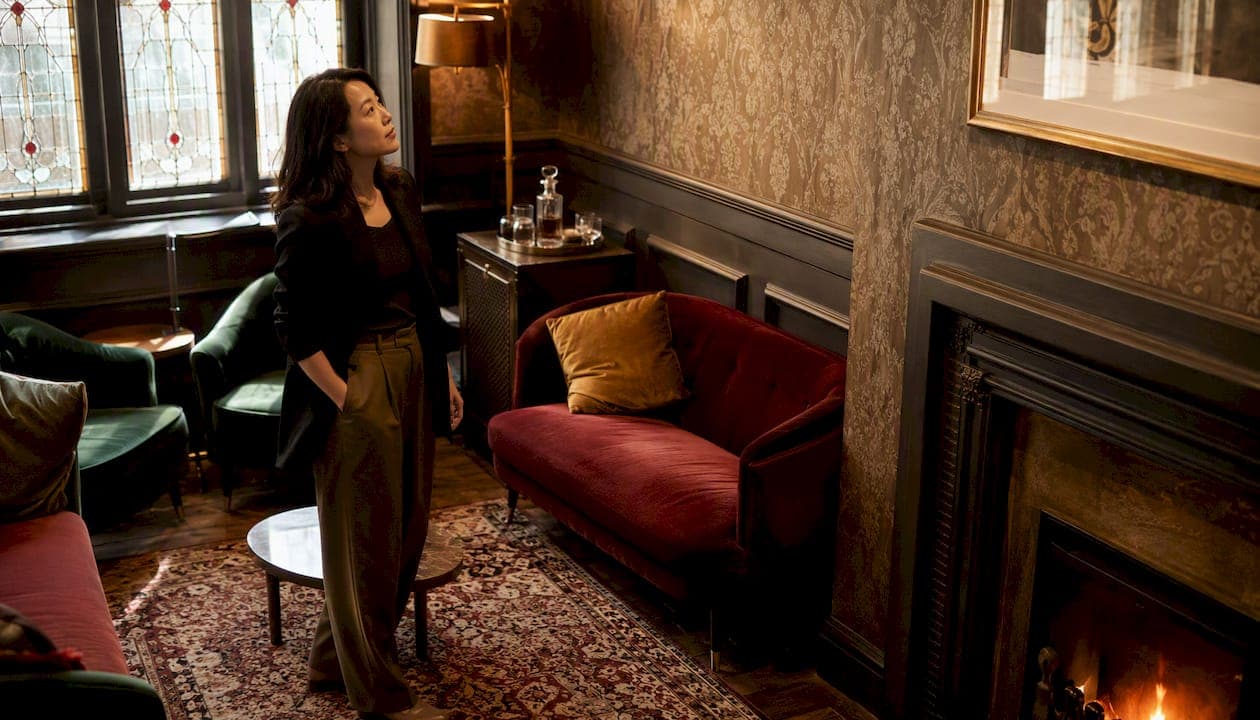
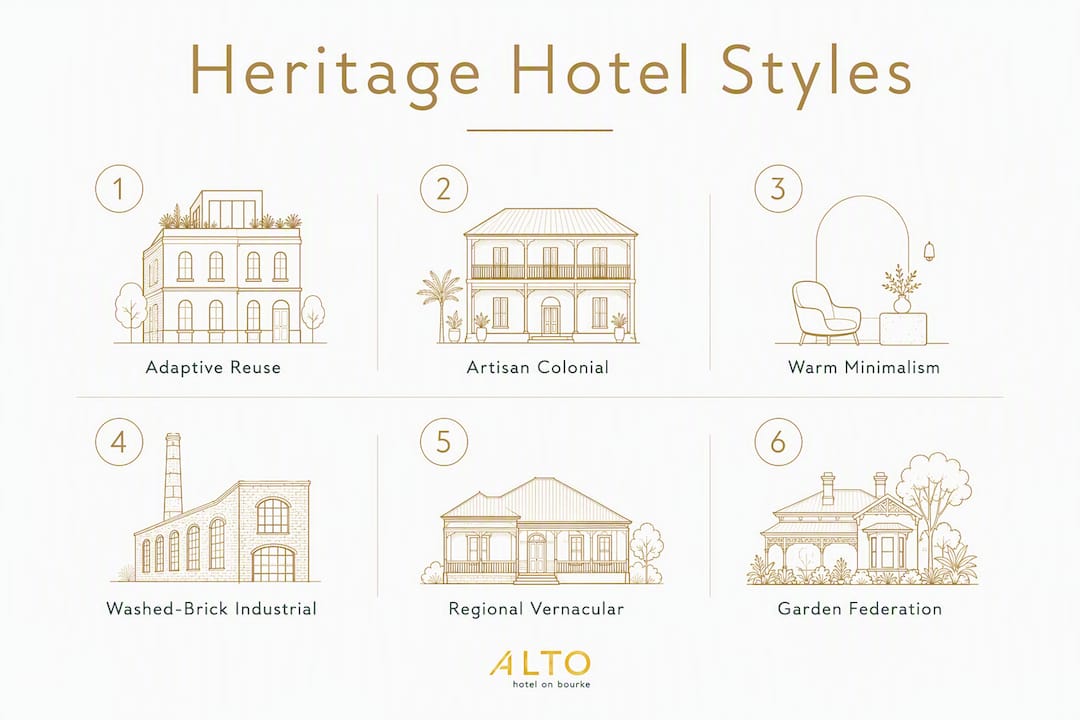
For eco-conscious travellers in Melbourne, the heritage-inspired boutique hotel styles worth prioritising are: adaptive reuse heritage, artisan colonial, warm minimalism, washed-brick industrial, regional vernacular, and garden-orientated Federation. Alto Hotel on Bourke sits squarely within this field as one of Melbourne's first environmentally rated boutique properties, recognised by the Victorian tourism sector's Hall of Fame and built around local artisan partnerships. Boutique hotel palettes are shifting toward warm, earthy tones — terracotta, clay, and sand — and that shift rewards heritage styles that already lean on natural, repairable materials.
TL;DR — ranked styles at a glance:
- Adaptive reuse heritage: reclaimed structural materials; reduces demolition waste; strongest local resonance
- Artisan colonial: handmade tiles, full-grain leather; visible local craft; tactile warmth
- Warm minimalism: honed stone, cork, smoked timber; absence of plastic veneers; grounding calm
- Washed-brick industrial: exposed masonry, solid joinery; durable patina; urban authenticity
- Regional vernacular: locally quarried stone, rammed earth; lowest transport emissions; sense of place
- Garden-orientated Federation: recycled timber verandahs, natural fibre; quieter streets; biophilic calm
Table of Contents
- Heritage-inspired boutique hotel styles ranked: profiles, materials, and guest experience
- How to spot genuine sustainability before you book
- What to expect when you arrive at a heritage-inspired boutique room
- Matching your trip type to the right heritage style
- Why Alto Hotel on Bourke fits the ranked criteria
- Key takeaways
- The detail most travellers overlook
- Alto Hotel on Bourke: a practical choice for eco-conscious Melbourne stays
- Useful sources
Heritage-inspired boutique hotel styles ranked: profiles, materials, and guest experience
Each style below carries a distinct Melbourne heritage lineage, a material signature, and a clear sustainability signal. Read them as a shortlist, not a hierarchy — your best match depends on trip type, covered in the section after this one.
1. Adaptive reuse heritage
Melbourne's warehouse and factory belt gave this style its bones. Adaptive reuse projects reduce demolition waste and deliver stronger local resonance than new builds. Expect exposed original structure — rolled-steel beams, original brick, concrete soffits — paired with reclaimed timber joinery. Palette: warm charcoal, raw umber, aged brass. Lighting should be warm to protect material warmth. Red flag: plastic-laminate panels applied over original masonry to "clean up" the look.
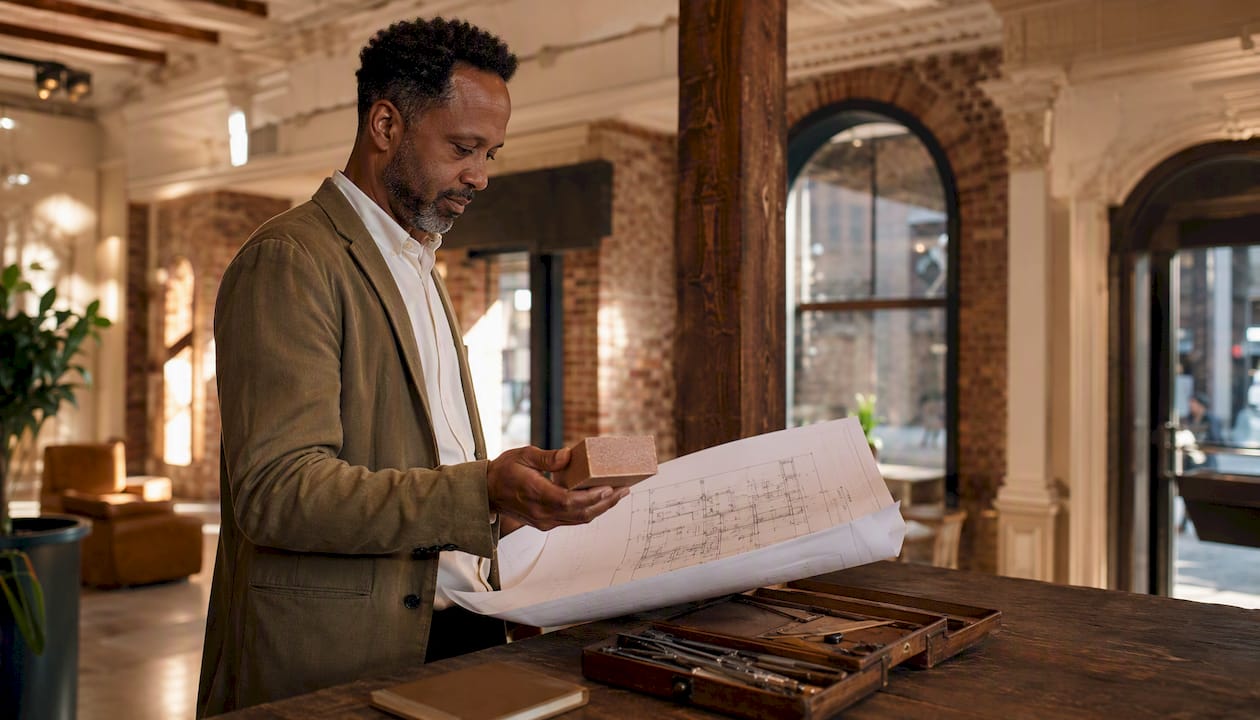
Pro Tip: Ask the hotel whether the structural elements are original or replicated. A genuine adaptive reuse property can name the building's previous use and show heritage overlay documentation.
2. Artisan colonial
Rooted in Victoria's gold-rush era, this style draws on ornate plasterwork, tessellated tile floors, and full-grain leather upholstery. The sustainability case rests on locally sourced, repairable materials — handmade tiles can be individually replaced; full-grain leather improves with age rather than requiring replacement. Palette: warm ivory, deep teal, burnished gold. Inner-city Melbourne properties in this style tend toward the mid-to-upper price band.
Pro Tip: Request the artisan commission notes. A credible property names the maker and suburb of origin for its tiles, joinery, and soft furnishings.
3. Warm minimalism
Fewer elements, better materials. Honed stone benchtops, cork flooring, and smoked-timber wall panels define this style. Smart-room controls are concealed within joinery — no visible cable clusters or plastic switch plates. Palette follows the 70/30 rule: 70% warm neutral (sand, clay) to 30% accent (terracotta, deep olive). This style suits inner-city Melbourne properties where the heritage shell is retained but the interior is stripped back. Price band: mid-range to premium.
4. Washed-brick industrial
Fitzroy and Collingwood built Melbourne's industrial character, and this style preserves it. Exposed brick is cleaned, not painted; joinery is solid hardwood with repairable mortise-and-tenon joins. Durable, repairable materials like honed stone and solid timber lower total cost of ownership and signal genuine sustainability commitment. Palette: warm brick red, raw linen, aged iron. Red flag: brick-effect wallpaper or printed vinyl panels.
Pro Tip: Run a hand across the joinery. Solid timber has grain variation and slight irregularity; MDF veneer is perfectly uniform and slightly hollow-sounding when tapped.
5. Regional vernacular
Less common in the CBD, more often found in inner-suburban Melbourne or regional Victoria. Materials are locally quarried bluestone, rammed earth, or compressed clay brick — all with near-zero transport emissions. Combining lodging with local artisan partnerships reduces the carbon footprint of décor and enhances sense of place. Palette: slate grey, ochre, raw flax. Best suited to travellers who want a quieter, neighbourhood-embedded stay.
6. Garden-orientated Federation
Federation-era properties with intact verandahs, recycled-timber fretwork, and garden courtyards offer genuine biophilic calm. Natural fibre rugs, linen drapes, and terracotta pots keep the material story coherent. This style tends toward inner-suburban Melbourne — Carlton, Fitzroy, South Yarra — and suits longer stays where outdoor access matters. Price band: mid-range.
Pro Tip: Check whether the garden uses indigenous plantings. A property serious about regional ecology will name the species and the local nursery supplier.
How to spot genuine sustainability before you book
The quickest screen is visible material and sourcing evidence. If a hotel's website cannot name a single material supplier, artisan, or certification body, treat that as a gap.
Checklist — scan the hotel's website and booking page for:
- Named environmental rating (EarthCheck, Ecotourism Australia, or equivalent)
- Disclosed artisan partnerships with suburb or region of origin
- Absence of plastic veneers called out in material descriptions
- Refillable toiletry programme mentioned explicitly
- Lifecycle or maintenance policy for joinery and soft furnishings
Questions to ask reservations (two-line scripts):
- "Can you tell me what certification your environmental rating is under, and where I can verify it?"
- "Are the joinery and soft furnishings sourced from local makers? Can you name them?"
- "What happens when a piece of furniture or finish needs replacing — is it repaired or replaced wholesale?"
A credible property answers questions 1 and 2 immediately and question 3 with a maintenance policy, not a shrug.
What to expect when you arrive at a heritage-inspired boutique room
Concealed smart controls are the baseline expectation in a well-executed heritage property — not a luxury add-on. IoT climate and lighting systems should disappear into joinery or wall cavities, preserving the artisanal aesthetic.
On-arrival checklist:
- Light switches: solid brass or timber, not plastic
- Joinery: visible grain, repairable joins, no plastic-edged panels
- Toiletries: refillable dispensers, not single-use sachets
- Lighting temperature: warm (visually amber, not blue-white)
- At least one visible artisan piece — a ceramic, textile, or print with maker attribution
Common red flags: single-use plastic amenity bottles, glossy laminate joinery, visible cable management in plastic conduit, and décor that reads as mass-produced rather than locally commissioned.
Modular furniture is a practical sustainability signal: it enables reconfiguration for accessibility without wholesale replacement. For Melbourne inner-city properties, expect nightly rates to reflect heritage restoration costs — budget properties in this category are rare, and mid-range is the realistic entry point.
Matching your trip type to the right heritage style
The style that fits best depends less on aesthetics and more on what you actually need from the stay.
| Trip type | Best style match | Must-check amenity |
|---|---|---|
| Solo urban explorer | Washed-brick industrial | Walkable neighbourhood, local café partnerships |
| Family with children | Garden-orientated Federation | In-room kitchen, outdoor access |
| Business traveller | Warm minimalism | Strong WiFi, concealed workspace, quiet floor |
| Wellness-focused guest | Regional vernacular | Natural materials, biophilic elements, no synthetic fragrance |
| Couple, short break | Artisan colonial | Tactile comfort, warm lighting, local dining nearby |
Business-ready eco boutique hotels in the warm minimalism category tend to deliver the quietest working environment because the material palette absorbs sound rather than reflecting it. Families benefit most from Federation-style properties where kitchen facilities and garden access reduce reliance on external services — a practical sustainability win as well as a convenience one.
Why Alto Hotel on Bourke fits the ranked criteria
Alto Hotel on Bourke meets the core ranking criteria: heritage sensitivity, repairable materials, local artisan partnerships, and concealed technology. As one of Melbourne's first environmentally rated boutique hotels, it holds Hall of Fame recognition in the Victorian tourism sector — a trust signal that reflects sustained performance, not a one-year result. The property offers rooms, studios, and one- and two-bedroom apartments, which makes it practical for solo travellers, couples, and families alike.
Pro Tip: Book direct with Alto Hotel on Bourke for the best available rates and to access exclusive amenities not always listed on third-party platforms.
Key takeaways
Heritage-inspired boutique hotel styles ranked for sustainability reward properties that use repairable, locally sourced materials, hold a named environmental certification, and commission local artisans — with Alto Hotel on Bourke as a Melbourne example that meets all three criteria.
| Point | Details |
|---|---|
| Prioritise repairable materials | Look for honed stone, solid timber, cork, and full-grain leather — all age well and can be repaired rather than replaced. |
| Verify the certification | Ask for the specific rating body (EarthCheck, Ecotourism Australia) and check it is current, not historical. |
| Check artisan attribution | A credible property names the maker and origin suburb for tiles, joinery, and soft furnishings. |
| Match style to trip type | Warm minimalism suits business stays; Federation suits families; adaptive reuse suits urban explorers. |
| Altohotel as local benchmark | Alto Hotel on Bourke holds Hall of Fame recognition and environmental ratings, making it a practical Melbourne reference point. |
The detail most travellers overlook
The conversation around sustainable heritage hotels tends to fixate on certifications, which matter, but the more reliable signal is tactile. A room where the timber has grain variation, the lighting sits at a warm amber, and the ceramics show a maker's hand — that room was built to last. A room where every surface is perfectly uniform and slightly reflective was built for photography.
Heritage preservation regulations in Melbourne, administered under the Victorian Heritage Act, constrain what owners can alter in listed buildings. That constraint is actually a sustainability asset: it forces material choices that honour the original structure rather than covering it. Properties operating under a heritage overlay cannot simply rip out original joinery and replace it with flat-pack — which means the heritage neighbourhood context itself becomes a quality guarantee.
The design mistake I see repeated is prioritising finishes that photograph well over finishes that feel good. Layered textures and warm lighting reliably increase guest comfort — and comfort is what brings people back, not the Instagram grid.
Alto Hotel on Bourke: a practical choice for eco-conscious Melbourne stays
Alto Hotel on Bourke delivers what the ranking criteria actually require: an environmental rating, local artisan partnerships, heritage-inspired rooms with repairable finishes, and apartment options with in-room kitchen facilities. It is positioned in Melbourne's CBD, which means walkable access to the city's best independent dining and cultural institutions — reducing the need for transport during your stay.
Check availability and book direct at Alto Hotel on Bourke for the best available rates and to confirm which room type best suits your trip.
Useful sources
- Boutique hotel interior design: rules and trends for 2026 — Singapore Hotels Radar; supports adaptive reuse benefits and warm-earth palette claims
- Boutique hotel design trends for 2026 — Censo Home; supports repairable/locally sourced material guidance and sustainability indicators
- Hotel room interior design trends for modern boutique hotels — MINGSUN; supports concealed IoT and smart-room expectations
- Hotel interior design trends in 2026: authenticity, resonance and resilience — Design for Travel; supports durable material selection and local-artist investment guidance
- How to combine lodging and gastronomy: 2026 guide — Wild Foodz; supports regenerative artisan partnership and carbon-reduction claims
- Alto Hotel on Bourke — official site — publisher reference; environmental rating, Hall of Fame recognition, and booking information