
Top apartment-style eco accommodations for families in Australia
The strongest options for families wanting apartment-style eco accommodation in Australia right now span coastal Queensland, the Whitsundays, Sydney Harbour, and Canberra. Each property below combines multi-bedroom living space with genuine sustainability credentials, not just a recycling bin in the corner.
| Property | Location | Family suitability | Eco features | Key amenities | Best for |
|---|---|---|---|---|---|
| Turtle Beach Resort | Hervey Bay, QLD | Multi-bedroom apartments, full kitchens, living areas | Waste reduction, conservation programmes | Beach access, kids' activities, pools | Coastal eco stays with ample activities |
| Meriton Suites Broadbeach | Broadbeach, QLD | 1-bedroom suites, full kitchens | Energy-efficient design, eco-education events | City access, pools, gym | City convenience with sustainable comforts |
| Q1 Resort & Spa | Surfers Paradise, QLD | Spacious apartments, full kitchens | Renewable energy, eco certifications | Spa, pools, child-focused eco activities | Luxury with sustainability awareness |
| RACV Noosa Resort | Noosa, QLD | Multi-bedroom villas and apartments | Organic gardens, waste composting | Nature trails, pools, family programmes | Natural settings and green practices |
| Oaks Sunshine Coast Oasis Resort | Sunshine Coast, QLD | 1-bedroom apartments, kitchenettes | Low-energy lighting, recycling education | Pools, recreational facilities | Active stays with sustainable ethos |
| Mantra Crown Towers Surfers Paradise | Surfers Paradise, QLD | Large apartments, full kitchens | Water-saving technology, sustainability programming | Pools, spa, family facilities | Premium stays with green credentials |
| Adina Apartment Hotel Darling Harbour | Sydney, NSW | Studio to one-bedroom apartments, kitchens | Green building certification, childcare facilities | Harbour access, city attractions | City families valuing eco comfort and location |
| East Hotel | Canberra, ACT | 1-bedroom apartments, full kitchens | Renewable materials, zero-waste dining | Restaurant, gym, family-friendly spaces | Intimate eco stays |
| Star of the Sea | Broadbeach, QLD | Apartments with living areas, kitchens | Eco tours, energy-efficient amenities | Beach access, education programmes | Coastal eco-lodging with education focus |
| Whitsunday Apartments Hamilton Island | Hamilton Island, QLD | Self-contained apartments, full kitchens | Solar energy, environmental education | Island activities, beach, family programmes | Island eco experience with space |
Turtle Beach Resort and RACV Noosa Resort lead on nature immersion, with conservation programmes that pull children directly into the environment rather than keeping them poolside. Q1 Resort & Spa and Mantra Crown Towers Surfers Paradise suit families who want the full resort experience without sacrificing green credentials. For urban stays, Adina Apartment Hotel Darling Harbour and East Hotel deliver certified sustainable buildings with the kitchen and living space families actually need.
Detailed profiles of the top family eco apartment stays
Turtle Beach Resort sits at Hervey Bay, a logical base for whale-watching season and Fraser Island day trips. The apartments are genuinely spacious, with full kitchens and separate living areas that make a week-long stay practical rather than cramped. The resort's waste reduction and conservation volunteer programmes give kids a direct role in protecting local marine life, including turtle monitoring activities that leave a stronger impression than any classroom lesson.
Meriton Suites Broadbeach delivers the urban end of the spectrum. The suites run from one to three bedrooms, all with full kitchens, and the building's energy-efficient design keeps running costs lower than older high-rises nearby. Eco-education events are scheduled on-site, which suits families who want sustainability woven into the stay rather than bolted on as an optional excursion.

Q1 Resort & Spa holds eco certifications and uses renewable energy across its operations. The child-focused eco activities here go beyond colouring sheets: kids can engage with the resort's sustainability story through structured programmes that explain how the building's energy systems work. The apartments are large enough for extended family groups, and the spa gives parents a reason to stay put while children are occupied.
RACV Noosa Resort stands apart for its organic gardens and composting programme. Families can join guided sessions where children harvest vegetables and learn how food waste becomes garden fertiliser, a hands-on loop that sticks. The natural Noosa hinterland setting reinforces every lesson the resort delivers.
Oaks Sunshine Coast Oasis Resort keeps things straightforward: one and two-bedroom apartments with kitchenettes, low-energy lighting throughout, and a recycling education programme that teaches children to sort waste correctly. The recreational facilities are well suited to active families who want structured activities alongside their eco stay.
Mantra Crown Towers Surfers Paradise brings water-saving technology and sustainability programming to a luxury apartment format. The apartments are among the largest on the Gold Coast, which matters when you are travelling with young children who need room to move. The sustainability programming here tends to be event-based rather than embedded in daily operations, so families should ask at booking what is running during their dates.
Adina Apartment Hotel Darling Harbour carries green building certification and offers childcare facilities, a combination that is harder to find in Sydney than you might expect. The studio to two-bedroom apartments all include kitchens, and the Darling Harbour location puts the Australian National Maritime Museum, Tumbalong Park, and the Chinese Garden of Friendship within walking distance.
East Hotel in Canberra takes a boutique approach. Renewable materials feature throughout the building, and the zero-waste dining options in the on-site restaurant give families a practical introduction to sustainable food practices. The apartments are well appointed and the Canberra location suits families with older children interested in the national institutions nearby.
Star of the Sea focuses on coastal eco-lodging with structured education programmes and organised eco tours. The energy-efficient amenities are standard across the property, and the education focus makes it a natural fit for families who want their children to leave with a genuine understanding of the local marine environment.
Whitsunday Apartments Hamilton Island runs on solar energy and offers environmental education activities tied to the Great Barrier Reef ecosystem. The self-contained apartments give families full independence, and the island setting means sustainability is not an abstract concept: children can snorkel over coral, join guided reef education sessions, and see directly why conservation matters.
How to choose the right eco apartment for your family
The right choice comes down to three things: how much space your family genuinely needs, what kind of sustainability experience you want, and whether the location suits your travel style. Getting clear on those three before you search saves a lot of time.
Family suitability checklist:
- Confirm bedroom count matches your group. Two adults and two children in a studio is a recipe for a short holiday.
- Check for a full kitchen, not just a kitchenette. Full kitchens with stovetops, ovens, and dishwashers make a week-long stay manageable and cut dining costs.
- Ask whether childcare or supervised kids' programmes are available and whether they require advance booking.
- Verify living area size. Separate lounge and dining spaces matter when children need to sleep at different times.
Eco features worth prioritising:
- Renewable energy use (solar panels or certified green electricity supply).
- Active waste reduction programmes, including composting and recycling education rather than just bins.
- Water-saving fixtures and systems, particularly in Queensland where water conservation is an ongoing concern.
- Sustainability education activities for children that are hands-on, not just informational brochures.
Eco accommodations often operate with fewer daily services than conventional hotels. Housekeeping may be every second or third day, and some remote properties ask guests to bring their own cot bedding. Knowing this before you arrive avoids frustration on arrival day.
Location considerations:
- Proximity to family attractions: national parks, beaches, reef access, and cultural sites.
- Public transport or shuttle access. Many car-free eco stays provide bike storage or shuttle services, which reduces the trip's carbon footprint and simplifies logistics with young children.
- Safety of the immediate environment, including pool fencing compliance and beach patrol coverage.
Booking policies to check:
- Cancellation flexibility, especially for school-holiday periods when plans can shift.
- Whether extra beds or cots incur additional charges.
- Availability of allergy-friendly or dietary-specific meal options if the property includes dining.
Pro Tip: When comparing eco credentials, ask the property directly whether their sustainability certifications are independently verified. Self-declared "eco" claims vary widely; certifications from bodies like Ecotourism Australia carry a recognised standard.
Balancing luxury with ecological responsibility is genuinely possible, as the environmentally rated boutique hotel sector in Australia demonstrates. The key is knowing which trade-offs you are comfortable with before you book.
What makes an eco apartment genuinely family-friendly?
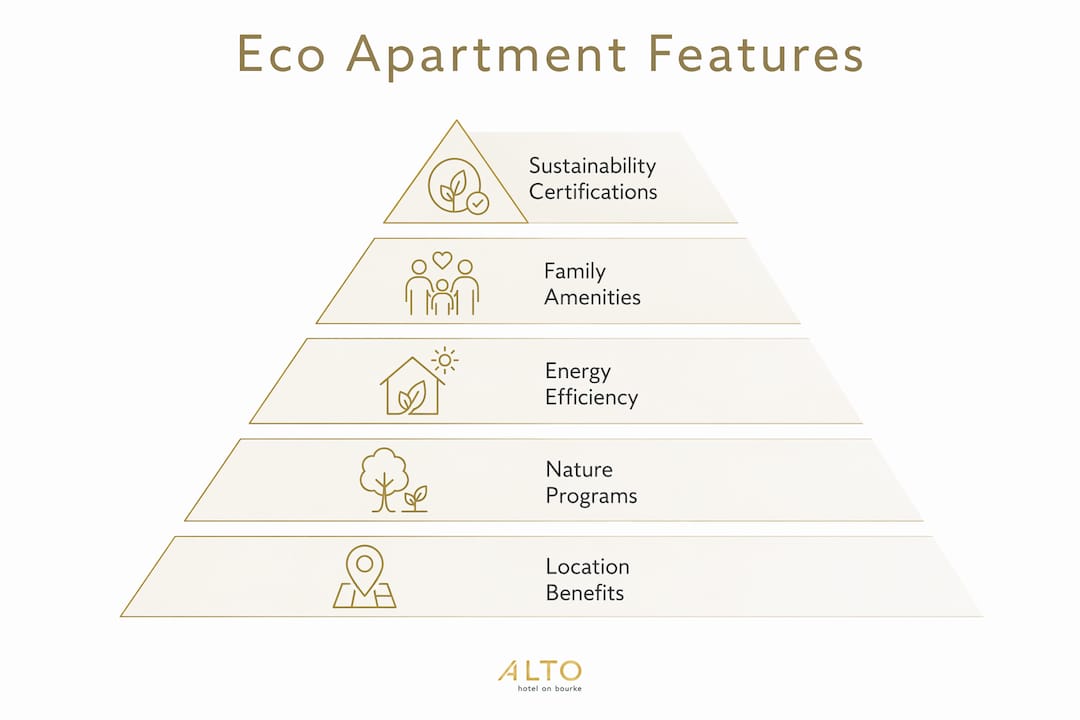
A family eco apartment does more than swap plastic toiletries for bamboo ones. The defining features are structural: the building's energy systems, water management, waste practices, and the degree to which sustainability is embedded in the guest experience rather than applied as a surface layer.
Core eco features in genuine family eco apartments:
- Solar or renewable energy powering common areas and, ideally, individual apartments.
- Natural heating and cooling systems. Sustainable climate control in Australian eco stays often relies on passive design, cross-ventilation, and thermal mass rather than energy-intensive air conditioning. Families travelling in summer should verify that the approach keeps rooms comfortable in Queensland heat.
- On-site composting and food waste reduction, often involving guests directly.
- Low-energy lighting and smart power management across the building.
- Water-efficient fixtures and greywater recycling where local regulations permit.
The family-specific layer sits on top of that foundation. Kitchens reduce single-use packaging from takeaway meals. Separate bedrooms mean children can sleep without disrupting adults. Play areas built from natural or recycled materials reinforce the sustainability message without a lecture. Some properties, like RACV Noosa Resort, go further with on-site organic gardens where children can participate in growing and harvesting food.
Childcare services in eco accommodations increasingly incorporate nature-based learning, with facilities designed around outdoor play and environmental discovery rather than screen-based entertainment. That shift reflects a broader understanding that children engage with sustainability most effectively when they are physically part of it.
The family apartment hotel versus traditional hotel comparison is worth making explicitly: apartment-style stays give families the autonomy to manage meals, schedules, and space in ways that a standard hotel room simply cannot match.
How Australian eco accommodations teach children about sustainability
The most effective sustainability education for children at eco stays avoids the classroom format entirely. Six Senses' Climate Warriors programme, which pioneered climate education in the hotel sector, is built on a principle that transfers directly to Australian family eco stays: children learn by doing, not by listening. Building a solar oven, harvesting vegetables, sorting recyclables, and joining a beach cleanup all create the "look what I've done today" moment that abstract lessons cannot.
Australian eco accommodations that do this well share a common structure. Activities have a task, a tool, and a visible outcome. Children leave with something tangible, whether that is a keepsake made from reclaimed materials, a plant they have grown, or a turtle monitoring record they have contributed to. The ecoBirdy circular workshop model, where children collect beach plastic and reshape it into a personal pendant, shows how a single activity can cover waste, circularity, and ocean conservation without once feeling like a lesson.
What effective family eco engagement looks like in practice:
- Beach cleanups tied to local conservation data, so children see the direct impact of their effort.
- Upcycling workshops that turn waste materials into something the child keeps and takes home.
- Garden-to-table sessions where children grow, harvest, and eat produce from the property's kitchen garden.
- Guided reef or wildlife education with a local naturalist, connecting the stay to the broader ecosystem.
- Energy and water challenges that gamify conservation, such as tracking the household's daily water use.
Eco stays that treat sustainability as a shared family discovery rather than a scheduled activity tend to produce the most lasting effect. When parents participate alongside children, the values shift from "something we did on holiday" to something the family continues at home.
One practical note: reduced daily services are standard in eco accommodations. Less frequent housekeeping, limited WiFi in some remote properties, and expectations around bringing your own cot bedding are all part of the model. Framing these as part of the sustainability experience, rather than inconveniences, helps children understand that every resource decision has a reason.
Altohotel: Melbourne's eco boutique alternative for families
The properties compared above are all resort or apartment-hotel scale, which suits families wanting a full-service holiday experience. If your family is visiting Melbourne and you want something smaller, more personal, and with a verified environmental track record, Altohotel offers a genuinely different approach.
Altohotel on Bourke is one of Melbourne's first environmentally rated hotels, recognised in the Victorian tourism sector's Hall of Fame for its sustained commitment to sustainability. The hotel features studio and apartment-style rooms built with eco-conscious materials, and its partnerships with local artisans mean the guest experience connects directly to Melbourne's creative community. For families who want a city base with real green credentials rather than a resort package, it sits in a category of its own.
Altohotel suits families travelling to Melbourne for cultural visits, school holiday programmes at the city's museums and galleries, or simply wanting a central, comfortable base that does not compromise on environmental values. You can explore the urban boutique hotel option or book directly at altohotel.com.au.
Key takeaways
The best apartment-style eco stays for Australian families combine multi-bedroom living space, full kitchens, and independently verified sustainability credentials with hands-on education programmes that give children a direct role in conservation.
| Point | Details |
|---|---|
| Space is non-negotiable | Full kitchens and separate bedrooms define a genuine family apartment stay, not just a larger hotel room. |
| Verify eco credentials independently | Ask for third-party certifications such as Ecotourism Australia rather than relying on self-declared claims. |
| Hands-on education beats passive learning | Children retain sustainability lessons from activities with a task, a tool, and a visible outcome. |
| Expect reduced daily services | Eco stays typically offer less frequent housekeeping; bring your own cot bedding for remote properties. |
| Altohotel for Melbourne city stays | Altohotel on Bourke is one of Melbourne's first environmentally rated hotels, suited to families wanting a verified eco city base. |