
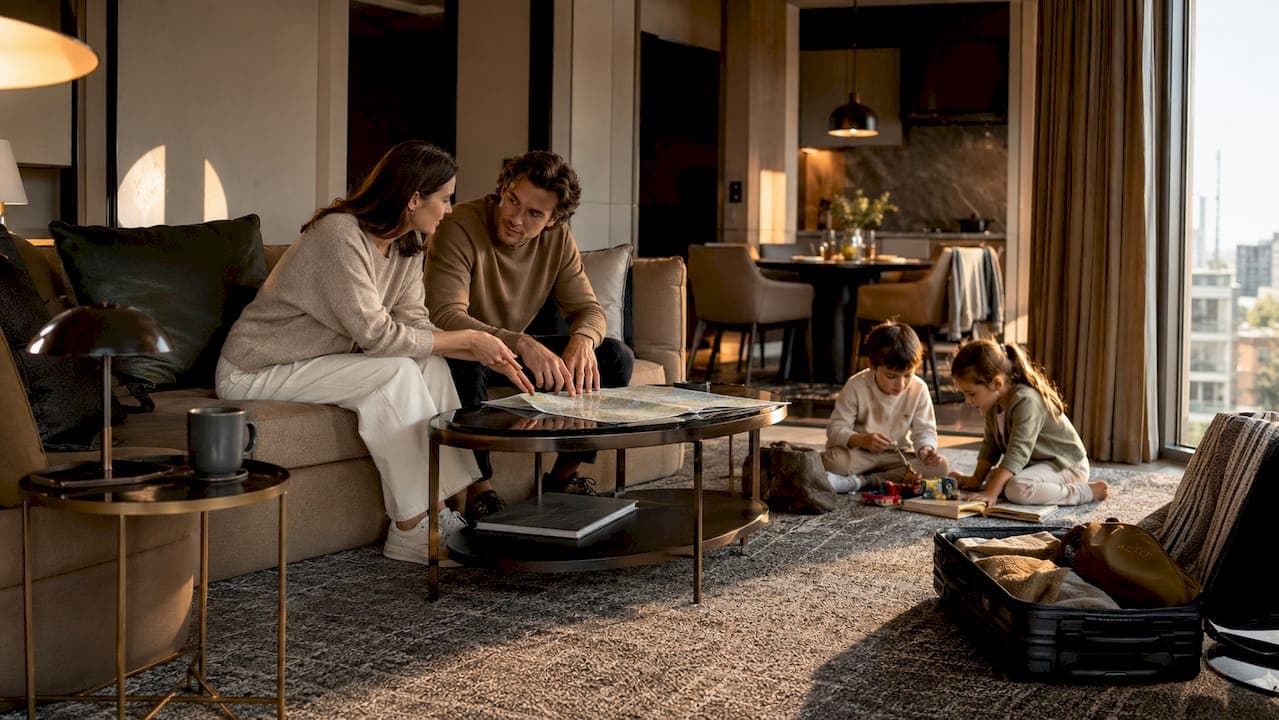
A family apartment hotel is defined as a self-contained lodging option that combines home-like living spaces with hotel services, offering separate bedrooms, a kitchen, and a living area within a single unit. The core difference between a family apartment hotel and a traditional hotel room is space and autonomy. Traditional hotels deliver daily housekeeping, 24/7 reception, and on-site dining, while apartment hotels trade some of those services for larger layouts and the freedom to cook, do laundry, and live at your own pace. For families, understanding what is family apartment hotel difference means choosing between convenience and comfort on every trip.
What is the family apartment hotel difference in room layout and space?
Apartment hotels offer 30–50% more space than standard hotel rooms. That extra square footage is not just a luxury. It is the difference between a family sharing one room and a family actually living comfortably across separate spaces.
A traditional hotel room consolidates everything into one area. The bed, the desk, the television, and the luggage all compete for the same floor space. An apartment hotel unit separates the living room, dining area, kitchen, and bedrooms into distinct zones. That separation matters enormously when you have a toddler who needs to sleep at 7pm while the adults want to watch a film.
Separate bedrooms for children and parents improve bedtime routines and give adults genuine privacy after a long day of sightseeing. Soundproofing and layout design also play a larger role in family comfort than most travellers realise when booking. A well-designed apartment hotel unit reduces noise transfer between sleeping areas, which is something a single hotel room simply cannot replicate.
| Feature | Traditional hotel room | Family apartment hotel |
|---|---|---|
| Sleeping areas | One shared room | Separate bedrooms |
| Kitchen access | Mini-bar or none | Full kitchen with appliances |
| Living space | Integrated with sleeping area | Separate lounge and dining zone |
| Laundry | Paid hotel laundry service | In-unit or on-floor machines |
| Space advantage | Standard | 30–50% more than hotel rooms |
Pro Tip: When comparing apartment hotel listings, filter by the number of bedrooms rather than the number of guests the listing claims to accommodate. A unit rated for four guests in one room is very different from a two-bedroom apartment.
What services and amenities do family apartment hotels provide?
Hotels provide daily housekeeping, 24/7 reception, and room service, while apartment hotels typically offer scheduled or weekly housekeeping and self-service facilities. That shift in service model is the defining operational difference between the two property types.
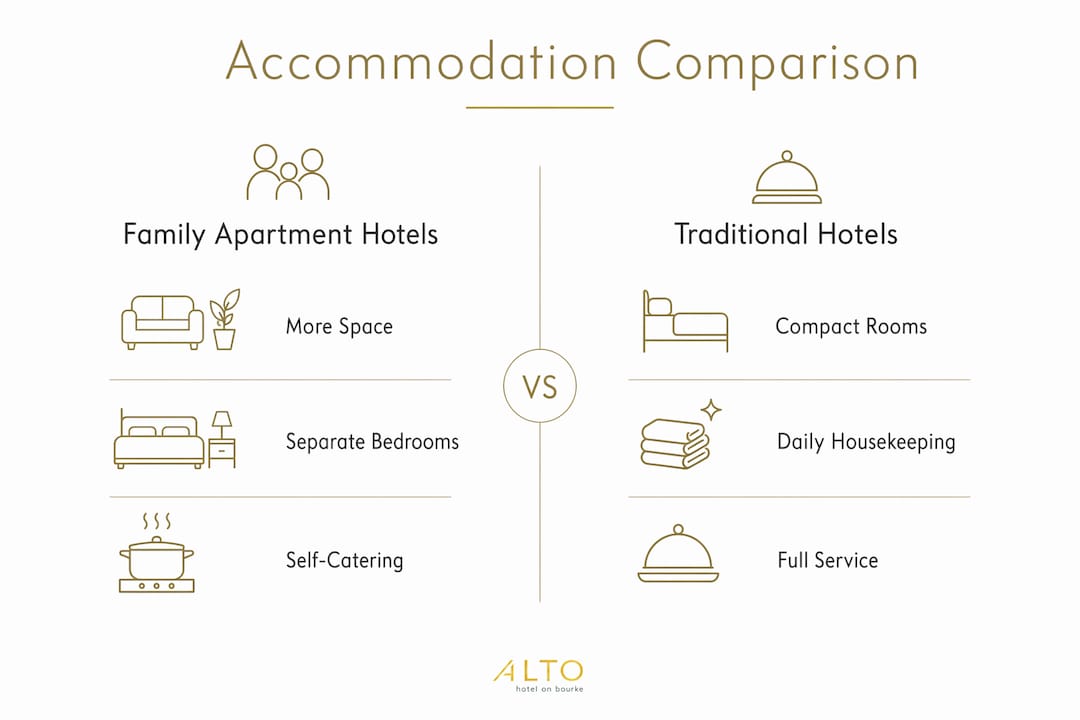
For families, the trade-off is worth understanding before you book. Daily housekeeping in a hotel means staff entering your room every morning, which can disrupt nap schedules, interrupt a sleeping baby, or simply feel intrusive. Serviced apartments reduce in-room interruptions by scheduling housekeeping less frequently, which gives families more control over their own space and routine.
Typical amenities in each accommodation type break down as follows:
Traditional hotel family amenities:
- Daily room cleaning and fresh towels
- 24/7 front desk and concierge support
- On-site restaurant and room service
- Pool, gym, and kids' club at larger properties
- Luggage storage and valet parking
Family apartment hotel amenities:
- Full kitchen with stovetop, oven, and fridge
- In-unit or shared laundry facilities
- Separate living and dining areas
- Weekly or on-request housekeeping
- More storage space for prams, luggage, and gear
Pro Tip: Before booking an apartment hotel, confirm whether the kitchen is fully equipped or just a kitchenette. A kitchenette with only a microwave and bar fridge will not support proper meal preparation for a family.
How do cost and stay duration affect your accommodation choice?
Hotels suit short stays of one to two nights, while serviced apartments deliver better value for trips of three nights or longer. The logic is straightforward. A hotel's full-service model is priced to cover all those included amenities, whether you use them or not.
For a family of four eating out three times a day in a city like Melbourne, dining costs alone can become the largest line item in the travel budget. Kitchen facilities in apartment hotels support meal preparation and reduce the need to eat every meal at a restaurant. Breakfast and lunch prepared in the apartment can cut daily food costs significantly, and that saving compounds over a week-long trip.
Hidden hotel fees including resort charges, parking, and dining can increase the total cost by 50% or more above the advertised nightly rate. Families who book a hotel based on a headline price often find the final bill looks very different at checkout.
When deciding between the two property types based on your trip, work through these factors in order:
- Trip length. One or two nights favours a traditional hotel. Three or more nights favours an apartment hotel on total cost.
- Group size. Larger families need more space, which apartment hotels provide at a lower per-person cost.
- Dietary needs. Families with allergies, fussy eaters, or specific dietary requirements benefit from kitchen access.
- Budget transparency. Compare the all-in cost including parking, breakfast, and fees before deciding.
- Service needs. If you want a concierge, daily cleaning, and on-call support, a full-service hotel is the better fit.
For guidance on how to choose family accommodation near attractions and transport, location research is just as important as the room type itself.
What are the practical benefits of apartment hotels for families with children?
Apartment hotels suit families with children better than traditional hotels across most stay scenarios longer than two nights. The reasons are practical, not aspirational. More space, kitchen access, and separate sleeping areas solve real problems that families face every day on the road.
Apartment hotels often provide better soundproofing and family-oriented layouts than standard hotel rooms. Children who sleep in a separate bedroom are less likely to be woken by adult conversation, television noise, or a late-night phone call. That alone can transform the quality of a family holiday.
| Family benefit | How apartment hotels deliver it |
|---|---|
| Children's sleep routine | Separate bedrooms reduce noise disruption |
| Dietary flexibility | Full kitchen supports any meal at any time |
| Space for play or study | Living area separate from sleeping zones |
| Laundry for kids' clothes | In-unit machines handle daily washing |
| Privacy for parents | Adults can relax after children are in bed |
Families travelling with infants also benefit from the extra storage space. Prams, portacots, nappy bags, and feeding equipment take up significant floor space. A single hotel room leaves nowhere to put any of it. The benefits of urban boutique hotels for families that offer apartment-style layouts are particularly clear in cities where room sizes in standard hotels tend to be compact.
How do location and operational hours affect family stays?
Hotels maintain 24/7 front desk access, while many apartment hotels operate with limited reception hours. That difference matters most when flights are delayed, children get sick at midnight, or you simply need help at an unusual hour.
Families should check the following operational details before confirming any apartment hotel booking:
- Reception hours. Confirm whether the desk is staffed around the clock or closes in the evening.
- After-hours check-in. Ask whether a key lockbox or digital access system is available for late arrivals.
- Emergency contacts. Identify who to call if something goes wrong outside business hours.
- Proximity to medical facilities. Families with young children should note the nearest hospital or after-hours clinic.
- Transport access. Apartment hotels in residential areas may be further from public transport than city-centre hotels.
Location shapes the entire experience of a family stay. Booking based solely on style or price without checking proximity to family-friendly attractions adds unnecessary travel time and stress to every day of the trip. A well-located apartment hotel near parks, supermarkets, and public transport removes friction from the daily routine in a way that a stylish but isolated property cannot.
Hotels are designed for short, standardised stays with full-service support, while apartment hotels are built around longer stays and home-like independence. Understanding that operational difference helps families set realistic expectations before they arrive.
Key takeaways
The most effective way to choose family accommodation is to match the property type to your trip length, group size, and service expectations before comparing prices.
| Point | Details |
|---|---|
| Space advantage | Apartment hotels offer 30–50% more space than standard hotel rooms. |
| Cost and stay length | Hotels suit one to two nights; apartment hotels save money on trips of three nights or more. |
| Service trade-off | Apartment hotels offer less daily service but more privacy and fewer interruptions for families. |
| Hidden hotel fees | Resort charges, parking, and dining can add 50% or more to a hotel's advertised rate. |
| Operational hours | Confirm reception hours and after-hours access before booking any apartment hotel. |
Why I always recommend apartment hotels for family trips of three nights or more
The hotel versus apartment debate gets framed as a luxury question, but for families it is really a practicality question. I have stayed in both property types with children in tow, and the difference is not subtle.
The moment you have a child who needs to sleep at 7pm and a partner who wants to decompress with a glass of wine and a conversation at a normal volume, a single hotel room becomes a negotiation. An apartment hotel removes that negotiation entirely. The kids go to bed in their room. The adults exist in theirs. That is not a small thing after a full day of travel.
The pitfall I see families fall into is expecting apartment hotels to operate like full-service hotels. They do not. If you arrive at 11pm and the reception closed at 8pm, you need to have sorted your key access in advance. If you want your room cleaned every morning, you will be disappointed. These are not flaws. They are features of a different service model, and families who understand that going in have a much better experience.
My honest advice: prioritise family-friendly apartment options that are transparent about their operational hours and housekeeping schedule. Read the fine print on kitchen equipment. And always check the location on a map relative to where you actually plan to spend your time. A beautiful apartment hotel that adds 40 minutes of transport to every outing is not the bargain it appears to be.
— Kamal
Altohotel's apartment-style rooms for families in Melbourne
Families visiting Melbourne have a strong option in Altohotel, one of the city's first environmentally rated boutique hotels on Bourke Street. The property offers apartment-style accommodation with the boutique hotel conveniences that make a family stay genuinely comfortable rather than just functional.

The 2 Bedroom Sleepover apartments at Altohotel are designed with families in mind, providing separate sleeping areas, kitchen facilities, and the kind of space that makes a multi-night Melbourne stay feel like a home base rather than a hotel room. Altohotel has earned Hall of Fame recognition in the Victorian tourism sector, and its eco-conscious design means families can travel with less environmental guilt. For families who want more space without sacrificing location or quality, Altohotel's 2-bedroom apartment options are worth a close look before your next Melbourne trip.
FAQ
What is an apartment hotel?
An apartment hotel, also called a serviced apartment or aparthotel, is a property that combines hotel services with self-contained apartment-style units including a kitchen, separate bedrooms, and a living area.
Are apartment hotels better than hotels for families?
Apartment hotels are generally better suited for families on trips of three nights or more, offering more space, kitchen access, and separate bedrooms that support children's routines and parental privacy.
How much more space do apartment hotels offer compared to hotels?
Apartment hotels typically offer 30–50% more space than standard hotel rooms, with separate living, sleeping, and dining areas rather than a single combined room.
Do apartment hotels have daily housekeeping?
Most apartment hotels provide weekly or on-request housekeeping rather than daily service. That schedule reduces interruptions for families but means rooms are not cleaned every morning.
What hidden costs should families watch for in traditional hotels?
Resort fees, parking charges, and dining costs can add 50% or more to a hotel's advertised nightly rate, making the total cost significantly higher than the headline price suggests.