

Eco-friendly hotel stays are not automatically more expensive for guests, and for operators, green upgrades typically raise upfront costs while cutting ongoing bills. Travellers booking certified sustainable accommodation in Australia often pay a modest premium, but that premium usually covers real infrastructure, not marketing spin. Hoteliers face the harder maths: capital outlays on solar, water systems and electrification can run into hundreds of thousands of dollars, yet the operational savings and asset resilience that follow tend to justify the spend over a 10–25 year horizon. Ecotourism Australia's certification programme, Australian government business grants, and the example of Alto Hotel on Bourke all point the same direction: the trade-off is front-loaded cost versus long-run savings and guest value.
For travellers:
- Look for Ecotourism Australia certification or equivalent labels before accepting a higher rate; certified properties justify their pricing with verifiable practices.
- Book directly with the property to keep more revenue flowing to local sustainability programmes rather than intermediary commissions.
For hoteliers:
- Capital costs concentrate in energy systems (solar, heat pumps, electrification) and water infrastructure (greywater recycling, low-flow fixtures).
- Quick wins like LED retrofits, linen opt-out programmes and smart thermostats deliver rapid payback and require minimal disruption.
The central trade-off is straightforward: higher upfront capital, lower operating costs over time, and a guest base willing to pay a small premium for credible sustainability.
Table of Contents
- What does an eco-friendly hotel actually look like?
- How do eco-friendly hotel expenses actually affect operator costs?
- Which sustainability measures should small and medium hotels prioritise?
- Are eco stays more expensive for travellers, and how do you avoid overpaying?
- Which Australian certifications actually mean something?
- How do you categorise eco hotel stays and green investments in Australian accounts?
- Alto Hotel on Bourke: an Australian case study in cost-conscious sustainability
- Key takeaways
- Why the cost conversation around eco hotels is still being had wrong
- A cost-conscious eco stay in Melbourne, done properly
- Useful Australian sources and further reading
What does an eco-friendly hotel actually look like?
The term gets used loosely, so it helps to anchor it in the operational decisions that actually change a hotel's cost structure. An eco-friendly hotel is one that systematically reduces its environmental footprint across energy, water, waste, procurement and guest programming, and can demonstrate that reduction through measurable outcomes or third-party verification.
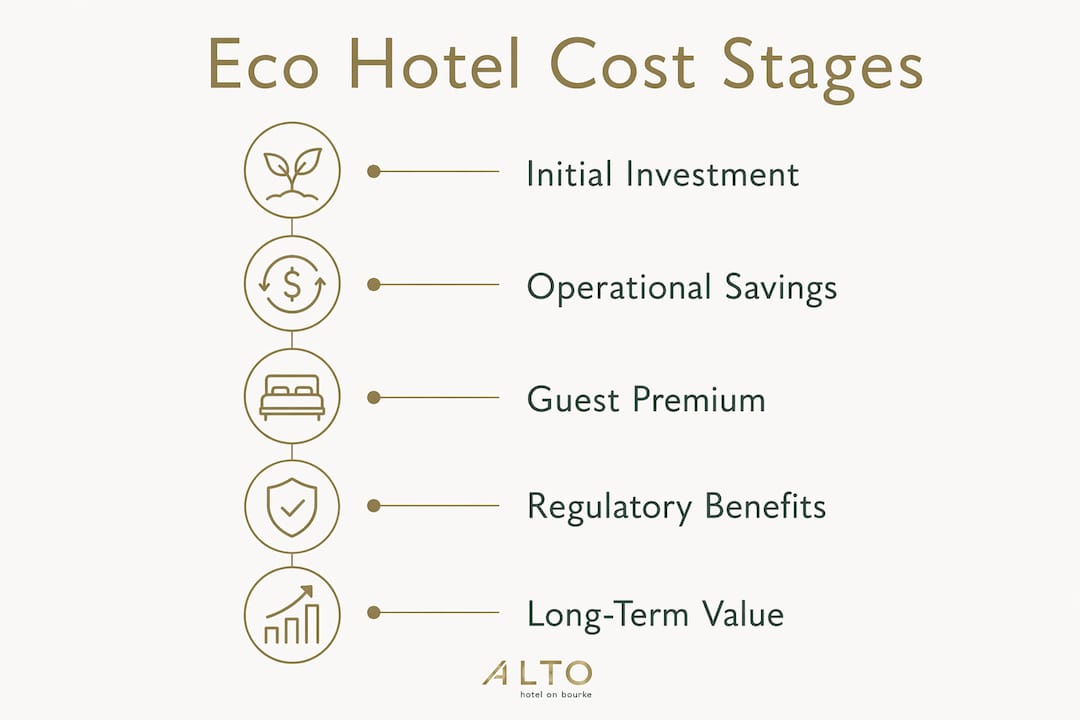
On the energy side, that typically means on-site renewable generation (rooftop solar is the most common in Australia), high-efficiency HVAC systems, heat pump hot water, and occupancy-based lighting and climate controls. Water measures include low-flow showerheads and taps, dual-flush toilets, greywater recycling for irrigation or toilet flushing, and rainwater capture where site conditions allow. Waste programmes cover kitchen composting, single-use plastic elimination, and supplier packaging requirements.
Procurement choices matter too, and they show up in the guest experience. Local and seasonal food sourcing, Australian-made toiletries, and partnerships with local artisans all reduce transport emissions while giving guests something genuinely distinctive. Some properties include conservation levies or curated local experiences in the room rate rather than selling them as extras, which bundles the environmental cost into a transparent price rather than hiding it.
The credibility gap between genuine eco-friendly lodging and self-declared "green" marketing is wide. Verification through a recognised certification scheme is what separates the two. Without it, a hotel's sustainability claims are unaudited and, from a guest's perspective, unverifiable.
How do eco-friendly hotel expenses actually affect operator costs?
This is where the numbers get interesting, and where most commentary oversimplifies. Green upgrades split cleanly into two buckets: capital items that sit on the balance sheet and operational measures that show up in monthly bills.

A mid-sized 100-room property might invest substantial amounts in rooftop solar and greywater recycling systems, amortised over a decade or more. Those are fixed asset additions, not operating expenses. The payback logic is that energy and water bills fall year after year, and the cumulative saving eventually exceeds the capital outlay. Leading eco-hotels have reported carbon reductions of up to 90% compared with conventional properties, with water conservation measures saving 200 or more gallons per room per day in some cases.
The Radisson net-zero hotel in Manchester offers a useful data point for electrification specifically. After spending over $1 million to electrify operations, the property reported energy costs roughly the same as before conversion one year on, despite higher unit electricity prices. Analysts modelling that project put the payback window at 15–25 years depending on financing structure. That is a long horizon, but the asset is now insulated from fossil fuel price volatility and future building emissions regulations.
The table below maps common green investments against the dimensions that matter most for operator decision-making, describing relative cost, savings, payback timelines, and other factors without specifying precise numeric values.
Pro Tip: Stage your capital investments rather than attempting a full conversion at once. Start with LED retrofits and smart thermostats (payback under three years), use the operational savings to fund the next tier, and model the larger items like solar and greywater as a second or third phase. This approach reduces cash pressure and lets you demonstrate measurable results to lenders or grant assessors before committing to the bigger spend.
Electrification also protects asset value against tightening building and emissions regulations. Australian states are progressively strengthening commercial building energy requirements, and a property that has already electrified faces far less retrofit risk than one still running gas systems.
Which sustainability measures should small and medium hotels prioritise?
Not every measure makes sense for every property. The practical question is which investments deliver the best return for the capital and disruption involved. Here is a ranked approach by cost class.
Low-cost quick wins (under AU$10,000, payback under three years)
- LED lighting retrofit across all guest rooms and common areas. Operational savings are immediate and the technology is mature. Low-cost measures like LEDs and energy controls consistently rank as the fastest ROI items for smaller hotels.
- Occupancy-based thermostats and key-card energy controls. Prevents heating and cooling empty rooms, which is one of the largest sources of avoidable energy waste in hotels.
- Linen and towel opt-out programme. Reduces laundry frequency, water use, and chemical costs with no capital outlay. Guest uptake is typically high when framed as an environmental choice rather than a cost-cutting measure.
- Eliminating single-use plastics in rooms and food service. Reduces procurement costs over time and removes a visible greenwashing red flag.
Medium investments (AU$10,000–AU$100,000, payback three to eight years)
| Measure | Typical cost range | Key saving | Notes |
|---|---|---|---|
| Low-flow showerheads and taps | AU$10,000–AU$100,000 | Water and hot water energy | Minimal disruption, fast payback |
| Heat pump hot water system | — | Hot water energy costs | Replaces gas or resistive electric |
| Kitchen electrification (induction) | — | Gas costs, Scope 1 emissions | Disruption during changeover |
| Local and seasonal food procurement | Minimal capital | Reduced transport costs, fresher product | Requires supplier relationship management |
| Waste diversion and composting | under AU$10,000 | Reduced landfill levies | Staff training required |
High-capital investments (AU$100,000+, payback 10–25 years)
Rooftop solar, greywater recycling, and full electrification fall into this category. These are genuine fixed asset additions that require capital planning, often with access to Australian government grants or green finance. The payback windows are long, but the operational savings compound and the asset value argument is strong. High-efficiency HVAC systems also belong here for larger properties.
For a small boutique hotel, the practical sequence is: complete all quick wins first, then stage medium investments as cash flow allows, and plan high-capital items with grant funding and long-term financing in mind. Measuring energy and water consumption before and after each stage gives you the data to justify the next investment internally and to certification assessors.
Are eco stays more expensive for travellers, and how do you avoid overpaying?
The short answer: yes, certified sustainable accommodation often carries a small premium, but it is usually modest and frequently justified. Eco-certified hotels often command an average price premium in the low single digits to mid single digits. Research on tourist willingness to pay for local green certification found that over 50% of travellers were willing to pay incremental nightly premiums, with a lower-bound mean around US$1.55 per night.

What that premium actually funds matters. A higher nightly rate at a genuinely sustainable property often bundles conservation levies, guided experiences and amenity packages that would otherwise be sold as extras. You are not paying more for the same thing; you are paying for a different thing. The guest experience at a well-run eco property tends to include healthier room environments, quieter spaces (a natural outcome of better insulation and lower-density layouts), and locally sourced food and materials that a conventional hotel simply does not offer.
What to check before accepting a premium rate:
- Is the property certified by Ecotourism Australia or another recognised scheme? Self-declared "eco" claims without third-party verification are a red flag.
- What is included in the rate? Conservation levies, local experiences, and sustainable amenities bundled into the price represent genuine value.
- Does the property source food and materials locally? This is one of the clearest indicators of authentic commitment rather than surface-level greenwashing.
- Are the sustainability measures visible and specific? Vague language about "caring for the environment" with no operational detail is a warning sign.
For booking tactics, booking directly with the property is the most effective way to direct revenue to local sustainability initiatives rather than losing a share to intermediary commissions. Direct bookings also tend to unlock exclusive rates and packages not available through third-party platforms. Timing matters too: shoulder season rates at eco properties can bring the nightly cost well within range of conventional alternatives, making the sustainability premium effectively zero.
A useful guide for travellers is the sustainable hotel booking checklist on the Altohotel blog, which walks through the key questions to ask before confirming a booking.
Which Australian certifications actually mean something?
Certification is the mechanism that converts a hotel's sustainability claims into something a guest or business travel manager can rely on. In Australia, the most relevant scheme is Ecotourism Australia.
Ecotourism Australia operates the ECO Certification programme, which assesses properties across environmental, social and economic sustainability criteria. There are three tiers: Ecotourism, Advanced Ecotourism, and Nature Tourism. Properties must meet independently audited standards covering waste management, energy and water use, community engagement, and interpretation of natural or cultural values. Certification is renewed regularly, which means a certified property is not coasting on a one-time assessment. For hoteliers, the process involves an application fee, documentation of practices, and an audit; the credibility signal to guests is significant, particularly for international visitors familiar with the scheme.
Other relevant labels and schemes:
- Green Star (Green Building Council of Australia): Applies to the building itself rather than operations. A Green Star-rated building signals that the physical structure was designed or retrofitted to high environmental standards, which underpins operational sustainability claims.
- NABERS (National Australian Built Environment Rating System): A government-backed rating for energy, water, waste and indoor environment performance. Hotels can obtain a NABERS rating that gives guests and corporate clients a standardised, independently verified performance score.
- EarthCheck: An international certification used by some Australian properties, particularly in the resort and tourism sector. Recognised by corporate travel programmes globally.
For travellers, the practical rule is: look for environmentally rated boutique hotels that carry at least one of these labels, and treat unverified "eco" branding with scepticism. For hoteliers, the cost of certification is modest relative to the credibility it provides, and it is a prerequisite for accessing some government tourism grant programmes.
Ecotourism Australia's official guidance and certification applications are available at ecotourism.org.au. NABERS information and self-assessment tools are at nabers.gov.au.
How do you categorise eco hotel stays and green investments in Australian accounts?
For business travellers, hotel accommodation sits in the travel and accommodation expense category. This applies whether the property is conventional or eco-certified; the sustainability credentials of the hotel do not change how the expense is classified. GST-registered businesses can claim the GST component on accommodation expenses in the normal way, provided the stay has a business purpose and is properly documented with a tax invoice.
For hoteliers, the accounting treatment of green upgrades depends on the nature of the expenditure:
- Capital items (rooftop solar, greywater systems, heat pumps, HVAC upgrades): these are depreciable assets under Australian tax law. They sit on the balance sheet and are depreciated over their effective life. The ATO's effective life schedules provide guidance on depreciation rates for specific asset classes.
- Operational measures (LED bulbs, low-flow fixtures, waste diversion programmes): lower-cost items may be immediately deductible as operating expenses, depending on their cost and the applicable instant asset write-off threshold in the relevant financial year.
- Government grants and incentives: amounts received under Australian government grant programmes reduce the cost base of the relevant asset or are assessable income depending on the programme's terms. Always confirm treatment with a registered tax agent.
Practical documentation steps:
- Retain tax invoices for all capital purchases and installation costs.
- Record energy and water meter readings before and after each upgrade to substantiate operational savings claims.
- Keep grant application documentation and acquittal records.
- Track operating savings separately in your management accounts so you can demonstrate ROI to lenders or future grant assessors.
Australian hoteliers should check the business.gov.au grants and programmes finder for current federal and state incentives relevant to energy efficiency and sustainability upgrades. State-level programmes vary; in Victoria, for example, the Victorian Energy Upgrades programme provides financial incentives for eligible energy efficiency improvements in commercial buildings.
This section is general information only. Consult a registered tax agent or accountant for advice specific to your property and circumstances.
The Altohotel blog post on eco hotel room economics covers the capital versus operating cost logic in more detail for hoteliers working through their own investment cases.
Alto Hotel on Bourke: an Australian case study in cost-conscious sustainability
Alto Hotel on Bourke occupies a specific and instructive position in the Australian market: it was among the first environmentally rated hotels in Melbourne, which means its sustainability choices predate the current wave of green hotel marketing. The decisions made there were operational and economic, not cosmetic.
The hotel's approach reflects the staged investment logic described earlier in this article. Eco-conscious materials were specified at fit-out, reducing the need for costly retrofits later. Energy measures, water-efficient fixtures, and partnerships with local artisans and suppliers were built into the operating model from the outset rather than added as afterthoughts. The result is a property where sustainability is embedded in the cost structure rather than layered on top of it.
For guests, this translates into rooms and apartments that use sustainable materials, in-room kitchen facilities that reduce the need for resource-intensive restaurant meals, and a quieter, lower-density environment that is a direct outcome of considered design rather than a marketing claim. The benefits of locally curated hotel experiences are visible in the sourcing choices and partnerships that distinguish the property from conventional city hotels.
Alto Hotel on Bourke has received Hall of Fame recognition in the Victorian tourism sector, which reflects sustained performance rather than a single-year result. For hoteliers looking at the business case for sustainability, that kind of long-run recognition is the outcome of consistent operational choices, not a one-off certification exercise.
The direct booking model matters here too. When guests book directly with Alto Hotel, a greater share of the revenue stays with the property and the local programmes it supports, rather than flowing to third-party platforms. That is both a financial and a sustainability argument for direct booking, and it is one that eco-conscious travellers increasingly understand.
For hoteliers drawing practical lessons: the Alto Hotel model demonstrates that sustainability and commercial viability are not in tension when the investment decisions are staged, the guest communication is honest, and the certification is genuine. The boutique hotel benefits that flow from this approach, including stronger guest loyalty and premium positioning, compound over time.
Key takeaways
Eco-friendly hotel stays cost more upfront for operators and carry a modest guest premium, but both are offset by operational savings, asset resilience, and measurable environmental outcomes.
| Point | Details |
|---|---|
| Guest premium is modest | Certified sustainable hotels in Australia often command an average price premium in the low single digits to mid single digits, with travellers generally accepting a 5–15% uplift for credible sustainability claims. |
| Capital costs are front-loaded | A 100-room property might invest ~AU$400K in solar and ~AU$150K in greywater recycling, amortised over 10–12 years. |
| Quick wins pay back fast | LED retrofits, smart controls, and linen opt-out programmes typically pay back within one to three years. |
| Certification matters | Ecotourism Australia, NABERS, and Green Star ratings convert sustainability claims into verifiable, guest-trusted credentials. |
| Altohotel as a working example | Alto Hotel on Bourke demonstrates staged sustainable investment with Hall of Fame Victorian tourism recognition and a direct booking model that keeps revenue local. |
Why the cost conversation around eco hotels is still being had wrong
Most commentary on sustainable accommodation frames the cost question as a binary: eco stays cost more, or they do not. The more useful frame is when costs occur and who bears them.
Operators carry the upfront capital burden. Guests pay a modest premium that reflects real infrastructure. And both parties benefit from outcomes that a conventional hotel cannot offer: lower energy bills, better indoor environments, genuine local economic contribution, and an asset that is not exposed to fossil fuel price shocks or tightening building regulations. The sustainable travel sector in Australia is not a niche anymore; it is the direction the market is moving, and the properties that have already made the investment are better positioned than those waiting for costs to fall further.
What gets underestimated is the compounding effect of small measures. A linen opt-out programme costs nothing to implement and reduces laundry costs immediately. An LED retrofit pays back in under three years. Those savings fund the next tier of investment. The hotels that struggle with sustainability economics are usually the ones that tried to do everything at once rather than building a staged programme with measurable milestones.
The other thing worth saying plainly: a higher nightly rate at a certified eco property is not a premium for virtue signalling. It is a price that reflects what the room actually costs to build, operate, and maintain at a genuine environmental standard. Travellers who understand that tend to be more satisfied guests, not less, because their expectations are calibrated to what they are actually getting. For Australian hoteliers, communicating that clearly, with certification to back it up, is the single most effective way to justify the rate and build the guest loyalty that makes the economics work long-term.
A cost-conscious eco stay in Melbourne, done properly
Alto Hotel on Bourke is Melbourne's answer for eco-conscious travellers who want a genuine sustainable stay without paying a premium for greenwashing. As one of the city's first environmentally rated hotels, it offers rooms, studios, and two-bedroom apartments built around sustainable materials, in-room kitchen facilities, and partnerships with local artisans — all at rates that reflect real infrastructure rather than marketing spin.
Booking directly through the Altohotel website gives you access to exclusive rates and ensures your spend supports the property's local sustainability programmes rather than third-party platforms. Whether you are travelling solo, as a couple, or with family, the Studio Queen and apartment options offer flexible, eco-aware accommodation in the Melbourne CBD. Check availability and book directly at altohotel.com.au.
Useful Australian sources and further reading
The sources below are the most authoritative starting points for hoteliers and travellers seeking official guidance on certifications, grants, and sustainable operations in Australia.
| Source | What it offers |
|---|---|
| Ecotourism Australia | ECO Certification programme for tourism operators; application guidance and certified property directory |
| NABERS | Government-backed energy, water, waste and indoor environment ratings for commercial buildings including hotels |
| Green Building Council of Australia | Green Star ratings for building design and fit-out; relevant for new builds and major refurbishments |
| business.gov.au grants finder | Federal and state grant and incentive programmes for energy efficiency and sustainability upgrades |
| Victorian Energy Upgrades (VEU) | Victorian government financial incentives for eligible commercial energy efficiency improvements |
| University of Queensland — sustainable hotels research | Academic perspective on how hotels can operate sustainably while saving money |
| Altohotel blog — eco hotel economics | Practical capital vs operating cost breakdown for Australian boutique hotel operators |
For sustainable travel inspiration beyond Australia, the green getaways guide from Secret Namibia shows how conservation-focused properties structure their guest experience and pricing, which is a useful reference point for Australian operators thinking about bundled conservation offers.
Consult a registered accountant or tax agent for formal financial planning, and verify current grant eligibility directly with the relevant government programme before applying.