
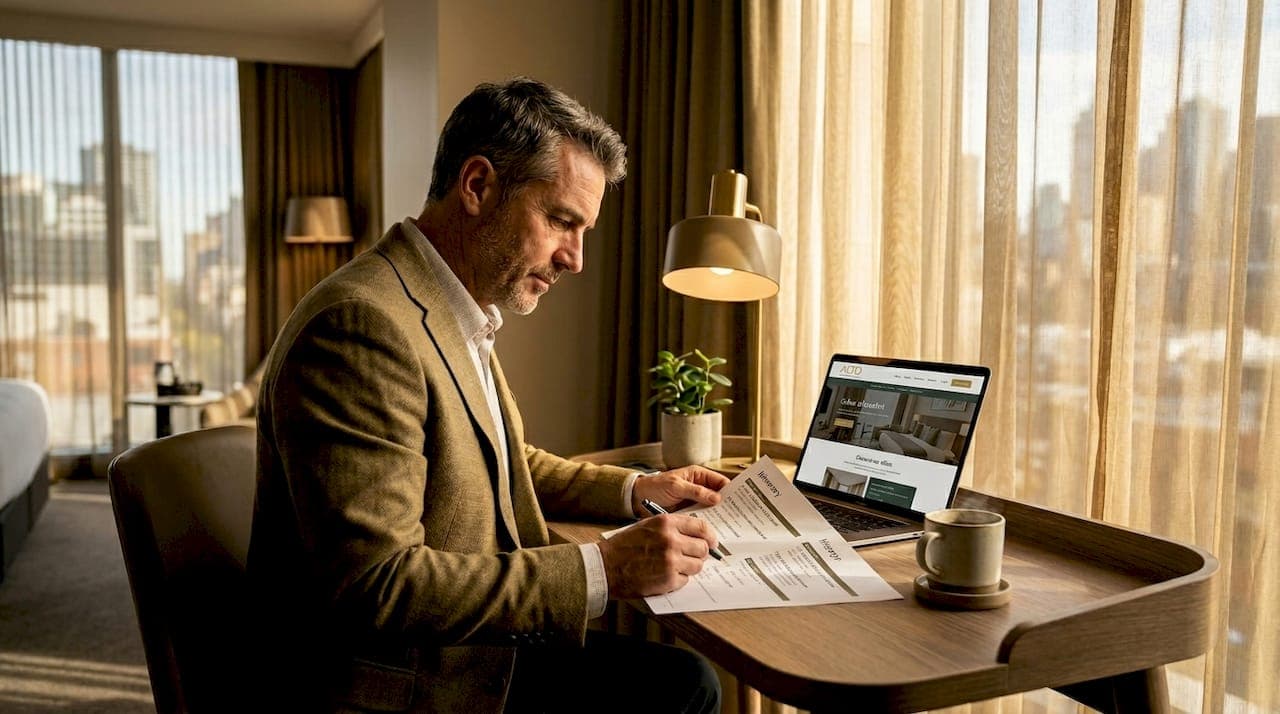
Boutique hotels are defined as intimate properties with 75 rooms or fewer that deliver bespoke, personalised experiences far removed from the standardised formula of large hotel chains. The role of boutique hotels in executive travel has grown considerably as corporate travellers increasingly prioritise authenticity, wellbeing, and sustainability alongside the practical demands of doing business on the road. In 2026, these properties are no longer a niche preference. They sit at the centre of a broader shift in how executives think about accommodation, productivity, and the environmental footprint of every trip they take.
What unique benefits do boutique hotels offer to executive travellers?
Boutique hotels function as what industry observers now call "executive command centres", combining privacy, security, and work readiness in a single, calm environment. Unlike large branded properties where guests can feel anonymous, boutique hotels build their service model around knowing who you are and what you need before you ask. That distinction matters enormously when you are managing a packed schedule across multiple time zones.
The benefits of boutique hotels for executives fall into four clear categories:
- Personalised service: Staff-to-guest ratios are higher, meaning requests around early check-in, late checkout, or a last-minute meeting room are handled without friction.
- Cultural authenticity: Boutique hotels are locally immersive by design, reflecting the neighbourhood, the city, and the community rather than a corporate brand standard. This gives executives a genuine sense of place that supports relationship-building with local clients and partners.
- Work-ready environments: Properties like MOA Berlin demonstrate what business-focused amenities look like in practice: dedicated workspaces, high-speed fibre internet, ergonomic seating, and business centre access that rivals a serviced office.
- Privacy and calm: Smaller guest counts mean quieter corridors, more attentive security, and a general absence of the conference-crowd noise that plagues large convention hotels.
Pro Tip: When booking boutique accommodation for a high-stakes trip, call the property directly and brief the concierge on your schedule. Boutique hotels can pre-arrange meeting spaces, catering, and transport in ways that automated booking platforms simply cannot replicate.
How have boutique hotels entered mainstream corporate travel?
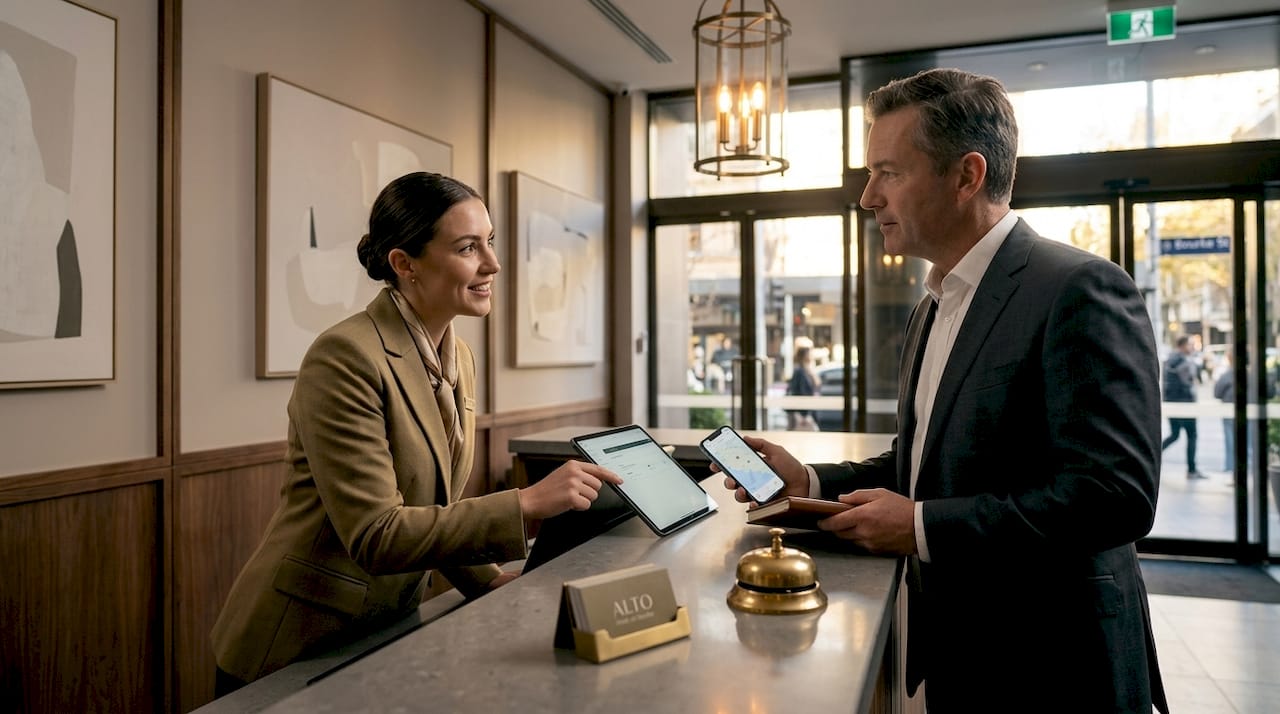
The boutique hotel model has moved well beyond independent operators. By 2026, major hotel groups operate roughly 40 lifestyle brands across more than 2,000 properties and 350,000 rooms. That scale means corporate travel managers can now include boutique-style properties in approved supplier lists without sacrificing the operational consistency their programmes require.
This mainstreaming creates a practical advantage for executives. Marriott's Autograph Collection, Hyatt's Unbound Collection, and IHG's Vignette Collection each offer the aesthetic and service philosophy of independent boutique hotels while sitting inside familiar booking and billing infrastructure. Travel managers can negotiate rates, track spend, and report on sustainability metrics through the same platforms they already use.
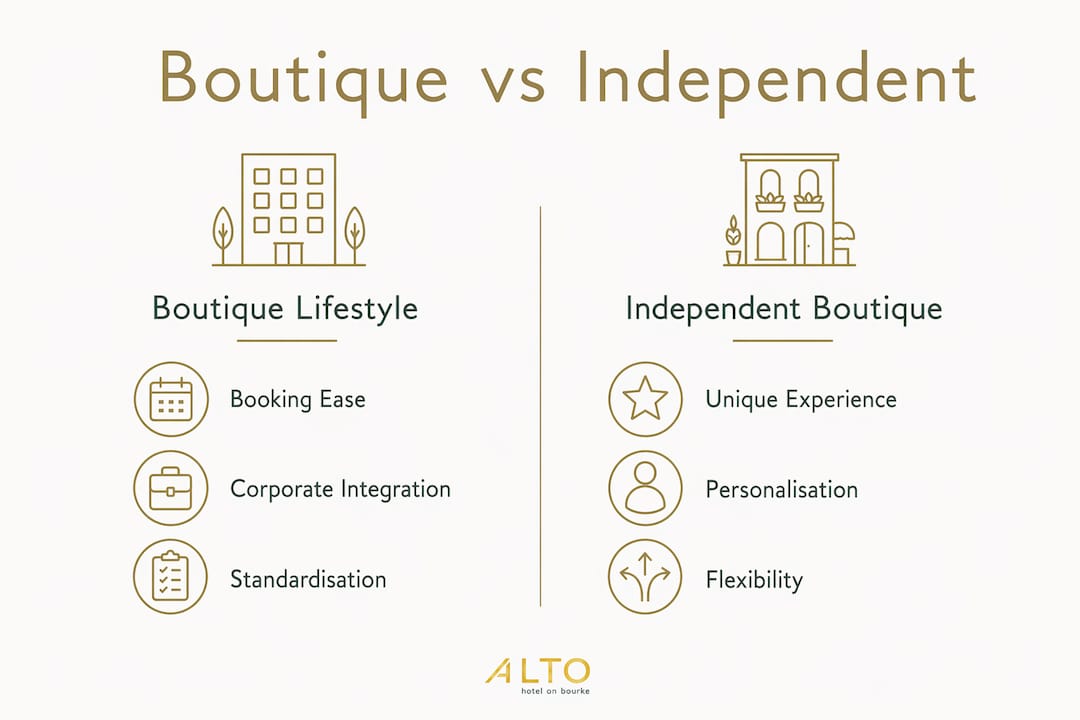
The trade-off is real, though. Boutique uniqueness versus standardised hospitality remains a genuine tension. A property absorbed into a major loyalty programme may retain its design character but gradually lose the operational flexibility that made it distinctive. Executives who value true independence should still seek out properties that operate outside the major group structures.
| Factor | Boutique lifestyle brands (within major groups) | Independent boutique hotels |
|---|---|---|
| Booking integration | Fully integrated with corporate travel platforms | Often requires direct booking or specialist TMC |
| Loyalty programme access | Yes, points accrual available | Rarely, though some join programmes like Small Luxury Hotels |
| Service personalisation | Moderate, guided by brand standards | High, driven by property-level discretion |
| Operational consistency | Reliable across portfolio | Variable, dependent on individual management |
| Cultural authenticity | Partial, filtered through brand guidelines | Strong, reflects local ownership and character |
Why does sustainability matter so much in executive accommodation?
Sustainability has shifted from a preference to a procurement requirement in corporate hotel selection. 76% of travel buyers now include sustainability questions in hotel RFPs, and 63% select suppliers based on sustainability performance. That means a boutique hotel without credible certifications is increasingly invisible to corporate procurement teams, regardless of how good the rooms are.
Boutique hotels that invest in recognised standards gain a measurable competitive edge. 1 Hotel San Francisco holds LEED Gold certification and diverts at least 90% of its waste from landfill. Those are not marketing claims. They are audited outcomes that procurement teams can cite directly in their ESG reporting. For executives whose companies have committed to net-zero travel targets, staying at a certified property is not just a preference. It is a compliance decision.
What makes boutique hotels particularly well-suited to sustainability is the way they operationalise it. Hotel Fortyseven in Rome demonstrates a regenerative luxury model built around low-friction guest touchpoints: refill stations instead of single-use plastics, linen changes on request rather than daily by default, and energy systems linked to key card removal. None of these practices inconvenience a busy executive. They simply remove waste from the system without requiring any behavioural change from the guest.
Executives evaluating boutique properties for sustainability should look beyond marketing language. A guide on choosing an environmentally rated hotel outlines the specific certifications and third-party ratings worth trusting, including EarthCheck, Green Star, and LEED. Greenwashing remains common in hospitality, and the difference between a property that claims sustainability and one that proves it is significant.
Pro Tip: Ask your travel manager to add a minimum certification requirement to your hotel RFP template. Even a single mandatory question about third-party environmental ratings filters out properties that cannot substantiate their claims.
How do boutique hotels support executive productivity?
Productivity in a boutique hotel is less about the number of facilities on offer and more about the quality and accessibility of the ones that matter. Executives do not need a 500-seat ballroom. They need fast, reliable Wi-Fi, a desk that is actually ergonomic, a quiet space to take a call, and a concierge who can solve problems without being asked twice.
The most effective boutique properties approach executive productivity through a structured set of priorities:
- Connectivity as infrastructure: High-speed fibre internet is non-negotiable. The best boutique properties treat connectivity the way they treat hot water. It is always on, always fast, and never the subject of a complaint.
- Dedicated workspaces: Rooms designed with a proper desk, adequate lighting, and accessible power points make a material difference to a full working day. Properties that double the bed as the only flat surface are not suitable for executive travel.
- Concierge integration with executive platforms: Booking travel for executives through platforms like Navan now includes self-service itinerary management and direct integration with boutique hotel selections. This reduces the coordination burden on executive assistants and gives travellers real-time flexibility.
- Stay and work packages: Several boutique properties now offer dedicated "stay and work" packages that bundle room access with private meeting space, catering, and printing facilities. These packages are particularly useful for executives who need to host client meetings without booking a separate venue.
The concierge function at a boutique hotel is genuinely different from its equivalent at a large chain. At a 400-room property, the concierge desk manages volume. At a 60-room boutique hotel, the concierge manages relationships. That distinction translates directly into the quality of support an executive receives when a flight is cancelled, a dinner reservation falls through, or a last-minute brief needs printing at 11pm.
How do boutique hotels compare with large chain hotels for executives?
The choice between a boutique property and a large branded hotel is not a question of quality. It is a question of fit. Large chains offer scale, loyalty point accumulation, and predictable operational standards that matter on certain trips. Boutique hotels offer something different: a stay that reflects where you actually are, not just where your company's preferred supplier list says you should be.
How boutique hotels differ from chain hotels comes down to three practical dimensions. Service personalisation at a boutique property is driven by individual staff discretion rather than a brand service script. Cultural immersion is genuine rather than curated. And the physical environment is designed by an architect or interior designer with a specific vision, not reproduced from a corporate fit-out template.
The cost argument is more nuanced than it appears. Boutique hotels are not always more expensive than large chains. In many cities, an independent boutique property in a central location offers comparable rates to a branded four-star hotel, with a materially better experience. The booking channel is the main friction point. Boutique properties are less likely to appear prominently in corporate booking tools, which means travel managers need to actively include them in preferred supplier lists rather than waiting for them to surface organically.
Loyalty programmes remain the strongest argument for large chains among frequent travellers. An executive who spends 150 nights per year in hotels has a legitimate financial reason to consolidate stays within a single programme. The counter-argument is that boutique hotel networks like Small Luxury Hotels of the World and Design Hotels offer their own loyalty structures, and the quality of the experience often outweighs the points arithmetic.
Key takeaways
Boutique hotels deliver measurable advantages for executive travellers across service personalisation, sustainability credentials, and productivity support, making them a serious alternative to large chain accommodation in 2026.
| Point | Details |
|---|---|
| Scale defines the experience | Properties with 75 rooms or fewer deliver higher staff-to-guest ratios and genuinely personalised service. |
| Sustainability is now procurement-critical | 76% of travel buyers include sustainability questions in hotel RFPs, making certifications a selection requirement. |
| Mainstream integration is real | Major hotel groups now operate over 2,000 boutique-style properties, making programme inclusion practical. |
| Productivity depends on specifics | Fast connectivity, proper workspaces, and concierge quality matter more than the size of the facilities list. |
| Authenticity has a business case | Cultural immersion supports client relationship-building in ways that standardised brand environments cannot. |
Why I think executives underestimate the boutique advantage
Most executives I speak with default to large branded hotels because the booking is easy and the loyalty points are familiar. That is a rational choice, but it is not always the best one. The properties that have genuinely improved my working trips are almost always boutique. Not because they were luxurious, but because someone at the front desk knew my name by the second morning and had already arranged the meeting room I mentioned in passing the night before.
The sustainability dimension is where I think the gap between perception and reality is widest. Executives often assume that sustainable accommodation means some compromise in comfort or convenience. The evidence from properties like Hotel Fortyseven in Rome and 1 Hotel San Francisco points in the opposite direction. The most thoughtfully designed sustainable boutique hotels are also the most comfortable, because the same attention to detail that drives their environmental programme drives every other aspect of the guest experience.
My advice for executives evaluating boutique properties is straightforward. Check the certification first. If a property cannot point to a third-party environmental rating, treat its sustainability claims with scepticism. Then look at the workspace setup, not the marketing photography. A beautiful room with a decorative desk is not a working environment. Finally, call the property before you book. The quality of that conversation tells you more about the service culture than any review platform.
The future of executive travel accommodations sits firmly in the boutique space. The properties that will define corporate travel over the next decade are the ones that combine genuine sustainability credentials, work-ready infrastructure, and the kind of personalised service that makes a difficult trip feel manageable.
— Kamal
Alto Hotel on Bourke: boutique executive accommodation in Melbourne
Alto Hotel on Bourke is Melbourne's premier eco-friendly boutique property and one of the first environmentally rated hotels in the city, making it a natural fit for executives whose companies have sustainability requirements built into their travel programmes.
The hotel's Studio King Plus rooms are designed with the working executive in mind, combining ergonomic workspaces, high-speed connectivity, and eco-conscious materials in a calm, well-considered environment. For executives travelling with a team or on extended assignments, the 2 Bedroom Deluxe Apartments offer apartment-style flexibility with the personalised service of a boutique property. Alto's Hall of Fame recognition in the Victorian tourism sector reflects a consistent standard of excellence that corporate travel managers can rely on.
FAQ
What is the role of boutique hotels in executive travel?
Boutique hotels serve as personalised, work-ready environments for executives, combining high staff-to-guest ratios, cultural authenticity, and sustainability credentials that large chain hotels rarely match. They function as practical bases for productive business travel rather than simply places to sleep.
Are boutique hotels suitable for corporate travel programmes?
Yes. By 2026, major hotel groups operate over 2,000 boutique-style properties that integrate with corporate booking platforms and travel management systems, making programme inclusion straightforward for travel managers.
How do boutique hotels support sustainability requirements in corporate procurement?
Boutique hotels with certifications such as LEED Gold or EarthCheck provide audited sustainability data that satisfies the RFP requirements now used by 76% of corporate travel buyers. Properties like 1 Hotel San Francisco demonstrate waste diversion rates of 90% or more.
What amenities should executives look for in a boutique hotel?
Executives should prioritise high-speed fibre internet, a dedicated ergonomic workspace, concierge services with genuine flexibility, and access to private meeting space. Stay and work packages offered by many boutique properties bundle these into a single booking.
How do boutique hotels differ from large chain hotels for business travellers?
Boutique hotels offer stronger service personalisation, genuine cultural immersion, and often superior sustainability credentials. Large chains offer loyalty programme accumulation and broader booking tool integration. The right choice depends on trip purpose, destination, and whether authenticity or operational predictability matters more on that particular journey.