

The single most effective action you can take this week: adopt a hotel-selection rubric that prioritises GSTC-accredited or EarthCheck-certified properties, embed that rubric as a default filter in your booking tool, and assign departmental carbon budgets so teams own their travel footprint. Everything else in a sustainable corporate travel policy builds from those three moves.
Three steps to start now:
- Build your hotel rubric. Require third-party certification accredited by the Global Sustainable Tourism Council (GSTC) or EarthCheck as a minimum for preferred-supplier status. Self-declared "green" badges do not count.
- Configure your booking tool. Surface certified properties first, flag non-compliant options, and require a justification field for any exception. Embedding the rule at point of sale is more effective than post-trip audits.
- Set carbon budgets by department. Align budget methodology with the ICAO carbon calculation standard for flights and an occupancy-adjusted energy metric for hotel stays, so your data is ready for Australian Sustainability Reporting Standards (ASRS) disclosure. Alto Hotel on Bourke in Melbourne's CBD is a practical local example of a property already equipped to supply that data.
Table of Contents
- Why does sustainable corporate travel matter for Australian organisations?
- What must a sustainable corporate travel policy include?
- How do you evaluate hotels on sustainability credentials?
- How do you measure and report travel emissions under Scope 3?
- What should RFPs and hotel contracts include?
- How do you make a sustainable travel policy stick?
- What do sustainable travel programmes typically cost to implement?
- Six-step implementation roadmap for Australian travel managers
- Alto Hotel on Bourke: what a sustainable hotel partnership looks like
- Key takeaways
- What travel managers often get wrong about sustainable hotel partnerships
- Partner with a Melbourne sustainable hotel for your pilot programme
- Useful sources and standards
Why does sustainable corporate travel matter for Australian organisations?
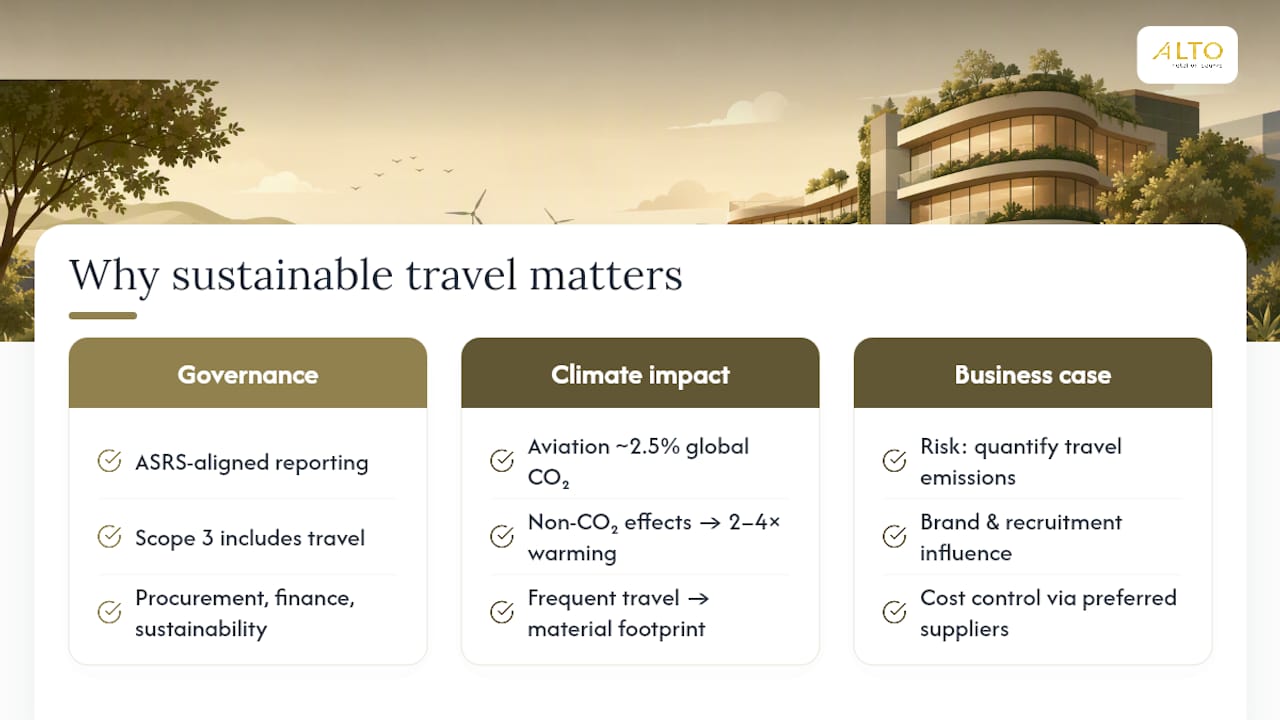
The governance pressure is real and accelerating. Australian organisations are now navigating ASRS-aligned reporting obligations that bring Scope 3 emissions, including those from business travel, into the disclosure frame. Integrating sustainability into travel policies is no longer a CSR nice-to-have; it is a governance expectation that procurement, finance, and sustainability teams are all being held to.
Aviation alone accounts for around 2.5% of global CO₂ emissions — and when non-CO₂ warming effects are included, the climate impact is estimated to be two to four times higher. For organisations with frequent interstate or international travel, the footprint is material.
Beyond compliance, the business case stacks up on three fronts. First, risk: organisations that cannot quantify their travel emissions face growing exposure in tender processes, investor questionnaires, and ESG ratings. Second, brand and recruitment: sustainability credentials influence both client decisions and the expectations of graduate talent. Third, cost control: consolidating spend with a smaller group of certified preferred suppliers typically unlocks better negotiated rates, reducing the net cost premium of going green.
The GBTA Foundation has documented how leading buyers use demand management, preferred sustainable suppliers, and carbon budgets together as a system rather than isolated tactics. That systems approach is what separates programmes that move the dial from those that produce a sustainability slide in the annual report and little else.
What must a sustainable corporate travel policy include?
A policy that sits in a shared drive and never gets read is not a policy. The elements below are the minimum for an enforceable, ASRS-ready programme.
- Travel hierarchy — Virtual meetings are the default for any trip under four hours of travel time. In-person travel requires documented business justification and manager approval. The GBTA frames this as demand management: question whether the trip needs to happen before optimising how it happens.
- Hotel selection rules — Preferred suppliers must hold GSTC-accredited or EarthCheck certification. Travellers booking outside the preferred list must select a certified property or submit a written exception with manager sign-off.
Pro Tip: Write enforcement clauses before you write aspirational goals. A policy that says "we prefer sustainable hotels" is unenforceable. One that says "bookings outside the certified preferred list require manager approval and are non-reimbursable without it" is not.
How do you evaluate hotels on sustainability credentials?
Certifications: what to look for
Prefer hotels holding certification from a body accredited by the GSTC, whose standards span four pillars: environmental management, social impact, economic contribution, and governance. In Australia, EarthCheck is the most widely adopted GSTC-recognised standard, making it the practical benchmark for local preferred-supplier lists. A hotel displaying a self-declared "eco" badge with no third-party audit behind it should be treated as uncertified.
For a deeper look at how to assess boutique properties specifically, the guide to choosing an environmentally rated boutique hotel walks through the key questions to ask before adding a property to your preferred list.
Operational criteria to verify on-site
Certification tells you a hotel has been audited. Operational criteria tell you what it actually does day-to-day. When vetting a property, check for:
- Waste: documented diversion rates, elimination of single-use plastics in rooms and food service (see how hotels reduce single-use plastics for practical examples)
The Sustainable Hospitality Alliance publishes sector-specific metrics and factsheets that give you a ready-made checklist for assessing hotel capability against corporate reporting needs.
Contract questions to ask during RFPs
Ask every shortlisted hotel these four questions before signing a preferred-supplier agreement:
- Can you provide occupancy-adjusted energy and water data on a quarterly basis, formatted for Scope 3 reporting?
- What third-party audit have you completed in the last 24 months, and can you share the report?
- What is your current waste diversion rate, and what is your target for the next contract period?
- What staff training programme covers sustainability practices, and how often is it delivered?
A hotel that cannot answer questions two and three clearly is not ready to be a preferred supplier, regardless of what its website says.
How do you measure and report travel emissions under Scope 3?
Understanding Scope 3 for travel
Scope 3 emissions are indirect: your organisation does not produce them directly, but they occur as a result of your activities. Business travel, including flights and hotel stays, sits in Scope 3 Category 6. Because you do not control the emissions source, measurement depends entirely on supplier data and standardised calculation methodologies.
Hotel stays belong in Scope 3 because the energy consumed to host your travellers is the hotel's operational emission, not yours. Your reporting obligation is to account for it using credible, supplier-verified data.
Recommended methodologies and tools
| Emission source | Recommended methodology | What you need from the supplier |
|---|---|---|
| Flights | ICAO carbon calculator (CO₂ per passenger-km) | Route, class, aircraft type |
| Hotel stays | kWh per occupied room × grid emission factor | Occupancy-adjusted energy data, renewable share |
| Ground transport | Distance-based emission factors (NGA factors for Australia) | Vehicle type, distance |
| Rail | National Greenhouse Accounts (NGA) factors | Route and distance |
The ICAO methodology multiplies fuel burned by 3.16 to estimate CO₂ and allocates it per passenger. Most travel management company (TMC) platforms and booking tools embed this calculation, so you do not need to run it manually. For hotel stays, the Sustainable Hospitality Alliance's methodology converts kWh per occupied room into a CO₂-equivalent figure using the relevant grid emission factor.
What should RFPs and hotel contracts include?
A preferred-supplier agreement with a hotel is the most powerful lever you have. It converts sustainability aspirations into contractual obligations.
Core contract clauses
Sustainability KPIs: Specify minimum performance thresholds for energy intensity (kWh per occupied room), water use (litres per occupied room), and waste diversion rate. Set a target trajectory over the contract term, not just a static minimum.
Reporting cadence: Quarterly data submissions are the workable standard. Monthly is ideal for large-volume accounts; annual is insufficient for credible Scope 3 reporting.
Audit and remediation: Include the right to request a copy of the hotel's most recent third-party audit. If performance falls below agreed KPIs, the contract should specify a remediation timeline (typically 90 days) before a review of preferred-supplier status.
Certification requirement: Require the hotel to maintain GSTC-accredited or EarthCheck certification for the duration of the contract. Loss of certification triggers a review clause.
Incentive and penalty structures: Volume commitments in exchange for preferred rates are the standard lever. Consider tiering rates: a base rate for certified properties and a premium rate for properties that also supply verified emissions data.
Procurement levers that offset cost premiums
Consolidating spend with fewer certified suppliers is the most effective way to negotiate away any price premium. A hotel that receives 60% of your Melbourne CBD nights has a strong commercial reason to invest in the data infrastructure you need. Eco-friendly hotel stay costs are often comparable to standard rates once volume discounts are applied, particularly in the boutique segment.
Joint pilots are another lever: offer a hotel a defined trial period with guaranteed volume in exchange for building out their reporting capability. That arrangement benefits both parties and creates a proof-of-concept you can use when onboarding other suppliers.
How do you make a sustainable travel policy stick?
Policy compliance does not come from the policy document. It comes from what happens at the moment a traveller opens the booking tool.
Booking-tool configuration
- Surface certified properties at the top of search results by default.
- Flag non-certified properties with a visible indicator (a yellow or red badge works better than a footnote).
- Require a free-text justification field for any booking outside the preferred list.
- Set carbon estimates to display on every search result, not just in a post-trip report.
Embedding sustainability at the point of sale is consistently more effective than relying on traveller goodwill or post-trip audits. The GBTA and industry practitioners both point to booking-tool configuration as the highest-leverage compliance mechanism available.
Incentives and consequences
Carbon budgets work best when allocated to departments rather than individuals. Teams then decide which trips deliver the most value within their allowance, which reduces low-value travel without requiring micromanagement from the travel desk. Publish a monthly departmental scorecard showing carbon spend against budget. Recognition for the lowest-emitting team costs nothing and changes behaviour.
Non-reimbursement for off-policy bookings is the most direct consequence. Apply it consistently from day one; inconsistent enforcement destroys credibility faster than any other single factor.
Training and communications
A short digital acknowledgement at policy launch, a one-page traveller guide covering the top five booking rules, and a quarterly update email to managers covers the communication minimum. For travel managers themselves, the GBTA Foundation publishes practitioner resources on sustainable programme design that are worth bookmarking.
Pro Tip: Frame the carbon budget to teams as a resource allocation decision, not an environmental lecture. "Your team has 12 tonnes of CO₂ for travel this quarter — how do you want to spend it?" lands very differently from "please travel sustainably."
Duty-of-care obligations do not diminish under a sustainable policy. Travellers still need access to safe, well-located accommodation. Sustainable hotels in central locations, like those near Melbourne's CBD, satisfy both requirements simultaneously.
What do sustainable travel programmes typically cost to implement?
Cost areas to budget for
Certification premiums on hotel rates vary, but consolidating volume with a smaller preferred list typically offsets them. Data integration between your booking tool and TMC platform carries a one-off configuration cost, usually absorbed by the TMC as part of a contract renewal. Training is largely internal time rather than external spend.
The meaningful cost is management time: building the rubric, running the RFP, negotiating contracts, and configuring the booking tool. Budget for a dedicated project resource for the first six months.
Negotiation levers
Volume consolidation is the primary lever. Longer contract terms (two to three years) give hotels the confidence to invest in reporting infrastructure. Joint pilots with guaranteed room nights in exchange for data capability are a low-cost way to build the supplier base you need.
For a detailed look at how cost and sustainability trade-offs play out in practice, this analysis of eco-friendly hotel stay expenses covers the negotiation dynamics well.
Six-step implementation roadmap for Australian travel managers
-
Set objectives and establish a baseline. Define the scope (domestic, international, or both), nominate a baseline year, and collect trip and hotel data for that year. Document your methodology so it is reproducible.
-
Build the travel hierarchy into approval workflows. Configure your booking tool so virtual-meeting options appear before travel search results. Set approval routing so trips that bypass the hierarchy require manager sign-off before the booking is confirmed.
-
Run the hotel RFP and negotiate contracts. Use the rubric from Section 4 to shortlist certified properties. Negotiate KPIs, reporting cadence, and audit rights into every preferred-supplier agreement.
-
Integrate measurement tools and define reporting cadence. Connect your TMC data feed to your emissions reporting platform. Set quarterly data collection from hotel suppliers. Align your reporting cycle to ASRS and ISO 14064 expectations so disclosures are audit-ready.
-
Run a pilot with selected properties. Alto Hotel on Bourke is a practical Melbourne CBD pilot partner: it holds environmental ratings, is business-ready with studio and apartment configurations suited to extended stays, and can supply the occupancy-adjusted energy data your Scope 3 reporting needs. A 90-day pilot with a defined room-night commitment and agreed data exchange gives you a proof-of-concept before full rollout.
-
Full rollout, monitoring, and continuous improvement. Launch the full preferred-supplier list and booking-tool configuration. Publish quarterly departmental scorecards. Conduct an annual supplier audit against contracted KPIs. Review and update the hotel rubric each year as certification standards evolve.
Alto Hotel on Bourke: what a sustainable hotel partnership looks like
Alto Hotel on Bourke sits on Bourke Street in Melbourne's CBD, a short walk from Southern Cross Station. For travel managers, that location matters: it means travellers arrive by train rather than taxi, which reduces ground transport emissions before they have even checked in. The hotel holds environmental ratings that place it among the first properties in Melbourne to be independently assessed on sustainability performance, and it has received Hall of Fame recognition in the Victorian tourism sector.
From a corporate programme perspective, Alto Hotel can supply the data a Scope 3 reporting process requires: occupancy-adjusted energy consumption, water use per occupied room, waste diversion rates, and linen-reuse statistics. Those figures feed directly into the hotel emissions line of your Scope 3 Category 6 inventory. The property's use of eco-conscious materials, partnerships with local artisans, and elimination of unnecessary single-use items also satisfy the operational criteria in a well-constructed hotel-selection rubric.

A sample pilot structure between a corporate travel programme and Alto Hotel might look like this: a 90-day commitment of a defined minimum room-night volume in exchange for quarterly data reports in an agreed format, a guest communication card explaining the programme to travellers, and a mid-pilot review to assess data quality and traveller feedback. The expected outcomes are a verified emissions figure for Melbourne CBD stays, a tested data-exchange process, and a template you can replicate with other certified suppliers.
For a broader view of business-ready eco boutique hotels that meet corporate programme requirements, the 2026 guide covers the key criteria across the market.
Key takeaways
The most effective sustainable corporate travel policy combines a certified hotel-selection rubric, booking-tool enforcement, and departmental carbon budgets aligned to ASRS reporting requirements.
| Point | Details |
|---|---|
| Prioritise certified hotels | Require GSTC-accredited or EarthCheck certification as the minimum for preferred-supplier status. |
| Embed rules at point of sale | Configure booking tools to surface certified properties first and require justification for exceptions. |
| Measure Scope 3 from day one | Use ICAO methodology for flights and occupancy-adjusted kWh data from hotels for credible emissions reporting. |
| Use contracts as the lever | Negotiate sustainability KPIs, quarterly data reporting, and audit rights into every hotel preferred-supplier agreement. |
| Pilot with Alto Hotel | Alto Hotel on Bourke offers Melbourne CBD proximity, environmental ratings, and the data capability needed for a Scope 3-ready pilot. |
What travel managers often get wrong about sustainable hotel partnerships
The conventional wisdom says the hard part of a sustainable travel policy is getting leadership buy-in. In practice, that is rarely where programmes stall. Leadership signs off on sustainability goals readily enough. The programme falls apart six months later when the travel desk cannot produce a credible emissions number for the annual report, because no one negotiated data obligations into the hotel contracts.
The gap is almost always contractual. Organisations spend considerable effort building a hotel rubric, shortlisting certified properties, and configuring their booking tool. Then they sign a preferred-supplier agreement that says nothing about reporting cadence, data format, or what happens when a hotel's certification lapses. The result is a preferred list that looks sustainable on paper and produces no usable data.
The fix is not complicated, but it requires treating hotels as data suppliers, not just accommodation providers. A hotel that cannot tell you its kWh per occupied room for last quarter is not a credible Scope 3 data source, regardless of what certification it holds. Certification tells you the hotel has been audited against a standard. The contract tells you what data you will actually receive and when.
The other underestimated factor is traveller experience. Sustainable hotels that are inconveniently located, poorly equipped for business use, or uncomfortable generate exception requests that erode the preferred list over time. The strongest argument for a property like Alto Hotel on Bourke is not just its environmental credentials. It is that the combination of CBD location, business-ready amenities, and sustainability performance removes the trade-off that causes travellers to book outside policy in the first place.
Partner with a Melbourne sustainable hotel for your pilot programme
Corporate travel programmes that want a ready-to-go Melbourne CBD pilot partner do not need to spend months sourcing and vetting options. Alto Hotel on Bourke combines environmental ratings, business-ready accommodation across studio and apartment configurations, and the data reporting capability your Scope 3 inventory requires.
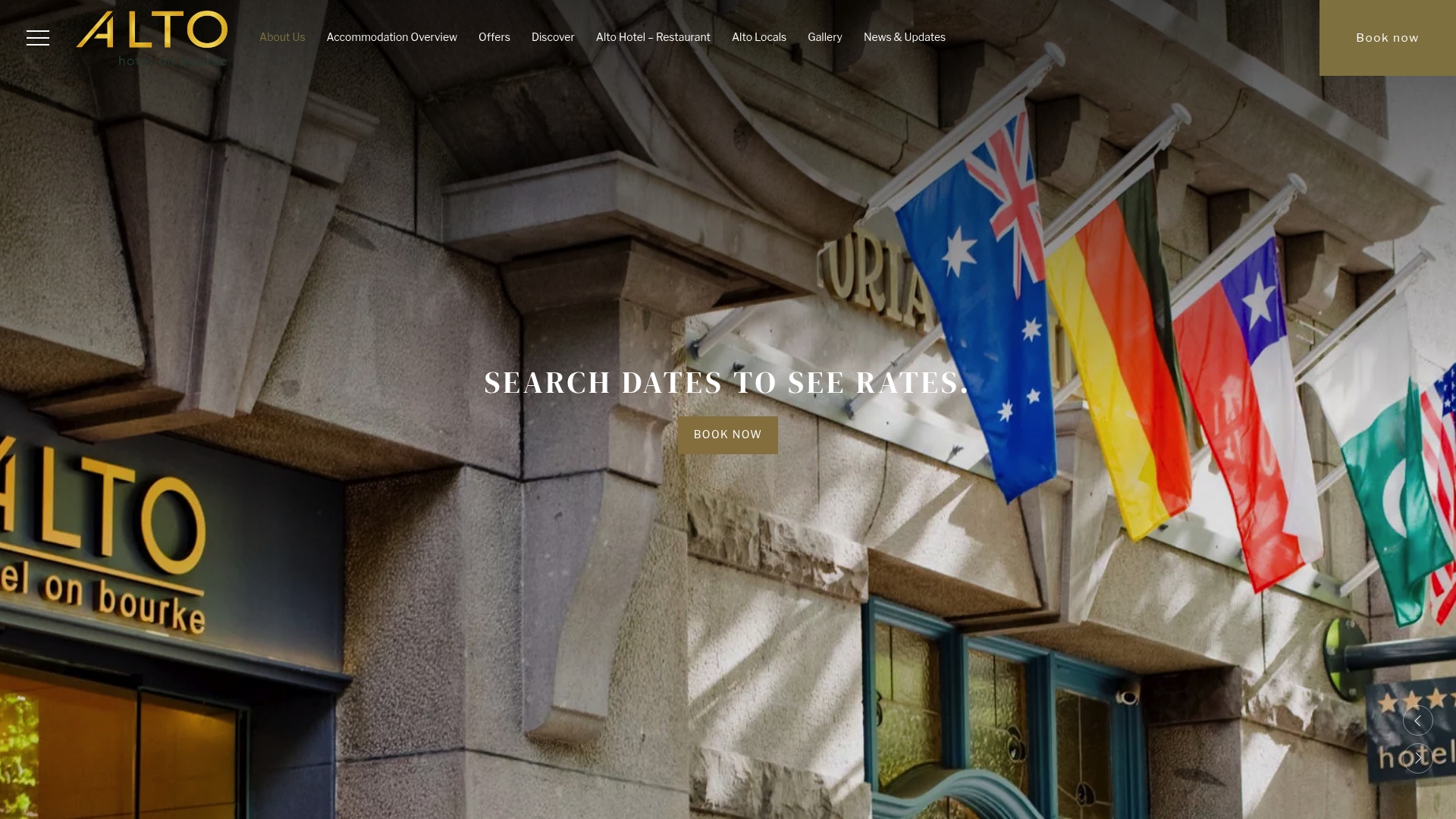
The property's proximity to Southern Cross Station means travellers arrive by public transport by default, reducing ground transport emissions without any policy intervention. Studio and apartment options, including the Studio Queen and two-bedroom configurations, suit both individual business travellers and small teams on extended stays. For travel managers ready to move from policy drafting to a live pilot, contact Alto Hotel directly to discuss a corporate rate and data-sharing arrangement that fits your programme timeline.
Useful sources and standards
- Global Sustainable Tourism Council (GSTC)
- Global Business Travel Association (GBTA)
- The GHG Protocol
- Sustainable Business Travel Policy: How to Build One — LegalClarity
- Why it’s time to choose sustainable hotels — FCM Travel
- CO2 emissions from aviation — Our World in Data
- Sustainable Hospitality Alliance — climate action
- Managing emissions from business travel programmes — GBTA Foundation report
- GSTC business travel guidance (notes EarthCheck and other recognised standards)