
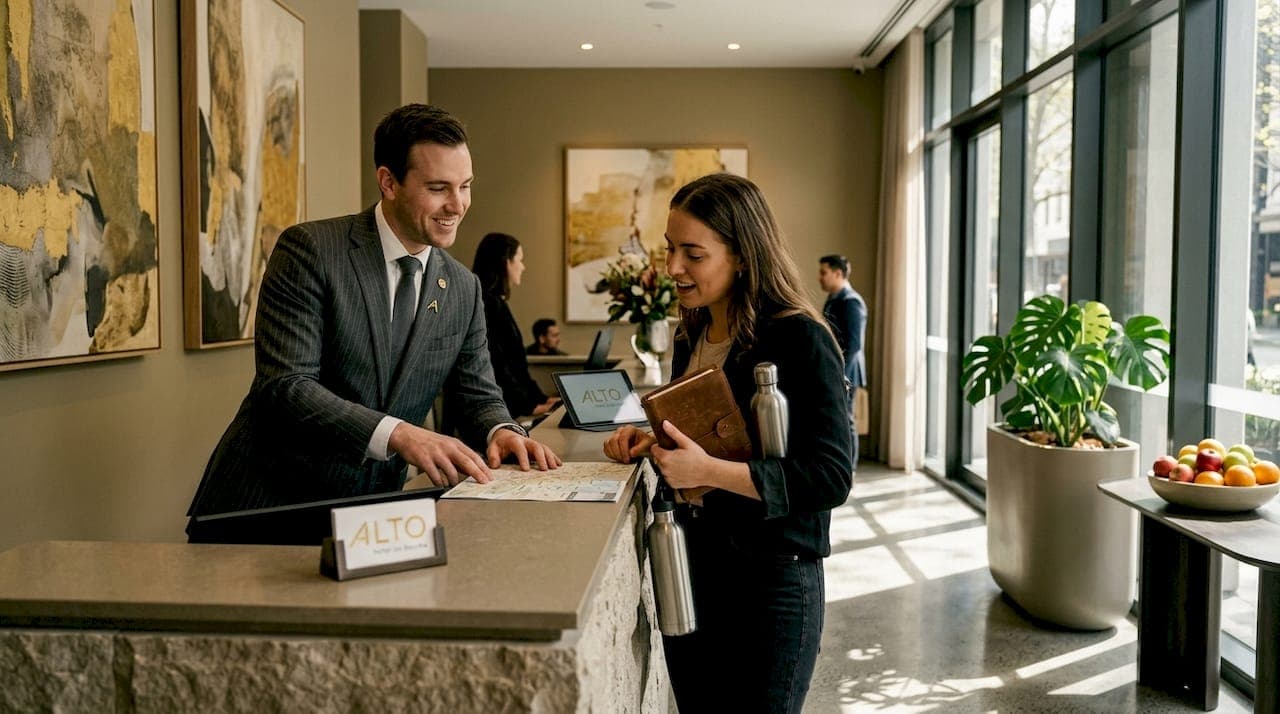
Travellers today want more than a clean bed and a buffet breakfast. They want accommodation that feels like it belongs somewhere, that knows their name, and that doesn't leave the planet worse off than before they arrived. The benefits of staying boutique hotels go well beyond aesthetics. From genuinely personalised service to sustainability practices woven into daily operations, boutique hotels have quietly redefined what a great stay actually looks like. If you've been defaulting to chain hotels out of habit, this article will give you good reason to reconsider.
Table of Contents
- Key takeaways
- 1. The real benefits of staying boutique hotels start with personalised service
- 2. Authentic design that connects you to where you actually are
- 3. Sustainability that's woven into the operation, not printed on a card
- 4. Real economic benefits for local communities
- 5. Flexibility and unscripted experiences you won't find in a chain
- 6. Technology that enhances comfort without replacing human warmth
- My honest take on why boutique hotels matter more now than ever
- Experience boutique stays at Altohotel in Melbourne
- FAQ
Key takeaways
| Point | Details |
|---|---|
| Personalised service sets boutiques apart | Staff at boutique hotels know guests individually and anticipate needs without a script. |
| Local character creates cultural immersion | Design, food, and art reflect the neighbourhood, giving guests an authentic sense of place. |
| Sustainability is built in, not bolted on | Boutique hotels integrate eco-conscious practices into operations rather than using them as marketing. |
| Local economies benefit directly | Local revenue retention in boutique hotels reaches 85–95%, compared with 15–25% for chains. |
| Technology supports, not replaces, human connection | Smart systems handle logistics quietly so staff can focus on genuine guest interaction. |
1. The real benefits of staying boutique hotels start with personalised service
The most cited reason travellers return to boutique hotels is not the décor. It's the feeling that someone actually noticed them. In a property with 20 to 80 rooms, staff genuinely learn guest preferences across a stay, sometimes within the first few hours.
Boutique hospitality in 2026 centres on what researchers are calling "behavioural precision." That means staff intuitively understand guest needs without formal instructions. They notice you skipped the gym but lingered over coffee. They remember you asked for an extra pillow on night one and it's already there on night two.
This is a genuine structural advantage of boutique hotels over chains. Large hotels rely on standardised service protocols because they have no other choice at scale. Boutique hotels don't have that problem.
- Staff-to-guest ratios are higher, allowing more attentive service
- Guests are recognised by name, not room number
- Preferences are noted and acted on without prompting
- Service feels like a conversation, not a transaction
Pro Tip: When booking a boutique hotel, send a brief note with your reservation about any preferences, dietary needs, or the reason for your trip. Boutique staff actually read these and act on them in ways chain hotels rarely do.
2. Authentic design that connects you to where you actually are
Walk into most chain hotels and you could be anywhere. The same marble lobby, the same artwork chosen to offend no one, the same menu that feels airlifted from a central kitchen somewhere in another country.

Boutique hotels take the opposite approach. The best ones treat the building itself as a form of storytelling. Local materials, commissioned works from neighbourhood artists, menus built around regional producers. 77% of travellers actively seek accommodation that delivers authentic local culture experiences, and boutique hotels are built to deliver exactly that.
The advantages of boutique hotels here go beyond aesthetics. When your hotel reflects the neighbourhood it sits in, you arrive already oriented. You understand something about the place before you've even stepped outside. That's a form of cultural intelligence that no amount of guidebook reading can replicate.
- Architecture and interiors often draw on local heritage and history
- Art collections feature work by local and emerging artists
- Food and beverage programmes use local and seasonal suppliers
- Staff are typically locals with genuine knowledge of the area
3. Sustainability that's woven into the operation, not printed on a card
There's a version of hotel sustainability that amounts to a card in the bathroom asking you not to wash your towels. Then there's the kind that actually changes how a property operates.
Boutique hotels are far more likely to practise the second kind. Sustainability at boutique hotels is woven into service timing, materials, and the consistency of the guest experience rather than used as a surface-level initiative. That means energy management systems, local sourcing, waste reduction, and building materials chosen for their environmental credentials, not just their appearance.
For eco-conscious travellers, this distinction matters. You're not just offsetting guilt. You're actively supporting a model of hospitality that puts environmental responsibility at the centre of every operational decision.
- Source ingredients locally to reduce food miles and support regional producers
- Use eco-certified building materials and furnishings where possible
- Install energy-efficient lighting, heating, and cooling systems
- Minimise single-use plastics across all guest touchpoints
- Partner with local environmental organisations for ongoing accountability
Pro Tip: Before booking, check whether a boutique hotel holds an independent environmental rating or certification. Properties like Altohotel, one of Melbourne's first environmentally rated hotels, provide a level of verified accountability that self-reported sustainability claims cannot match.
4. Real economic benefits for local communities
One of the most underappreciated boutique hotel perks is where your money actually goes. When you stay at a chain hotel, a significant portion of your spend travels directly to a corporate head office, often overseas. The local community sees relatively little of it.
Boutique hotels work differently. Local revenue retention in boutique hotels sits at 85 to 95%, compared with just 15 to 25% for chain hotels. Local employment rates follow the same pattern, with boutique properties employing locally at rates of 85 to 95% versus 40 to 50% for chains.
Searches for accommodation that supports local businesses have tripled year-over-year, which tells you something important about how traveller values are shifting. People want their spending to mean something. Staying in boutique accommodations is one of the most direct ways to make that happen.
73% of travellers say they want their accommodation spend to support local communities. Boutique hotels are the most direct way to act on that preference.
5. Flexibility and unscripted experiences you won't find in a chain
Chain hotels operate on protocols. Every interaction follows a script, every recommendation comes from a laminated card, every activity is pre-packaged. That's not a criticism. It's just how you manage consistency at scale across thousands of properties.
Boutique hotels don't have that constraint. Staff are encouraged to have genuine, unscripted interactions with guests, which is where the most memorable travel moments tend to come from. A concierge who grew up in the neighbourhood can tell you about the bakery that doesn't appear on any travel app, or the local market that only runs on Thursday mornings.
Here's a direct comparison of how these two models play out for guests:
| Experience type | Boutique hotel | Chain hotel |
|---|---|---|
| Staff recommendations | Personal, local, off-script | Standardised, from a printed list |
| Guest recognition | By name and preference | By room number |
| Cultural connection | Built into the property | Limited or absent |
| Flexibility on requests | High, staff have autonomy | Low, bound by protocol |
| Cultural experience score | 4.7 out of 5 | 3.1 out of 5 |
The unique experiences at boutique hotels that travellers remember most are rarely the ones that were planned. They're the conversations, the detours, and the discoveries that happen when staff are free to be genuinely helpful rather than procedurally correct.
6. Technology that enhances comfort without replacing human warmth
There's a common misconception that boutique hotels are low-tech by nature. Some are. But the best ones use technology precisely and quietly, in ways that remove friction without removing the human element.
Digital check-in, smart room controls, and instant messaging with staff are increasingly standard at boutique properties. The difference is in how these tools are deployed. At a chain hotel, technology often replaces human contact. At a boutique hotel, it handles the administrative layer so staff have more time for genuine interaction.
Successful boutique properties synchronise architecture, menus, lighting, and service around a single cohesive narrative. Technology is part of that synchronisation. When the lighting in your room adjusts automatically at sunset, or when a message arrives asking if you'd like your usual morning coffee order, that's not impersonal. That's precision in service of warmth.
| Technology feature | Purpose at boutique hotels |
|---|---|
| Digital room keys | Removes check-in friction, speeds arrival |
| In-app messaging | Connects guests directly to staff without queuing |
| Smart climate control | Reduces energy use while improving comfort |
| Guest preference tracking | Enables personalised service across repeat visits |
| Loyalty programme integration | Allows guests to earn and use rewards across independent properties |
80% of travellers are willing to pay more for unique wellness experiences, and boutique hotels increasingly use technology to deliver these without making them feel clinical or impersonal.
My honest take on why boutique hotels matter more now than ever
I've stayed in enough chain hotels to know exactly what you're getting before you arrive. That predictability has its place. But I've come to believe it's also a form of travel poverty. You're paying for the absence of surprise rather than the presence of something genuinely good.
What I find most compelling about the advantages of boutique hotels isn't the thread count or the locally sourced breakfast. It's the coherence. When a property has been designed around a single idea, where the art, the food, the materials, and the people all point in the same direction, you feel it immediately. It's the difference between a place that was assembled and a place that was made.
The challenge boutique hotels face is scaling that coherence without losing it. I've seen properties that started brilliantly and drifted into self-parody as they grew. The ones that hold their integrity are usually the ones where the founders stayed involved and where sustainability wasn't a marketing decision but a genuine operating principle.
For eco-conscious travellers, why choose boutique hotels comes down to this: your stay either reinforces a model of hospitality worth supporting, or it doesn't. Boutique hotels, at their best, are worth supporting.
— Kamal
Experience boutique stays at Altohotel in Melbourne
If the benefits described in this article resonate with you, Altohotel puts them into practice every day in the heart of Melbourne. As one of the city's first environmentally rated hotels, Altohotel combines genuine eco-conscious operations with the personalised service and local character that define why travellers choose boutique over chain. Rooms are designed with sustainable materials, partnerships with local artisans shape the guest experience, and the hotel's Hall of Fame recognition in Victorian tourism reflects a long-standing commitment to doing things properly. Book directly at Altohotel for the best available rates and a stay that genuinely reflects the neighbourhood it calls home.
FAQ
What are the main benefits of staying in boutique hotels?
Boutique hotels offer personalised service, authentic local character, and sustainability practices that chain hotels rarely match. Guests consistently rate boutique properties higher on personalisation (4.6/5) and cultural experience (4.7/5) compared to chains.
Why choose boutique hotels over chain hotels for eco-friendly travel?
Boutique hotels integrate sustainability into their core operations, including local sourcing, energy efficiency, and eco-certified materials, rather than treating it as an add-on. Local revenue retention also reaches 85 to 95%, meaning your spending directly supports the community.
Do boutique hotels offer loyalty programme benefits?
Yes. Networks like the Global Hotel Alliance connect independent boutique hotels, allowing guests to earn and redeem rewards across more than 1,000 properties worldwide while still enjoying the personalised service boutique stays are known for.
Are boutique hotels more expensive than chain hotels?
Not always, and the value calculation is different. With 80% of travellers willing to pay more for unique wellness and personalised experiences, boutique hotels often deliver significantly more for a comparable or only slightly higher price point.
What makes the guest experience at boutique hotels unique?
The most memorable aspect is the unscripted nature of interactions. Staff at boutique hotels are encouraged to engage genuinely rather than follow protocols, which creates the kind of spontaneous, locally informed moments that travellers remember long after checkout.