

An aparthotel is a self-contained apartment (kitchen, living area, separate bedroom) run with hotel services like reception and housekeeping. The core benefit: you get room to cook and spread out, plus the convenience of someone else changing the towels.
- Best for: stays of a few nights to several months
- Common guests: business travellers on assignment, relocating families, extended-stay holidaymakers
- Not for: anyone wanting a full-service restaurant and daily turndown as standard
Key Takeaways
An aparthotel combines an apartment's kitchen and living space with hotel-style booking, reception, and housekeeping, and it works best for stays beyond three or four nights.
| Point | Details |
|---|---|
| Core definition | An aparthotel pairs apartment-style living (kitchen, separate bedroom) with hotel services like reception and housekeeping. |
| Differs from hotels | Expect more space and a kitchen, but often less frequent housekeeping and shorter reception hours. |
| Differs from rentals | No lease is signed; you're a guest under hotel-style booking terms, not a tenant. |
| Pricing pattern | Discounts commonly kick in around five to seven nights, rewarding longer stays. |
| Quality varies | Kitchen inclusions and service levels swing widely between economy and premium properties, so check listings closely. |
Table of Contents
- What is an aparthotel? The layout and how it runs
- How does an aparthotel differ from a standard hotel?
- Aparthotel vs serviced apartment: what's the real difference?
- What amenities come standard in an aparthotel?
- Who actually books aparthotels?
- How booking and pricing actually work
- Weighing up the pros and cons
- How to choose the right aparthotel for your stay
- What an aparthotel looks like in practice
- When does an aparthotel actually make sense?
- Book an apartment-style stay with hotel service in Melbourne
- Where to check the definition and details yourself
- Frequently asked questions
- Sources
What is an aparthotel? The layout and how it runs
Every aparthotel starts with the same basic unit: a kitchen, a living area, and a bedroom that's separated from the rest of the space rather than crammed into one hotel-style room. Some properties add a washer and dishwasher; others leave laundry to a shared facility downstairs. That variation is normal. The dual nature of the model, apartment independence layered with hotel infrastructure, is what defines it, not any single appliance list.
On the services side, you still get a front desk, regular housekeeping (though not always daily), and shared facilities like a gym or lounge. Operationally, three things separate an aparthotel from a rental:
- You book it the same way you'd book a hotel room, through a portal or direct with the property.
- There's no lease to sign. You're a guest, not a tenant.
- Properties often set a minimum-stay rule, and that rule shapes both your booking flexibility and your nightly rate.
How does an aparthotel differ from a standard hotel?
The biggest gap is space. A hotel room is built around the bed; an aparthotel unit is built around the kitchen and living zone, with the bedroom as one part of a larger footprint. That difference drives almost everything else.
- Housekeeping: hotels clean daily as standard; aparthotels often clean every few days, sometimes as an optional extra.
- Reception: many aparthotels staff the desk during set hours rather than 24/7.
- Pricing: hotels price per night with little variation; aparthotels frequently drop their rate for weekly or extended bookings, since the model targets longer stays by design.
- Food: a hotel usually has a restaurant on-site; an aparthotel expects you to cook some of your own meals.
Pro Tip: If you're staying under three nights, a standard hotel room will almost always beat an aparthotel on both price and service. The self-catering advantage only pays off once you're there long enough to actually use the kitchen.
Aparthotel vs serviced apartment: what's the real difference?
This is where most people get confused, because the units can look identical. The difference is in who's managing the place and what contract you're under.
- An aparthotel runs on a hotel-style booking system with no lease. You check in, you check out, and there's no notice period.
- A serviced apartment can sit closer to a tenancy arrangement, sometimes with an agency or landlord standing behind it rather than hotel staff.
- Aparthotels keep on-site, hotel-trained staff for reception and cleaning; serviced apartments may outsource or offer far lighter service.
- The practical split: aparthotels suit anyone doing a temporary or extended stay measured in nights or weeks, while serviced apartments and rentals suit people effectively relocating for months or longer.
If you're not sure which you're booking, check whether cancellation works like a hotel (flexible, short notice) or like a lease (fixed term, penalties for breaking it).
What amenities come standard in an aparthotel?
Kitchens vary, but the baseline is consistent across most of the market: a sink, a fridge, a microwave, and a stovetop. Anything beyond that, like a dishwasher or a full oven, tends to depend on whether you're in an economy or premium property, since quality and inclusions swing widely between the two ends of the sector.
Beyond the kitchen, look for:
- Staffed reception, even if it's not round the clock
- Shared gym, meeting rooms, or lounge space
- Secure parking and key card access
- Free Wi-Fi, useful for anyone working remotely during the stay
- Optional paid extras like extra housekeeping visits or laundry service
None of these are guaranteed by the word "aparthotel" alone. One property's idea of business-friendly might mean a proper desk and fast Wi-Fi; another's might mean a coffee table and a login code. Always check the listing.
Who actually books aparthotels?
Four groups make up most of the demand:
- Business travellers and contractors on multi-week assignments who need reliable Wi-Fi, a desk, and consistent service without hotel-room costs stacking up. Convenience ranks as a top priority for this group, and an aparthotel's blend of space and support delivers exactly that.
- Relocating families, often mid-move between homes, who need a kitchen and separate sleeping space more than they need a restaurant downstairs.
- Students, medical visitors, and long-holiday travellers who want to cook their own food and control their own routine.
- Leisure travellers who simply want more room than a hotel offers, without giving up housekeeping or reception.
How booking and pricing actually work
Booking an aparthotel feels exactly like booking a hotel: search a portal or the property's own site, pick your dates, pay a deposit or the full amount upfront. There's no lease to negotiate.
- Rates are usually quoted per night, but many properties apply a discount once you cross a threshold, often somewhere around 5 to 7 nights.
- Minimum-stay rules vary by property. Some accept a single night; others require three or more during peak periods.
- Cancellation policies tend to mirror hotel norms (a cutoff of 24 to 48 hours before arrival is common), which is far less restrictive than breaking an apartment lease.
Always check the specific policy on the booking page. It's the one detail that changes most from property to property.
Weighing up the pros and cons
The trade-offs are fairly clean once you lay them out side by side.
- You gain: more living space, a working kitchen, hotel-level services, and flexible stay lengths without a lease.
- You give up: consistency. Housekeeping frequency, kitchen equipment, and even reception hours differ from one aparthotel to the next.
- Cost: short stays can cost more per night than a comparable hotel room, since you're paying for space you won't fully use in one or two nights.
- Location: aparthotel stock skews toward business districts and extended-stay corridors, so options can thin out in tourist-heavy pockets.
Quality spans a wide range too, from bare-bones economy units to genuinely polished apartment-style properties, so read the specifics before assuming any two aparthotels are alike.
How to choose the right aparthotel for your stay
Run through this before you book, whether you're comparing listings online or calling the property directly:
- Confirm the kitchen fit-out. Ask specifically what's included, fridge, microwave, stovetop, and whether a dishwasher or washing machine is on-site or shared.
- Ask about minimum stays and discounts. Find out if there's a weekly rate and what night count triggers it.
- Check housekeeping frequency. Daily, every third day, or on request only, all three exist in this market.
- Review the booking terms. Look at deposit requirements and how close to arrival you can cancel without penalty.
- Verify security and business amenities. Parking, key card access, and desk space matter if you're travelling for work.
Pro Tip: Call the property directly if the listing is vague on housekeeping or kitchen inclusions. Photos rarely show whether there's a full oven or just a stovetop, and that gap changes what you can actually cook.
What an aparthotel looks like in practice
Alto Hotel on Bourke lists studio, one-bedroom, and two-bedroom apartment options in Melbourne's CBD, each with kitchen facilities, free Wi-Fi, and secure parking, the standard aparthotel formula applied to a boutique, eco-focused property.
As one of Melbourne's first environmentally rated hotels, Alto pairs sustainable materials and local artisan partnerships with the practical inclusions guests expect from an apartment-style stay. That combination, recognised with Hall of Fame status in Victorian tourism, shows the model working at a genuinely high standard rather than a stripped-back economy version of it.
The one-bedroom apartments follow the same pattern: kitchen, living space, and hotel-grade service, without the guilt of an unsustainable stay.
When does an aparthotel actually make sense?
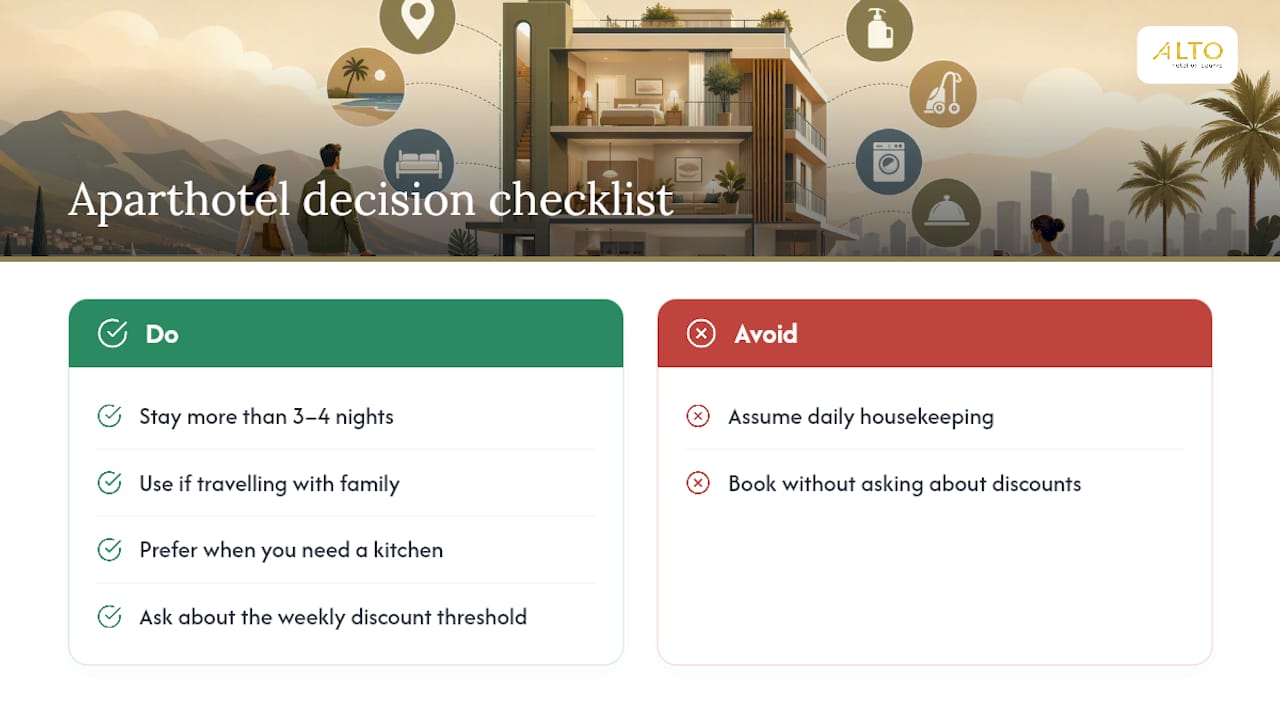
If you're staying more than three or four nights, or you're travelling with family and need a kitchen more than a lobby bar, an aparthotel usually earns its price. Two quick tips: always ask about the weekly discount threshold, and check housekeeping frequency before you assume daily service. Run through the How to choose the right aparthotel for your stay before you book.
Book an apartment-style stay with hotel service in Melbourne
Altohotel's studio and one- and two-bedroom apartments give you a working kitchen, free Wi-Fi, and secure parking, all inside a boutique property built on sustainable materials and local artisan partnerships. If your trip is long enough to justify a kitchen and a bit of extra room, the Petite Queen room and the apartment options at Alto Hotel on Bourke are worth a direct look before you book elsewhere.
Where to check the definition and details yourself
For the formal definition, Cambridge Dictionary covers the short-stay, hotel-serviced apartment sense directly. Wikipedia's apartment hotel entry adds detail on booking systems and stay lengths, while Booking.com's explainer covers the traveller-facing value proposition. For a real-world example, browse Altohotel's studio apartment guide.
Frequently asked questions
What does aparthotel mean exactly? An aparthotel is an apartment-style unit, kitchen, living area, and separate bedroom, operated with hotel services such as reception and housekeeping, booked the same way you'd book a hotel room.
Is an aparthotel cheaper than a hotel? Not always for short stays. Aparthotels tend to become better value once you book past a common discount threshold, often around 5 to 7 nights, rather than on a single night.
Do aparthotels require a lease? No. You book and check out on hotel terms, with no tenancy agreement, though the property will usually set its own minimum-stay rule.
What's the difference between an aparthotel and a serviced apartment? Aparthotels run on hotel-style booking and staffing throughout. Serviced apartments can lean closer to a tenancy arrangement, sometimes managed by a landlord or agency rather than hotel staff.